
U.S. consumers delivered a mixed message in July: retail spending weakened sharply, while a preliminary August survey showed confidence deteriorating again. For markets worried about an imminent Federal Reserve rate hike, that combination is welcome news. But for equities, a consumer slowdown that lasts too long could become a problem for corporate earnings.
Retail and food-services sales fell 0.6% in July, sharply missing expectations for a 0.1% increase. The weakness was broader than the headline number, with measures that strip out volatile categories also declining. At the same time, consumer sentiment deteriorated in August, suggesting households are becoming increasingly cautious about the economic outlook and their purchasing power.
Retail Sales Deliver a Third Positive Signal for Markets
For investors, the July retail sales report fits into a string of recent economic developments that have reduced concerns about an imminent rate hike.
"The past week has had three positive reports in a row that are good for a market that was concerned about an imminent rate hike," said Chris Zaccarelli, Chief Investment Officer at Northlight Asset Management.
He described the dynamic as a case of "bad news is good news" for markets. A weaker labor report, softer retail sales and cooling inflation pressures can all reduce the urgency for the Fed to tighten policy further.
That is particularly important for stocks because lower expectations for the federal funds rate can support equity valuations by reducing the discount rate applied to future corporate earnings.
But there is an important catch: bad economic news is only good for stocks up to a point.
The Weakness Was Broader Than the Headline
The July report looked soft even after accounting for some temporary factors.
Bill Adams, Chief U.S. Economist at Fifth Third Commercial Bank, said lower gasoline prices and the changing timing of Amazon Prime Day contributed to the decline, but argued that the report remained weak after adjusting for those effects.
- Retail and food-service sales fell 0.6%, versus expectations for a 0.1% increase. Gas-station sales declined 0.9%, partly reflecting lower gasoline prices, while motor vehicle and parts dealer sales fell 1.8%.
More importantly for gauging underlying consumer demand, core retail sales excluding food services, gas stations, autos and parts fell 0.3%, missing expectations for a 0.3% increase.
The weakness also showed up in control retail sales, which fell 0.4% against expectations for a 0.3% gain. The measure is particularly important for growth investors because it feeds into the calculation of nominal GDP.
Several discretionary categories also weakened. Electronics and appliance store sales fell 0.5%, while nonstore retail sales—which include e-commerce—dropped a sharp 2.2% after rising 0.9% in June.
Adams said consumers appeared to be pulling back on discretionary spending as higher gasoline and energy costs strained household budgets. He also pointed to the personal saving rate, which was at its lowest level since mid-2022 in June, as another indication that households have less room to absorb additional cost pressures.
The Consumer Is Starting to Look Less Confident
The preliminary August University of Michigan consumer survey adds another layer to the picture.
The Index of Consumer Sentiment fell to 51.0 in August from 55.2 in July, ending two consecutive months of improvement. The Current Economic Conditions Index dropped to 51.8 from 54.8, while the Index of Consumer Expectations fell to 50.6 from 55.4.
The deterioration was broad. According to Surveys of Consumers Director Joanne Hsu, views of business conditions weakened significantly, with expectations for conditions falling 11% over the next year and 17% over the next five years.
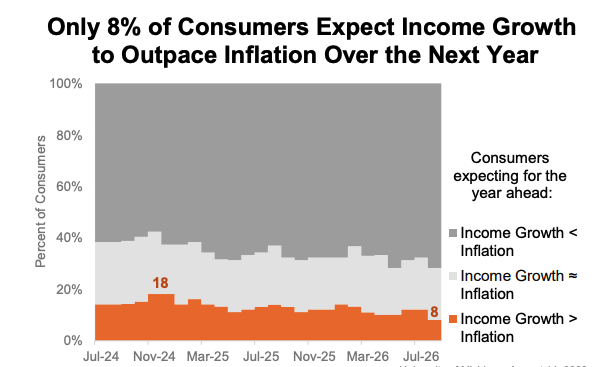
The survey also showed that consumers remain particularly concerned about purchasing power. Only 8% of consumers expect their income growth to exceed inflation over the coming year, down from 18% in December 2024.
Source: University of Michigan
That is an important signal for the consumer outlook: households are not simply becoming less optimistic about the economy—they increasingly expect prices to continue eroding their purchasing power.
Inflation Expectations Tick Higher
The sentiment report also complicates the Fed picture.
Consumers' one-year inflation expectations increased to 4.3% in August from 4.2% in July, according to the preliminary survey. Long-run inflation expectations remained at 3.3% for the third consecutive month, still above the 2.8%-3.2% range seen in 2024.
That combination—weaker spending and confidence alongside elevated inflation expectations—creates a difficult backdrop for policymakers.
A softer consumer could reduce demand-driven inflation and make further rate increases less necessary. But if inflation expectations remain elevated, the Fed may have less room to respond aggressively to weaker growth.
The Consumer Still Holds the Key to Earnings
The stakes are particularly high for equity investors because consumer spending accounts for roughly 70% of U.S. GDP.
Zaccarelli cautioned that investors should "be careful what you wish for." A modest slowdown that helps inflation cool and allows the Fed to remain on hold could be supportive for stocks. But a slowdown that becomes too deep or prolonged could eventually hit corporate revenues and earnings.
Adams' comments reinforce that concern. The July decline was not limited to gasoline and automobiles; weakness in core and control retail sales suggests the consumer's pullback was broader than the headline figure alone indicates.
That is the critical distinction for markets.
If retail sales weaken because consumers are becoming more disciplined while employment and incomes remain reasonably healthy, the Fed could view the slowdown as a welcome cooling of demand. But if weaker spending is accompanied by deteriorating employment and falling household income, the market could quickly shift from celebrating lower rate-hike risks to worrying about recession and earnings.
What It Means for the Fed
Taken together, the data give the Federal Reserve another reason to avoid rushing toward additional tightening, but they do not create a straightforward case for aggressive easing either.
The weaker retail sales report suggests demand is cooling. The decline in consumer sentiment reinforces that signal. Yet the August survey's rise in one-year inflation expectations and elevated long-term expectations show that inflation concerns have not disappeared.
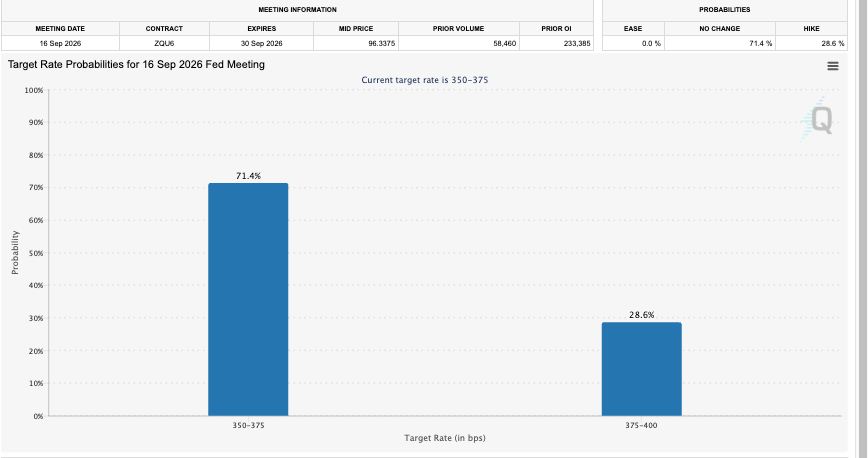
For now, financial markets are pricing in lower odds of a Fed rate hike at the next meeting following the weaker retail sales report, according to Adams.
Source: CME FedWatch Tool
That leaves the Fed with a delicate balancing act: weaker growth argues for patience, while sticky inflation expectations argue against declaring victory.
For Treasury and Fed funds futures traders, the key question is whether incoming data continue to weaken enough to pull rate expectations lower or whether inflation remains sufficiently persistent to keep policymakers on hold for longer.
How Markets Are Reacting
The equity market has struggled to digest the data, which carry mixed implications for the Fed's rate path. The S&P 500, after closing at a record high in the previous session, gave back its gains and was struggling to stay in positive territory. Positioning data from MarketFramework showed an extreme bullish divergence in E-mini S&P 500 (ES) futures: profitable traders were 38% more long than unprofitable traders, while the overall positioning bias remained slightly more bullish than bearish.
The bond market has sent a less reassuring signal. The 10-year Treasury yield climbed to around 4.66%, remaining elevated even after the weak retail sales report. Part of the upward pressure on yields has come from persistent geopolitical uncertainty in the Middle East, which continues to inject inflation risk through energy prices. Recent market commentary has also highlighted the tension between elevated yields and record equity valuations.
The U.S. Dollar Index (DXY), meanwhile, appeared to take its cue from the weaker retail sales data rather than the uptick in consumers' inflation expectations in the August University of Michigan survey. That reaction suggests currency traders are placing greater weight on the potential implications of softer consumer demand for the Fed's policy path than on the inflationary signal from households.
Bad News Is Good News Until It Isn't
This week's data have given equity investors a favorable combination: weaker economic activity reduces the perceived risk of additional Fed tightening, while the economy has not yet shown clear signs of a severe downturn.
But that balance could become harder to maintain.
"The economy is highly dependent on consumer spending," Zaccarelli said, noting that a slowdown that becomes too large or prolonged could eventually hurt corporate profits and, in turn, the stock market.
The latest retail sales data make that warning more relevant. The weakness extended beyond volatile categories, suggesting consumers may be feeling the squeeze from higher living costs more broadly.
September and October Could Test the Bull Market
There is another reason for caution as the market moves toward the fall.
Zaccarelli noted that September and October are seasonally weaker months for equities, often bringing increased volatility. He also pointed to the midterm-election calendar, which can add another layer of uncertainty and increase the potential for a pre-election market swoon.
That does not necessarily mean the bull market is ending. If inflation continues to moderate and the Fed can remain on hold, equities could continue to benefit from lower rate-hike risks.
But with stocks already pricing in a relatively favorable economic outcome, investors may have less tolerance for evidence that consumer weakness is becoming structural.
The Bottom Line for Traders
For equity traders, the message is increasingly two-sided. Softer retail sales and weaker sentiment reduce the immediate threat of additional Fed tightening, which is supportive for valuations. But if consumer weakness persists, the resulting hit to revenues and earnings could eventually overwhelm the benefit of lower interest-rate expectations.
For Treasury and Fed funds futures traders, the data strengthen the case for a Fed that can afford to remain patient, but the rise in inflation expectations limits the scope for assuming rapid rate cuts.
The market is therefore caught between two competing narratives: slower growth could be bullish because it reduces rate pressure, but too much weakness could become bearish because it threatens earnings.
For now, investors are still treating economic softness as good news. The next test will be whether the consumer slows just enough to help the Fed—or enough to hurt the economy.


