Heading into Nvidia’s print, traders were already on the edge. The Nasdaq E-mini futures (NQ) had climbed nearly 0.6% and the E-mini S&P 500 futures (ES) were up 0.3% on Tuesday, a day before the D-day, as traders positioned themselves for Nvidia’s earnings. By Wednesday, the optimism tempered as traders braced for the results, alongside a hotter-than-expected inflation reading.
Nvidia’s Print: A Strong Numbers, Confused Reaction
Nvidia delivered the kind of quarter that, on paper, should have triggered an immediate buying frenzy. Fiscal second-quarter revenue jumped 106% year over year (YoY) to $96.2 billion, beating Wall Street expectations of roughly $92.18 billion, while adjusted earnings per share came in at $2.22.
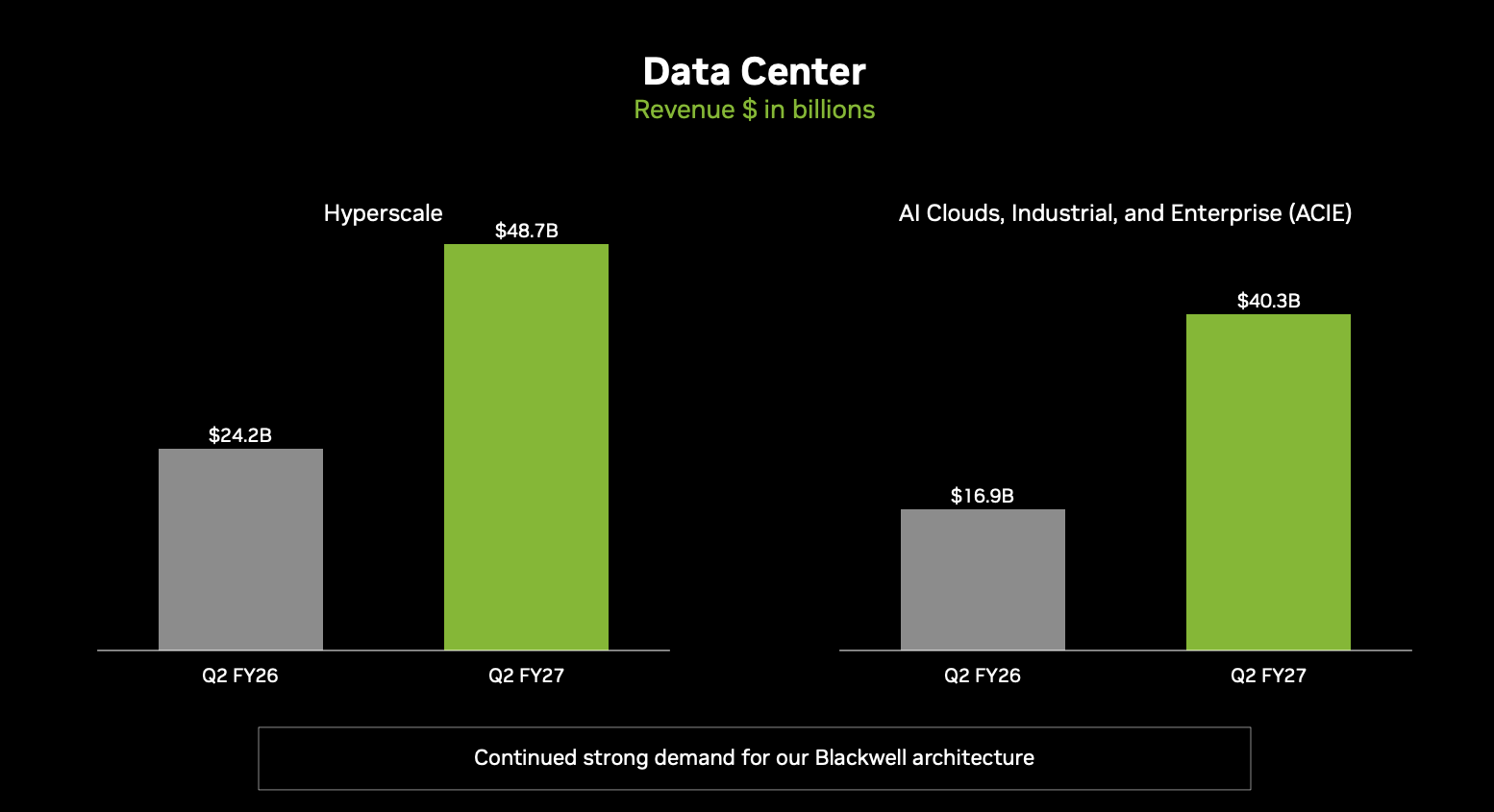
Data Center revenue was even more striking, surging 117% to $89 billion. Nvidia also guided third-quarter revenue to $108 billion, above consensus, marking the first time its quarterly revenue outlook crossed the $100 billion threshold.
Source: Nvidia
Yet the initial reaction was surprisingly muted. Nvidia shares fell nearly 2% immediately after the results before reversing sharply during the earnings call. That hesitation was less about the quarter itself and more about the extraordinary expectations already embedded in the stock. Investors have become accustomed to Nvidia beating estimates. So another blockbuster quarter was not necessarily enough. The market wanted evidence that the artificial intelligence (AI) spending cycle could remain powerful well beyond Blackwell's current ramp.
The Margin Question Initially Overshadowed the Beat
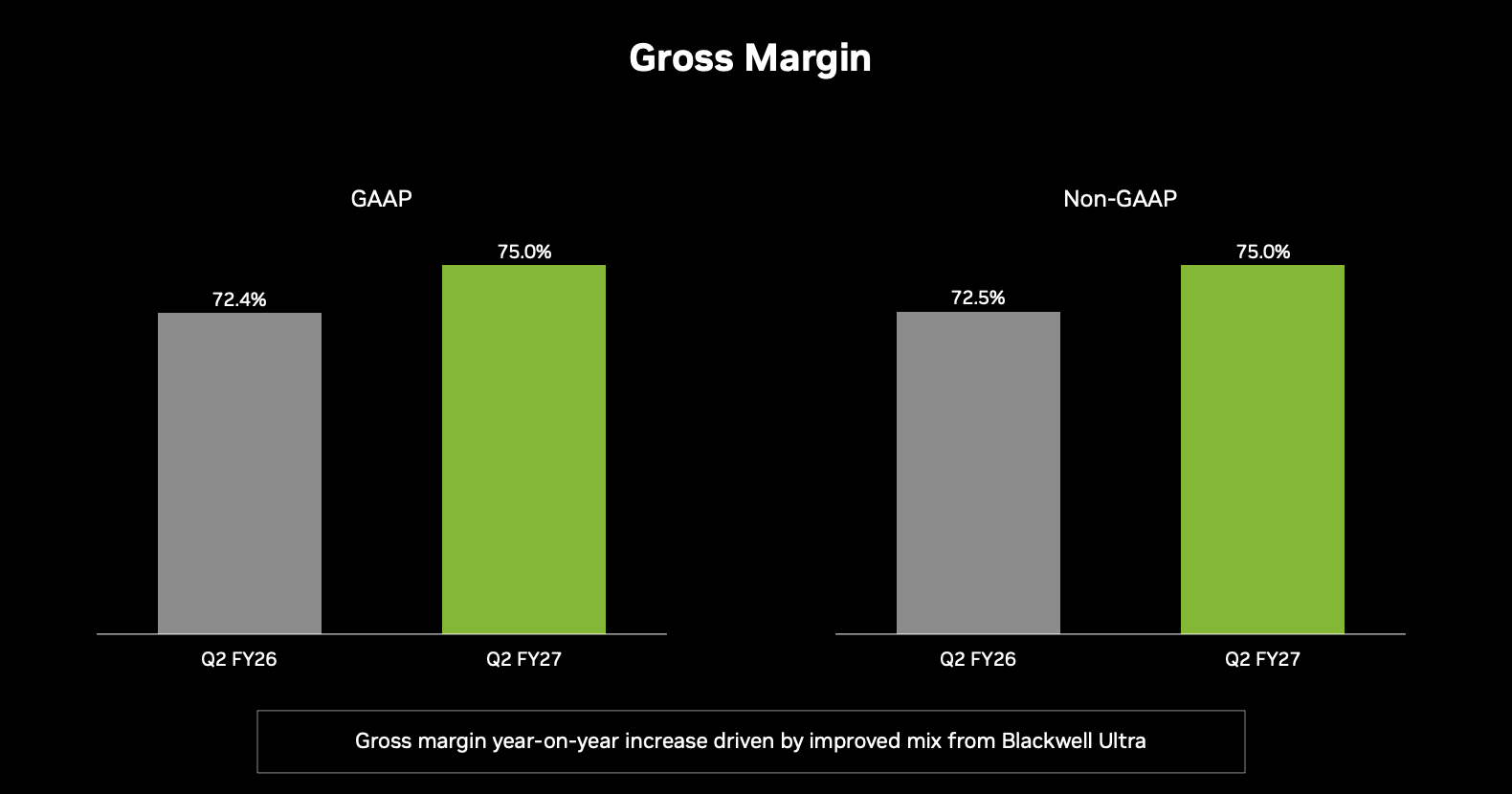
One reason investors hesitated was Nvidia's gross-margin outlook. The company reported a 75% gross margin for the quarter, but pointed to roughly 74% for the third quarter as higher memory costs and other supply pressures weigh on profitability.
Source: Nvidia
For a company whose earnings growth has been fueled by extraordinary operating leverage, even a modest margin decline can make investors question whether the peak of profitability is approaching.
That concern mattered because Nvidia is no longer being valued simply as a fast-growing semiconductor company. The stock has become a proxy for the broader AI infrastructure trade. With Nvidia already valued around $5 trillion, investors need not only strong earnings, but also confidence that the company's growth rate can remain exceptional at an enormous scale. The market's initial hesitation therefore reflected a familiar problem: the numbers were excellent, but the bar was even higher.
Then Nvidia Gave Investors the Number They Were Waiting For
The tone changed during the earnings call when CFO Colette Kress said Nvidia expects revenue to grow by approximately 70% in fiscal 2028.
That forecast was far more important for investors focused on the durability of the AI boom. Wall Street expectations had been closer to 45% growth, meaning Nvidia was effectively telling the market that the current AI investment cycle has considerably more runway than many investors had assumed.
The significance goes beyond the percentage itself. Nvidia said that outlook is supply constrained. In other words, the company is not saying demand is expected to grow only 70%; it is saying its ability to manufacture and deploy enough systems is currently limiting how much revenue it can recognize. CEO Jensen Huang reinforced the point by arguing that demand is substantially greater than the company's available supply. That turns the biggest near-term risk from a lack of customers into a lack of capacity.
An overnight report that stated that Nvidia has agreed to acquire open-source AI model repository Hugging Face for $12.9 billion also provided some thrust.
Also, Nvidia wasn’t trading alone. Earnings from Salesforce, Okta and CrowdStrike landed around the same window, providing the NQ futures a big impetus. This underscores how a handful of mega-cap reports can now move the entire index overnight.
Analysts Upbeat
Morgan Stanley analyst Joseph Moore said he was impressed by the short-term numbers, given supply constraints. The incremental surprise, the analyst said, was the FY28 revenue commentary, and a reset to gross margins, both of which are positives.
The analyst noted that the 70% growth forecast for FY28 compares to 52% growth Morgan Stanley models and roughly 40% consensus, even as the company remains severely supply constrained.
70% growth supply constrained is a remarkable figure, and to the extent possible we would expect Nvidia to continue to knock down barriers to higher growth. Management framed the demand as "much greater" than that 70% level.
Morgan Stanley reiterated an Overweight rating for Nvidia stock and upped the price target to $300 from $288.
Why It Matters
For NQ futures, the delayed Nvidia reaction is arguably more important than the eventual rally. Nvidia is one of the largest drivers of the index, so the earnings reaction offered a real-time test of whether investors were still willing to chase AI strength at elevated valuations.
The initial selloff showed that a beat is no longer enough. The subsequent reversal showed what can still unlock aggressive buying: stronger forward growth, evidence of sustained AI demand and visibility beyond the current product cycle. Nvidia ultimately climbed about 4% in after-hours trading and was up more than 7% in premarket trading Thursday, while Nasdaq futures gained roughly 1%.
NQ is rallying nearly 1%, but the positioning data points to a bearish divergence beneath the surface. Profitable traders are only 41.2% long, compared with 62.3% for unprofitable traders, meaning profitable traders are substantially more short than those currently losing money. The broader snapshot shows profitable traders at 43% long versus 64% for unprofitable traders, reinforcing nearly 20-percentage-point gap in positioning.
The divergence is notable because NQ is trading near 29,573, while profitable traders’ average short entry is around 29,617 putting the market just below their average entry level. If NQ pushes decisively above that level, profitable shorts could face pressure and fuel further upside through short covering.
The message for traders is straightforward: Nvidia's earnings did not immediately remove the market's doubts about AI valuations, margins or supply constraints. What changed was the longer-term growth equation. Once investors heard that Nvidia expects roughly 70% revenue growth into fiscal 2028 despite being supply constrained, the debate shifted from "Has the AI boom peaked?" to "How much longer can Nvidia keep exceeding the market's already-high expectations?"
That distinction could keep Nvidia and the broader NQ supported, but it also raises the bar for the next earnings cycle. Nvidia has once again beaten the numbers. The harder task now is convincing investors that extraordinary growth can remain ordinary.


