Nvidia (NVDA) reported its fiscal second-quarter results after Wednesday's closing bell, and the numbers were big enough to flip the mood in after-hours trading. The stock had been drifting lower into the print, but it reversed sharply once the figures hit the wire, erasing its earlier losses and jumping around 5%, a swing worth roughly $250 billion in market value in the minutes after the release.
For futures traders, the more important question is what this does to the Nasdaq 100 (NQ). Nvidia is one of the two or three largest weights in the index, so when it moves this hard, the whole benchmark tends to move with it.
Let's walk through what was actually reported, and then look at the levels on the NQ chart.
The Numbers: A Clean Beat Across the Board
Nvidia's quarter (which the company labels Q2 fiscal 2027, ended 26 July 2026) came in ahead of Wall Street on every line that matters:
- Revenue of $96.2 billion, up 106% from a year ago and up 18% from the prior quarter. Analysts were looking for about $92 billion.
- Data Center revenue of $89.0 billion, up 117% year-on-year, versus expectations near $86.3 billion. That single segment is now about 92% of the entire company.
- Gross margin of 75.0%. This is the slice of each sales dollar left after production costs. Investors had been nervous that rising memory prices would squeeze it, so holding the mid-70s was a relief.
- Earnings per share of $2.22 on an adjusted basis, ahead of the roughly $2.09 the street wanted.
One detail worth flagging for readers: the headline GAAP profit of $2.46 per share was flattered by a $7.8 billion paper gain on Nvidia's stakes in other companies. Strip that out and the "clean" operating number is $2.22, still a beat, but it's the figure to judge the business on.
The Guidance is What Really Moved the Stock
With Nvidia, the forecast usually matters more than the quarter just gone, and this one delivered. Management guided current-quarter revenue to $108 billion, give or take 2%, comfortably above the roughly $104–105 billion analysts expected, and notably that outlook assumes zero data-center chip sales to China.
CFO Colette Kress also pointed to a supply-constrained revenue growth estimate of around 70% for next fiscal year, which tells you demand is running ahead of what Nvidia can physically build.
Two data points underline how locked-in the pipeline is: supply commitments have swelled to $279 billion (mostly memory for the coming Vera Rubin platform), and Amazon Web Services agreed to buy 2 million Nvidia GPUs alongside Nvidia's new Vera CPU.
Kress said capital spending among the top five cloud builders should climb toward $1.3 trillion next year, up from roughly $800 billion in 2026.
The "Circular Financing" Debate Didn't Go Away
The one cloud hanging over the stock is the worry that Nvidia is helping fund the very customers who then buy its chips through equity stakes in firms like OpenAI, Intel and SpaceX, and through a proposed $500 billion financing framework with major Wall Street institutions. Critics call this "circular financing."
Nvidia met the criticism head-on. In its own words, the company said it sees things differently: it argues the market is going through a once-in-a-generation platform shift, that the companies it is backing are proven leaders with "skyrocketing" usage, and that "the equity returns on our invested capital will be excellent" while "our risk is limited."
Whether investors fully buy that argument is something to watch on the follow-through, but for now the reaction says they're willing to give management the benefit of the doubt.
What it Means for the Nasdaq 100 (NQ)
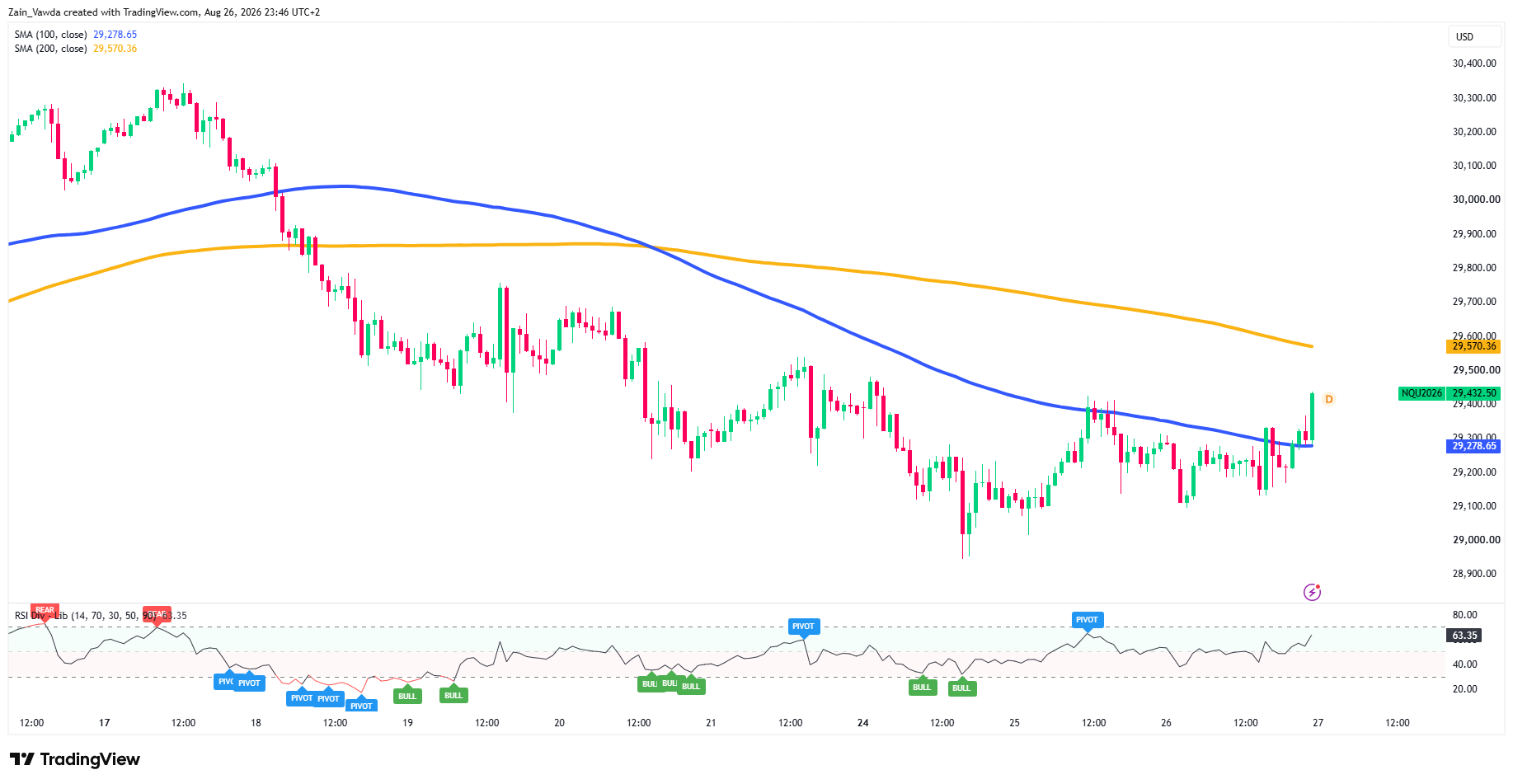
Going into the print, NQ (September contract, NQU2026) had already staged a decent recovery off the late-August lows near 29,000, and the latest push carried price back above the 100-period moving average around 29,278, the blue line on the chart, and the first sign that buyers were regaining control.
Momentum backs that up: RSI sits near 63, rising but not yet in overbought territory (70), so there's still room to run before the move looks stretched.
The Nvidia pop gives that recovery a fresh tailwind. If the after-hours strength holds into the cash session, the levels to watch on the upside are:
- 29,570: the 200-period moving average (the orange line). This is the first real overhead hurdle and the line bears will defend.
- 29,700, then 30,000: the next resistance shelf and the round-number psychological level that capped the market earlier in the month.
On the downside, the picture only stays constructive while price holds its recent gains:
- 29,278: the reclaimed 100-period average. Losing it back would suggest the breakout is failing.
- 29,100 then 29,000: the base of the recent range. A break here would put the whole recovery in question.
Nasdaq 100 (NQ) One-Hour Chart, August 26, 2026
Source: TradingView
The Caveats
Two things keep this honest.
First, after-hours moves can and do fade. Nvidia has actually fallen after its last couple of reports despite beating, because the market has grown used to blowout quarters. The gap needs to hold into Thursday's open to mean much.
Second, the index is bigger than one stock: rate expectations and the other mega-caps still have a say, and the circular-financing narrative is a slow-burn risk that could cap enthusiasm even on a strong print.
For now, though, the read is straightforward. Nvidia beat, raised, and defended its story, and that hands the Nasdaq 100 a reason to press toward that 200-day line rather than roll back over.


