The August employment report delivered a major upside surprise, but Nasdaq futures have shown notable resilience despite a sharp repricing in Treasury yields and September Federal Reserve rate-hike expectations.
Non-farm payrolls (NFP) increased 162,000 in August, nearly three times the roughly 55,000 consensus estimate. July payrolls were also revised to a 21,000 gain from the previously reported 23,000 decline. The unemployment rate held at 4.1%, reinforcing the picture of a labor market that remains considerably healthier than recent data had suggested.
The immediate market reaction was consistent with the report: Treasury yields jumped, the dollar strengthened and rate-hike expectations increased. Yet NQ gave back most of its pre-report gains rather than breaking sharply lower.
The reason may lie in an important detail beneath the headline payroll number: wage growth remains contained.
Jobs Surge, But Wage Pressure Does Not
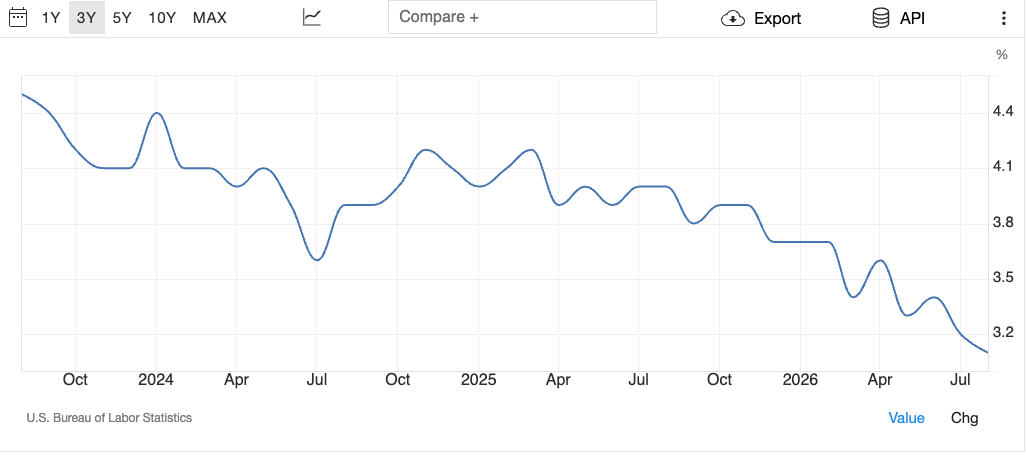
Average hourly earnings increased 0.3% month over month, matching expectations. On an annual basis, wage growth slowed to 3.1% from 3.2% in July, although it was slightly above the 3% consensus.
YoY Average Hourly Earnings Growth
Source: Trading Economics
That creates a more complicated signal for the Fed.
The payrolls number indicates that demand for workers remains strong, reducing concerns about an abrupt deterioration in economic growth. But the wage data provide little evidence of a renewed acceleration in labor-cost inflation.
For NQ, that distinction is important. Strong employment can support corporate revenues and economic activity, while contained wage growth reduces the risk that the Fed will have to respond aggressively to the jobs strength.
Rates Are Higher, But the Fed Has Not Been Forced Into a Corner
The report nevertheless strengthened the case for tighter policy. September rate-hike odds moved back above 50% following the release, reversing part of the decline triggered by Fed Governor Christopher Waller's comments on Thursday.
Waller had said he would be comfortable holding rates if inflation continued to moderate, while warning that a hotter inflation reading could change his view.
The NFP report therefore complicates but does not settle the September decision.
The benchmark 10-year Treasury yield briefly moved above 4.80%, while the more policy-sensitive 2-year yield climbed to a fresh 52-week high. Higher yields normally create a direct headwind for technology stocks because they increase the discount rate applied to future earnings.
Yet the move in NQ has been relatively contained.
Strong Growth Is Cushioning the Rate Shock
The market appears to be weighing two opposing forces.
On one side, stronger employment means the economy has more momentum than expected. That is positive for corporate earnings and reduces the immediate risk of a growth scare.
On the other, stronger growth gives the Fed less reason to ease policy and could keep interest rates higher for longer.
For now, investors appear willing to tolerate some increase in yields because the underlying economic backdrop remains supportive. That is particularly relevant for the Nasdaq, where expectations for technology earnings and AI-related investment remain major drivers of valuations.
The NFP report therefore isn't simply a rates-negative event for NQ. It is simultaneously a growth-positive event.
The Inflation Data Now Carry More Weight
That leaves inflation as the next major test.
If upcoming August CPI data remain contained, markets could conclude that the economy is generating solid employment growth without creating enough inflation pressure to force the Fed into a more aggressive tightening cycle.
That would be a relatively constructive combination for NQ: strong economic activity supports earnings, while contained inflation limits the rise in the discount rate.
The opposite outcome would be more problematic. If inflation proves sticky after the hot payrolls report, investors could conclude that the stronger economy is giving the Fed room—and perhaps a reason—to keep rates higher.
That would put greater pressure on technology valuations.
Jobs+Upcoming Inflation — Implications for NQ
| Setup | What it Means for Fed | NQ Implications |
|---|---|---|
| Hot NFP + contained wages | Strong labor market, but limited evidence of accelerating wage inflation | Resilient — growth support offsets part of the rate headwind |
| Hot NFP + contained CPI | Fed has less reason to respond aggressively | Bullish — strongest setup for NQ to extend its resilience |
| Hot NFP + Sticky CPI | Rate-hike risk remains elevated | Under pressure — higher yields become a bigger valuation problem |
| Hot NFP + yields stabilize | Market absorbs stronger growth without further rate repricing | Constructive — NQ can refocus on earnings |
| Hot NFP + yields continue higher | Markets price a more persistent higher-rate environment | Bearish risk — duration-sensitive tech faces increasing pressure |
NQ's Resilience Is Sending a Signal
For now, Nasdaq futures are effectively navigating a growth-versus-rates tug-of-war.
The employment data have clearly increased the rate risk. But because wage growth did not accelerate alongside the payrolls surge, the report has not delivered a second inflationary shock.
That may explain why NQ is holding up rather than following Treasury yields higher.
The market's next question is no longer whether the labor market is strong. It is whether that strength is translating into renewed inflation. If it isn't, NQ may continue to absorb higher yields without suffering a major valuation reset.
NQ’s price action is relatively stable following the hot NFP report, but retail positioning points to a potential downside risk. MarketFramework Positioning Edge data show profitable traders are 24% more short than unprofitable traders, with profitable traders 48,7% long versus 73.3% long among unprofitable traders.
That creates an extreme bearish divergence: traders currently losing money are heavily positioned long into the post-NFP rate repricing, while profitable traders have a much more defensive stance. With NQ near 29,550, the divergence suggests the stronger hands are less convinced that the index can sustain the current levels, raising the risk of a sharper pullback if Treasury yields continue higher.