Nasdaq-100 futures (NQ) enter a pivotal week with the contract clinging to the 29,200 area, leaving traders to decide whether this level can hold or whether another leg lower is developing. The setup comes after a weak week for technology stocks, with rising Treasury yields adding pressure to rate-sensitive growth assets, and as investors positioned ahead of Nvidia's earnings, Jackson Hole and other macro catalysts.
29,200 Is the First Line of Defense
The 29,200 area has become an important near-term battleground. Holding above it would give buyers a chance to stabilize the recent pullback and challenge higher resistance levels. A decisive break below it, however, could signal that sellers are gaining control and expose NQ to deeper losses, particularly if semiconductor stocks remain under pressure.
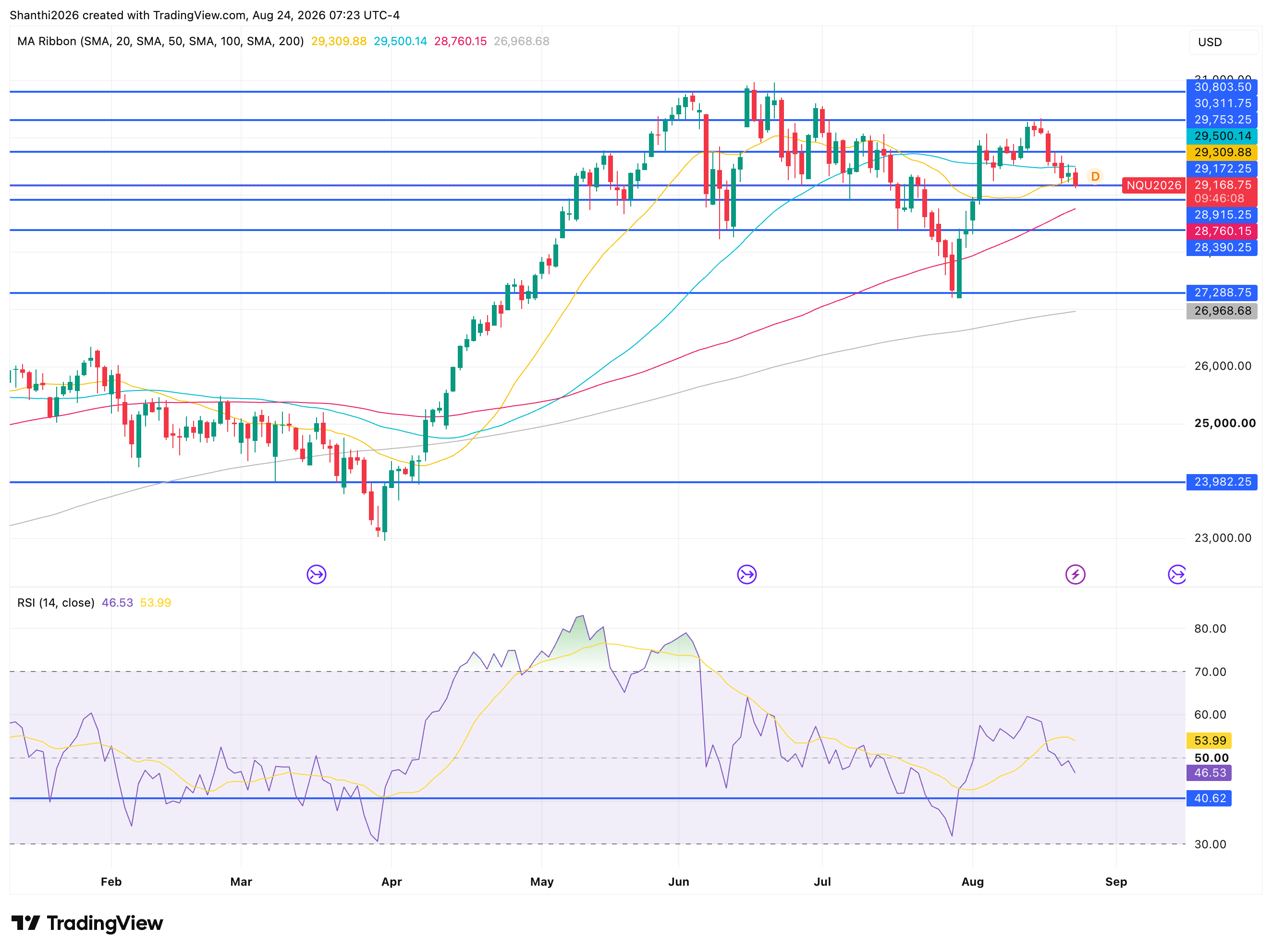
NQ is sitting around 29,170–29,200, with the chart showing a clear loss of short-term momentum. The contract is trading below its 20-day SMA at 29,309.88 and 50-day SMA at 29,500.14, leaving those averages as immediate resistance. The first key support is around 29,172, followed by 28,915. A sustained break below 28,915 would weaken the technical setup further and bring the 100-day SMA at 28,760 into focus. Below that, 28,390 and 27,289 are the next major downside levels.
Momentum also favors caution. The 14-day RSI is at 46.53, below the neutral 50 level and well above oversold territory, indicating that bearish momentum has increased but is not yet extreme. Importantly, NQ remains above its 100-day and 200-day moving averages, at 28,760 and 26,969 respectively, so the broader uptrend has not been decisively broken.
On the upside, NQ needs to reclaim 29,310 first, followed by the 29,500 50-day SMA. A move above 29,753 would improve the bullish setup and open the way toward 30,312, with 30,804 as the next major resistance. With Nvidia earnings due Wednesday and markets already under pressure from rising yields, the 29,172–28,915 support zone is the key technical battleground this week.
Source: TradingView
Positioning Offers a Mild Bullish Signal
MarketFramework’s Positioning Edge data shows a mild bullish divergence in NQ positioning. Profitable traders are 55.6% long, compared with 44.2% for unprofitable traders, meaning the traders with profitable positions have a 11-percentage-point greater long bias. Both groups have the same average entry level of roughly 29,191, while the latest NQ price is around 29,215.
The performance gap also favors the profitable group: profitable traders are averaging about +$974 per trade, compared with roughly -$1.1K for unprofitable traders. The positioning therefore offers a modest bullish signal, suggesting that better-performing traders are maintaining greater upside exposure even as NQ remains close to the 29,200 support area. If NQ holds support and Nvidia delivers a strong enough catalyst, this positioning could reinforce a rebound scenario.
Nvidia Is the Catalyst
The immediate catalyst is Nvidia's fiscal second-quarter earnings, due after the close on August 26. Expectations are already extremely high, with consensus revenue near $92.07 billion and adjusted EPS around $2.09. In late-May, Nvidia itself guided to roughly $91 billion in revenue for the quarter, excluding any artificial intelligence (AI) chip revenue from China.
Nvidia’s beat streak has been shrinking of late from +29% in the second quarter of fiscal year 2024 to 5.6% in the last reported quarter (Q1’27). The market wouldn’t just ask if the AI stalwart merely beat, but it would also ask if the margin of outperformance is healthy.
That makes the reaction function more important than simply whether Nvidia beats estimates. A strong report accompanied by an upbeat outlook could revive the AI trade, lift semiconductor stocks and provide NQ with the catalyst needed to reclaim lost ground. But if results merely meet lofty expectations, or if management signals any moderation in AI spending, margins or forward growth, the market could interpret the print as insufficient.
Rising AI Infrastructure Costs Could Complicate the Outlook
The earnings test is not only about whether Nvidia can beat near-term estimates. Investors will also be watching whether the rapidly rising cost of building AI infrastructure is beginning to affect the economics of the AI boom. A Bloomberg report said Nvidia has notified some of its largest customers that prices for servers containing its AI chips could rise by more than 15% for systems shipped early next year, with soaring memory costs cited as a key factor.
At the same time, Nvidia is moving deeper into the infrastructure needed to support AI demand. The company recently agreed to invest $1.5 billion in SB Energy and provide credit support for the land, power and initial infrastructure for a large Ohio AI data-center campus tied to OpenAI. A recent Wall Street Journal report said the Jensen Huang-led company was in advanced discussions to make an investment in Cloverleaf Infrastructure, a company that arranges power for data-center projects.
The contrasting developments could become an important part of the earnings narrative: higher server costs point to inflationary pressure within the AI supply chain, while Nvidia’s investment in power and data-center capacity suggests the company still sees demand strong enough to justify securing the infrastructure needed for the next phase of AI expansion.
For NQ, the question is whether Nvidia can convince investors that higher costs are simply the price of scaling AI, or a sign that the economics of the AI buildout are becoming less attractive. If management points to strong customer demand and continued spending despite higher memory and power costs, the developments could reinforce the bullish case. If costs begin to threaten customer returns or spending plans, however, they could add to the downside risk for Nvidia and the broader Nasdaq-100.
How Nvidia’s Print Plays Out in 3 Scenarios
| Blowout Beat + Raised Guidance | In-line beat, Cautious guidance | Miss/Guide-down |
|---|---|---|
| Revenue well above $92B-$93B | Revenue about $91.7B-$92B (near consensus) | Revenue below $91B (guidance midpoint) |
| Q3 guidance well below consensus | Guidance matches consensus | Soft, below-consensus guidance |
| Accelerating data center growth | Steady data center growth | Demand softness in data center and margin compression |
| NQ Reaction: Reclaims 29,501 (50-day SMA)-30K level | NQ Reaction: Choppy pop/dip; fades intraday | NQ Reaction: Breaks 29.2K |
| NQ Target level - Push toward 30.3K+/all time high-zone (just under 31K) | NQ Target level: trapped in the 29.2K-30K zone | NQ Target level: Tests 200-day SMA, slips below 29K or lower |
| Key risks: sell the news, fade if margins soft | Key risks: Range extends, no resolution | Key risks? Compounds with yield/chip-sector pressure |
For NQ, therefore, 29,200 is more than a technical level, it is the line separating stabilization from further deterioration. Nvidia's earnings could determine which side of that line the market chooses. It is worth keeping in mind that the market also has to contend with Kevin Warsh’s debut appearance as Federal Reserve chair at the central bank’s Jackson Hole symposium.


