The Nasdaq 100 Index (NDX) is heading toward the end of a roller-coaster week, as rising Treasury yields, renewed inflation concerns and worries over the path of Federal Reserve policy have pressured technology stocks. The index fell for a fifth straight session on Thursday, while the broader Nasdaq was on track for its first weekly loss since late July.
The pullback comes after the S&P 500 (SPX) and the Dow Jones Industrial Average (DJI) had pushed into record territory, leaving investors to decide whether the recent weakness is simply a pause in the rally or an early warning that the market's assumptions are beginning to change.
Next week could provide some answers.
Two events stand out: Nvidia's earnings on August 26 and the Federal Reserve's Jackson Hole symposium from August 27-29. Together, they could test the two major pillars supporting the Nasdaq 100, namely expectations for continued artificial intelligence (AI)-driven earnings growth and hopes that monetary policy will not become significantly more restrictive.
Rising Yields Are the Immediate Problem
The latest selloff has not been driven by a collapse in corporate earnings. Instead, the bond market has become the key source of pressure.
The 30-year Treasury yield has climbed to its highest level since 2007 this week, while the 10-year yield has remained elevated. Higher long-term yields can put pressure on technology valuations because they increase the discount rate applied to future earnings.
That creates an important test for the Nasdaq 100. The index has benefited enormously from expectations of strong future earnings from AI and other technology businesses. But the higher valuations become, the more sensitive those stocks can be to changes in interest rates.
The question now is whether earnings growth can continue to outweigh the valuation pressure coming from the bond market.
Nvidia Is the First Big Test
That is where Nvidia enters the picture.
Nvidia is scheduled to report second-quarter results on August 26, making it the first major catalyst for the Nasdaq-100. The company has become a proxy for the broader AI infrastructure trade, so its results could have implications well beyond its own stock.
Investors will be looking beyond the headline earnings number. Revenue growth, data-center demand, the outlook for AI infrastructure spending and management's guidance will be particularly important.
A strong report and upbeat outlook could reassure investors that the AI investment cycle remains powerful enough to support elevated technology valuations. It could also give semiconductor stocks a fresh catalyst after their recent weakness.
But a simple earnings beat may not be enough. Expectations are already high, meaning the market could demand evidence that AI spending is continuing to accelerate rather than merely holding up.
That makes guidance arguably more important than the headline beat.
Then Comes Jackson Hole
The following day, attention shifts from corporate earnings to monetary policy.
The Federal Reserve's annual Jackson Hole symposium runs from August 27 through August 29, with Fed Chair Kevin Warsh's appearance attracting particular attention. Investors are looking for clues about how policymakers view inflation, financial conditions and the recent rise in Treasury yields.
The timing could hardly be more important.
Markets are already wrestling with whether inflation remains sufficiently persistent to limit the Fed's ability to ease policy. At the same time, higher oil prices and elevated long-term borrowing costs have complicated the outlook further.
A less-hawkish message from Warsh could help stabilize Treasury yields and give growth stocks room to recover. Conversely, if his remarks reinforce concerns that inflation remains a problem or that monetary policy could stay restrictive for longer, yields could move higher again.
For the Nasdaq 100, that could matter almost as much as Nvidia's earnings.
NQ’s Twin Catalysts: Bull, Bear and Volatility Scenarios
| Scenario | Nvidia Earnings | Jackson Hole | Implications for NQ |
|---|---|---|---|
| Bullish | Strong beat with upbeat AI-demand guidance | Warsh delivers a less-hawkish message and yields stabilize or fall | Rally resumes, with Nvidia and other megacap technology stocks leading |
| Base | Solid results but guidance largely meets expectations | Warsh offers limited policy clarity | Choppy, range-bound trading as AI optimism offsets continued rate uncertainty |
| Bearish | Weak guidance or signs of softer AI spending | Warsh emphasizes inflation risks and keeps policy restrictive | Deeper correction, as weaker AI expectations combine with higher yields |
A strong Nvidia report could lift the Nasdaq-100 even if the Fed remains cautious, but the rally could struggle to sustain itself if Treasury yields continue climbing. Likewise, a dovish shift at Jackson Hole could support valuations, but a disappointing Nvidia outlook could undermine the AI narrative that has powered much of the market's gains.
The strongest bullish combination would therefore be strong Nvidia results plus a benign Fed message.
The most damaging combination would be the opposite: disappointing Nvidia guidance alongside renewed concerns about inflation and higher-for-longer rates.
Technical Picture: NQ's Short-Term Uptrend Faces a Key Test
The NQ contract enters next week with the technical damage from this week's decline still relatively fresh.
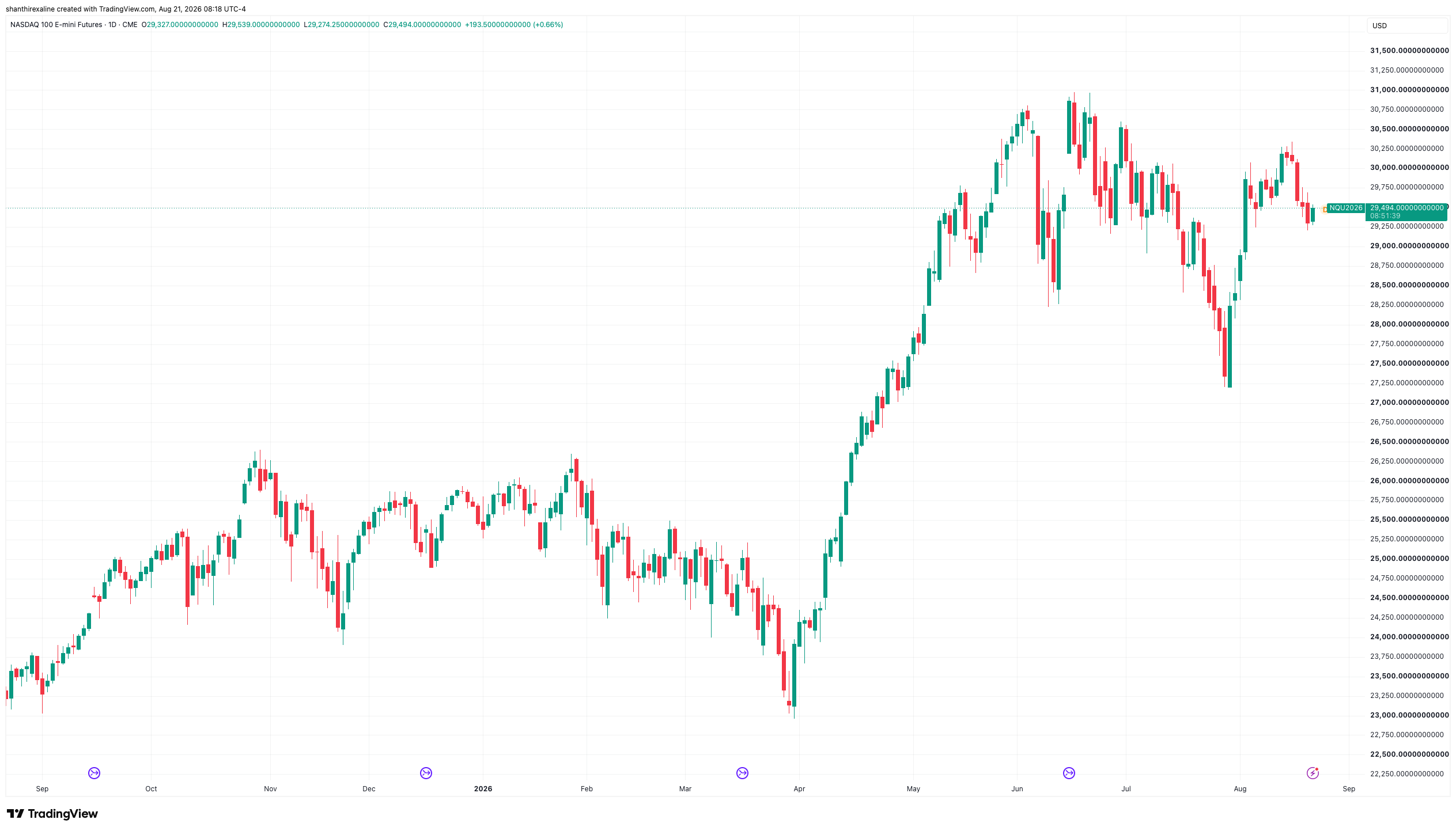
NQ's dominant trend since April has been a powerful rally from the late-March low near 23,000 to a mid-June high just below 31,000, a gain of roughly 34%. But price action has turned choppy since that peak, with the contract falling to a low of 27,176 in late July before clawing back to a recent high just below 30,200. It has since rolled over again, giving back some of those gains during this week's sell-off.
Source: TradingView
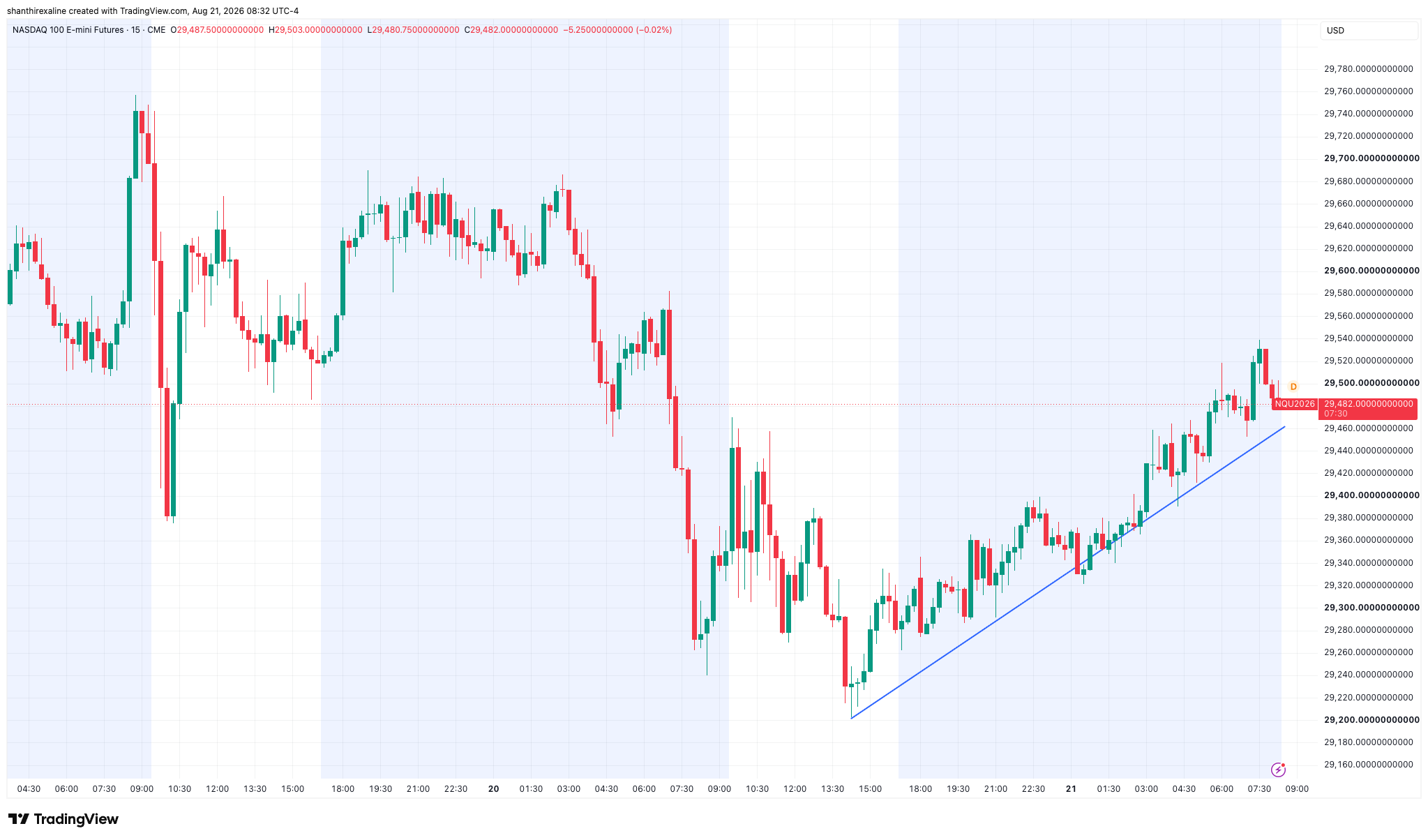
On the 15-minute chart, NQ bottomed near 29,220 in the early afternoon session on Thursday before turning higher and grinding steadily upward through the overnight session and into Friday's premarket trading.
As long as price holds the 29,440–29,460 trendline, the short-term uptrend structure remains intact, suggesting that dips could continue to attract buyers. A decisive break and close below this line, however, would weaken the setup and raise the risk of a retest of the week's low in the 29,300–29,200 zone.
Source: TradingView
The immediate technical question, therefore, is whether NQ can maintain the overnight recovery or whether Friday's bounce proves to be a temporary reprieve within the broader pullback.
MarketFramework’s Positioning Edge is showing a mild bearish divergence. Profitable traders are 55% long, compared with 60% long among unprofitable traders, meaning the less-successful group is carrying a slightly larger bullish exposure.
The difference is modest at 5 percentage points, but the positioning becomes more interesting when viewed alongside performance. Profitable traders have an average long entry near 29,709.95 and are currently showing an average gain of $821 per trade, while unprofitable traders entered around the same level but are carrying an average loss of $990. With NQ trading below both groups’ average long entries, both profitable and unprofitable traders are underwater on their long positions.
What Comes Next for NQ?
The reaction to next week's catalysts is more important than the weekly loss itself.
If buyers step in after Nvidia's report and Treasury yields begin to retreat following Jackson Hole, this week's decline could look like a healthy reset after the index's run toward record highs.
If, however, Nvidia fails to meet increasingly demanding AI expectations while Jackson Hole reinforces the bond market's inflation concerns, the recent pullback could become more significant.
In other words, next week's question is not simply whether the Nasdaq 100 can rebound. It is whether the two forces that have supported the rally — AI earnings and favorable financial conditions — can remain aligned. Nvidia will test the first. Jackson Hole will test the second.


