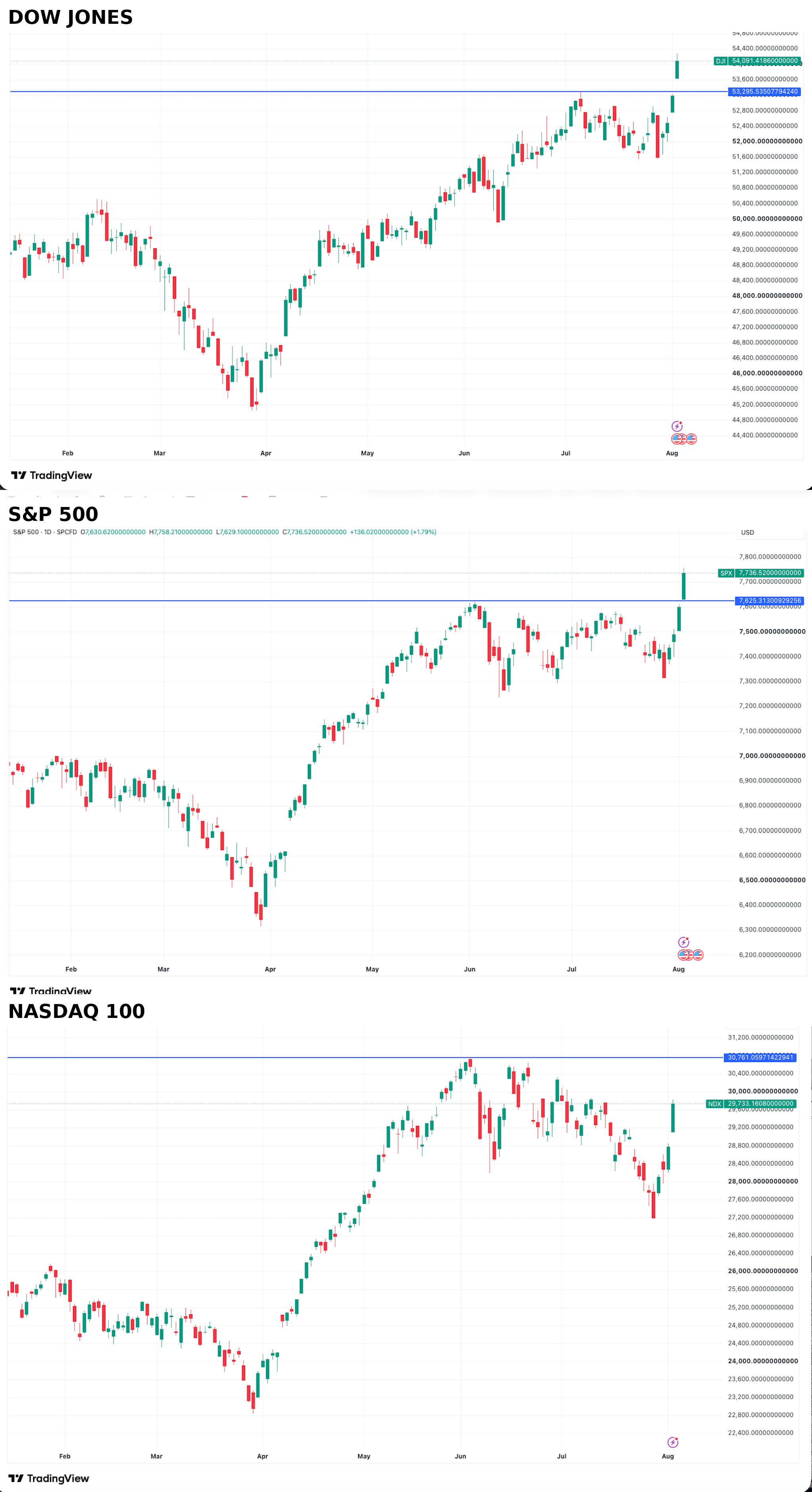
Wall Street closed out Tuesday with a split personality. The Dow Jones Industrial Average (DJI) blew through 54,000 for the first time ever, up roughly 908 points, and the S&P 500 notched its first record close since early June, rising 1.8% to 7,737. Both indexes are now firmly in uncharted territory.
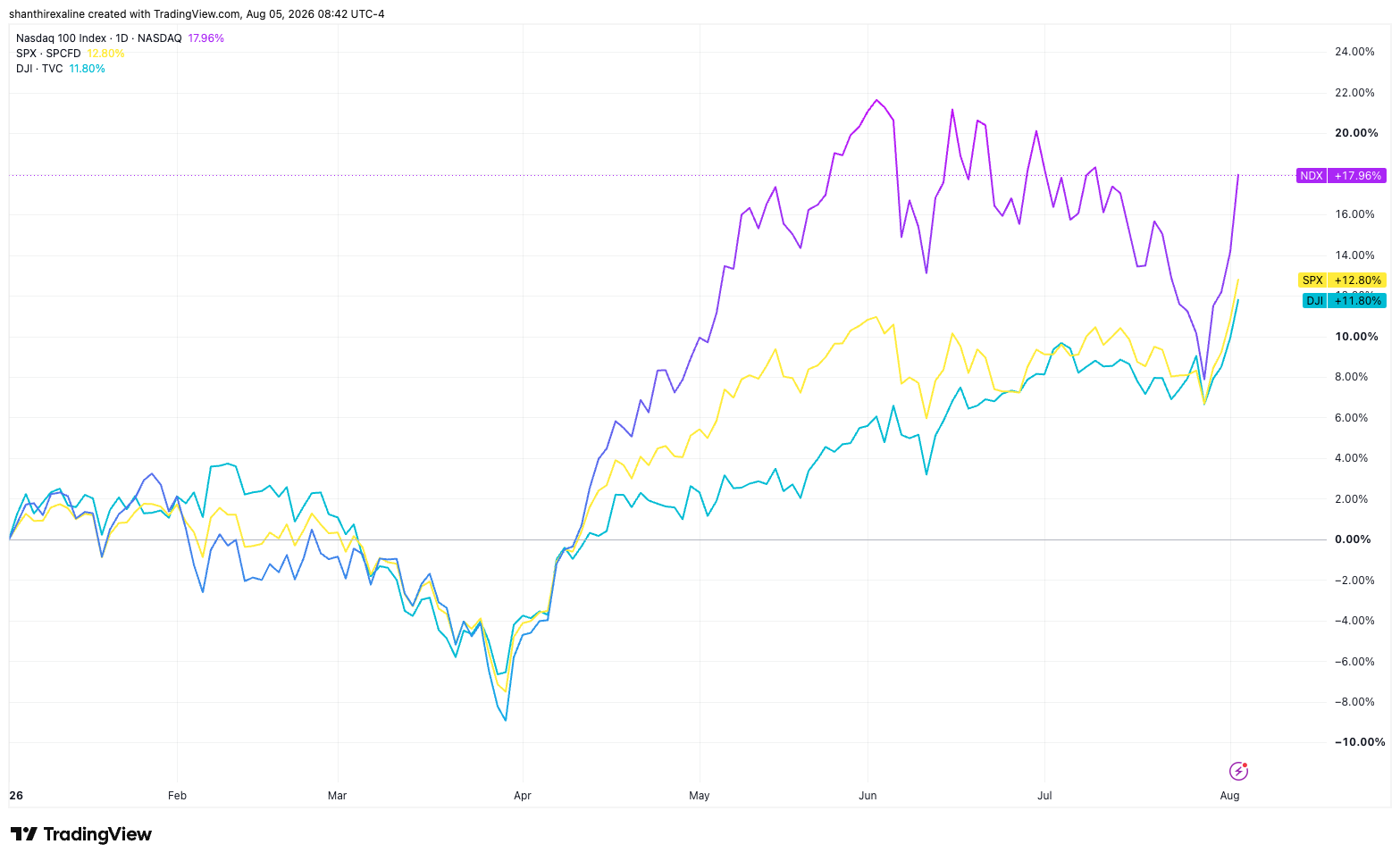
Tech didn't miss the party, with the Nasdaq 100 (NDX) jumping 3.3% on the day, its best single session in months, and the broader tech gauge, the Nasdaq Composite, rose 2.60% and is up nearly 9% since its July 29 low. These indices are also the leaders, in terms of their year-to-performances.
NDX Vs. SPX Vs. DJI (Year-to-date Performance)
Source: TradingView
But even after the surge and the year’s outperformance, the Composite closed Tuesday’s session roughly 2% below the record it set back on June 1 and the NDX is down 3.3% from its June 3rd record intraday high (30,762.20).
Source: TradingView
Tech may have led the day and also the year but it is yet to reclaim its peak. That gap is the story.
What Drove Tuesday
The rally had two clear engines.
- First, earnings: Caterpillar and McDonald's beat estimates, Palantir posted a blowout quarter and soared 29%, its best day in over two years
- Semiconductor names ripped across the board, with Intel up 10.8%, Marvell up 13%, Micron up 7.6%, and Broadcom up 6.6%. Second, macro relief: crude oil fell as reports emerged of progress toward reopening the Strait of Hormuz, and Treasury yields eased alongside it.
Notably, the industrials that powered the Dow to its record, namely Caterpillar, Cisco, IBM, aren't the artificial intelligence (AI) trade. That's the tension underneath the headline number: broad-market leadership is coming from cyclicals and "old economy" names even as tech posts the bigger single-day pop.
The Rotation Case
The simplest explanation is beta, not breakdown. Tech fell harder in the summer sell-off than the rest of the market. The Dow's 1,100-point drop in late July was driven explicitly by fears the Fed was falling behind on inflation, a scenario that punishes long-duration growth stocks disproportionately. Under this reading, the Nasdaq's 3% shortfall isn't a red flag; it's simply a deeper hole that takes more sessions to climb out of. Tuesday's chip and AI earnings are the evidence: fundamentals are intact, and the gap closes from here.
The First-Crack Case
There's a less comfortable read. Hours before Tuesday's session, investor Michael Burry was quoted warning that markets may be nearing a major top, drawing a comparison to 1987. Layer that onto the composition of Tuesday's rally. Money flowing into industrials and value names while tech's gain looks more like short-covering after a violent drawdown than fresh conviction. The rotation story becomes a warning story. If capital is quietly diversifying away from the most crowded AI trade even as headline tech stocks post outsized single-day gains, the 3% gap may not close. It may become the ceiling.
That said, Lloyd Financial Chief Investment Officer Colin Symons thinks it is otherwise: For now, the evidence points more toward a rotation than a structural crack. To make his case, he underlined the solid corporate earnings, and resilient economic growth.
Symons sees the sharp pullback in technology shares as consistent with an unwinding of crowded positioning than a deterioration in fundamentals, with the strategists pointing to the recent deleveraging by Situational Awareness fund as a clearing event that removed excess speculation and helped pave the way for the market's rebound.
The strategist also surmised that leadership may be starting to change.
Semiconductors are cyclical; expectations are high, and breadth may be weakening. Are semiconductors going to be replaced by something like hyperscalers as future tech leaders?
Positioning remains moderately bullish, but not excessively so. MarketFramework's Positioning Edge data shows profitable traders holding about 10% more net-long exposure than unprofitable traders, suggesting that the "smart money" cohort continues to lean higher. At the same time, with roughly 57% of all contracts positioned long, overall sentiment is positive but far from the kind of one-sided bullishness that typically signals overcrowding.
The Number That Settles It
The key is relative strength. If NQ futures reclaim their June high in the coming sessions, it would support the rotation-and-catch-up story. If the Nasdaq continues to lag the S&P 500, even as both indexes move higher, it would suggest a deeper crack in leadership.
For now, tech is leading the market on up days—but it still hasn't earned a new record high.


