
Gold, wrestling with its own internal contradictions in a conflict-driven inflation environment, steadied above $4,500 as negotiations between the US-Iran showed limited signs of progress. The yellow metal is coming off a month, when it fell nearly 1%, pressured by inflation concerns and expectations of prolonged higher interest rates.
The geopolitical situation involving the U.S. and Iran continues to swing back and forth. Are markets operating on a ‘buy the rumor, sell the news’ narrative?
The IRGC Fracture - Is a Wider War on the Horizon?
Over the weekend, Iran International, the London-based outlet covering Iranian affairs, reported that President Masoud Pezeshkian submitted an official resignation letter to Supreme Leader Mojtaba Khamenei's office, citing the Islamic Revolutionary Guard Corps' effective takeover of large portions of the Iranian government and stating that the president and other high-ranking officials had been cut out of vital decision-making.
Iran's presidency denied the claims within hours, calling them "ridiculous media games." The denial, however, may be doing more work than the original report.
The geopolitical significance lies not in whether Pezeshkian formally resigned, but in what the underlying reality, contested or not, signals about who actually controls Iran's negotiating position.
Anonymous sources told Iran International that the primary source of the rift between Pezeshkian and the IRGC leadership, believed to currently hold the lion's share of power within the regime was "the way the war was managed and its destructive consequences on the people's livelihoods and the country's economy."
As the US session got underway on Monday, market sentiment took a further hit as Tasnim news reported that Tehran's negotiating team is stopping exchanges of messages with the U.S. through mediators due to attacks on Lebanon, as diplomatic efforts to end the three-month-old Iran war continue.
Tasnim further reported that Iran and the Resistance Front, which includes its Shiite allies in Yemen, Lebanon and Iraq, have set an agenda to completely block the Strait of Hormuz and activate other fronts, including the Bab El Mandeb Strait, in order to "punish" Israel and its supporters.
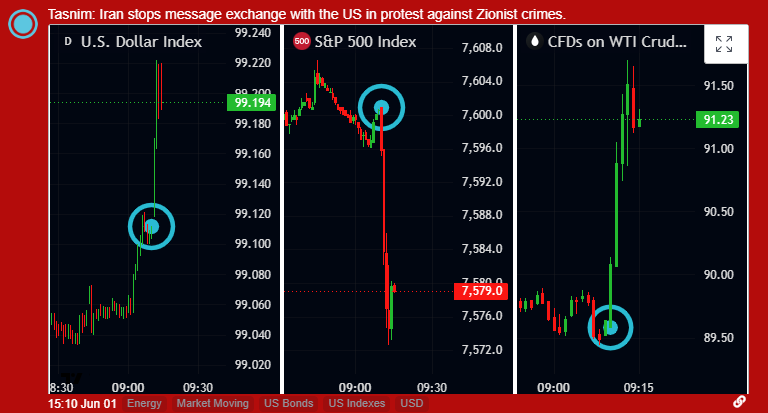
Source: FinancialJuice
Once again markets appear to be reacting to the rumor as we saw gold prices plummet around 2%.
Gold's Contradictory Signal
Gold's behaviour through this conflict has been one of the more instructive macro stories of 2026. The bullion tumbled as much as 25% peak-to-trough from the conflict onset as surging energy prices fueled inflation fears and forced a hawkish shift in central bank outlooks — gold struggled to perform its traditional safe-haven role as investors liquidated positions to cover losses elsewhere.
A breakdown in talks driven by IRGC hardliners is unambiguously bullish for oil, which is inflationary and thus bearish for gold. As things stand, the probability of a genuine geopolitical collapse and strikes escalating with the Strait of Hormuz fully closed again seems to be growing.
Goldman Sachs has reiterated a $5,400/oz target, while Wells Fargo has an upside target of $6,300 for Gold by the end of 2026, hinting that this could be a possibility.
Gold’s Next Move - A Return to $4,000/oz On Its Way?
The market consensus entering this week was a 60-day extension, a Hormuz reopening, and a gradual normalisation in energy prices. This now seems to be at risk.
For gold, the near-term outlook is murkier. U.S. inflation data showed the fastest rise in three years in April, reinforcing expectations the Fed will keep rates unchanged well into 2027. A headwind that does not resolve cleanly regardless of what happens in Tehran.
Traders should watch the sequence: if oil breaks back above $95 on a confirmed deal collapse, the inflationary impulse it generates will ultimately circle back to a gold bid as the stagflationary scenario becomes undeniable.
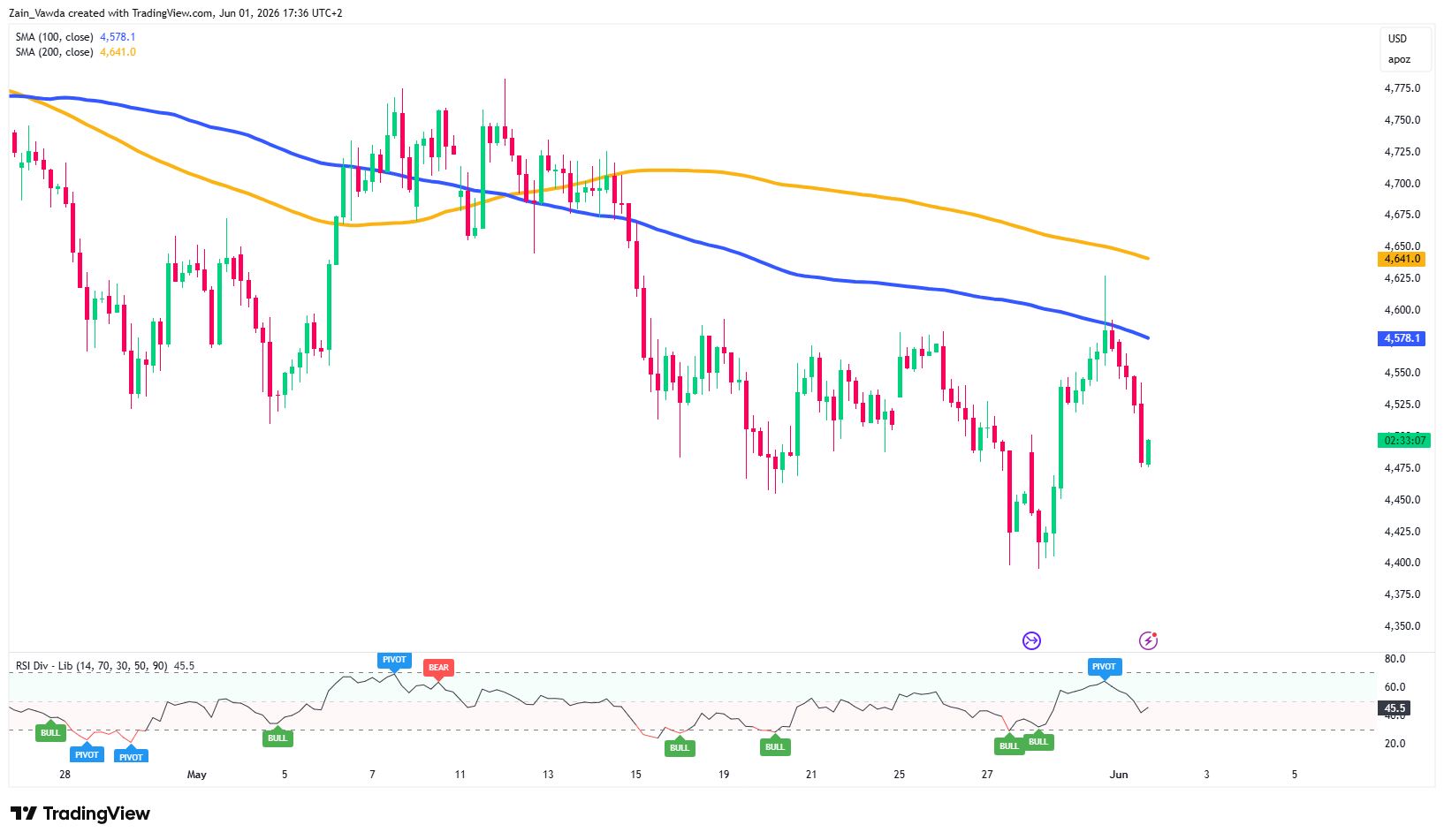
Gold Four-Hour Chart, June 1, 2026
Source: TradingView
For now the Gold H4 chart exhibits a distinct bearish market structure, with price trading below both the 100-day MA ($4,578.1) and the 200-day MA ($4,641.0).
Following a recent relief rally, price action printed a bearish pivot and faced a sharp rejection exactly at the descending 100-day MA resistance, driving the market lower toward immediate support around $4,475.
Momentum is firmly in favor of sellers; the RSI (14) has rolled over from a local peak down to 45.5, indicating accelerating downside pressure. Continued weakness points to a retest of the major $4,400 structural floor and beyond depending on how the geopolitical risk angle shakes out.
The ceasefire trade was a bet on the moderates. The moderates may no longer be in the room.


