The South Korean stock market benchmark, the Kospi, climbed to a fresh record high on Monday, driven by strong gains in heavyweight technology stocks. Investor sentiment toward the sector was buoyed by May trade data, which showed export growth reaching its strongest pace in four decades.
Until recently, the idea that developments in South Korea, a nation in East Asia roughly the size of the U.S. state of Indiana, could influence trading sentiment on Wall Street might have seemed far-fetched. Today, however, the country's outsized role in the global technology supply chain means that movements in its markets are increasingly viewed as a barometer for the broader tech sector and, by extension, the U.S. market.
Chips Rewrite Korea's Export Record
South Korean exports climbed 53.2% year over year (YoY) in May, faster than May’s 48% growth, according to a report released by the Ministry of Trade, Industry and Resources. Economists had expected a more modest 48.4% growth for the month. Working-day adjusted shipments jumped a steeper 60.7%.
May exports ($87.75 billion) also notched up a monthly record. Semiconductor exports jumped about 170% to $37.16 billion, marking a record monthly total for the industry. Computers and displays also recorded strong growth due to increased demand for solid-state drives for artificial intelligence (AI) servers and the launch of new mobile products.
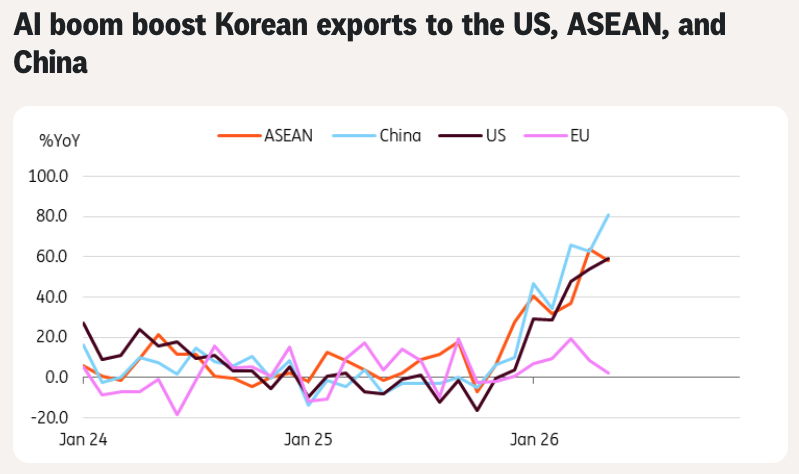
Source: CEIC via ING
Automobile exports fell 5.9% due to the U.S. tariffs and disruptions caused by the war in the Middle East. Petroleum product exports increased (up 46.6%) in value terms but fell (down 23.8%) in volume terms.
Imports, on the other hand, climbed 20.8% YoY, slower than the 21.5% consensus, but faster than the 16.7% growth in the previous month. The acceleration relative to April is due to higher energy prices, with import volume dropping, while import value climbed nearly 16%. Semiconductor manufacturing equipment imports jumped 71%.
Korea and The Wall Street Connection
For Wall Street analysts tracking high-profile U.S. tech giants such as Nvidia (NVDA), AMD (AMD), Microsoft (MSFT) or the broader AI infrastructure trade, Korea’s export data arrived more than a month before the U.S. earnings calls. Record shipments by Samsung and SK Hynix are a bottom-up confirmation that hyperscaler capex boom is for real.
Memory chipmaker SK Hynix reported record revenue for its first quarter, and an enviable 72% operating margin, exceeding Nvidia’s 65%, — a commendable feat for a hardware name. The fundamental outperformance is reflected in the meteoric climb in the stock seen since the middle of last year. And as recently as in May, the company market capitalization topped the covetous $1 trillion mark.
SK Hynix 5-Year Chart
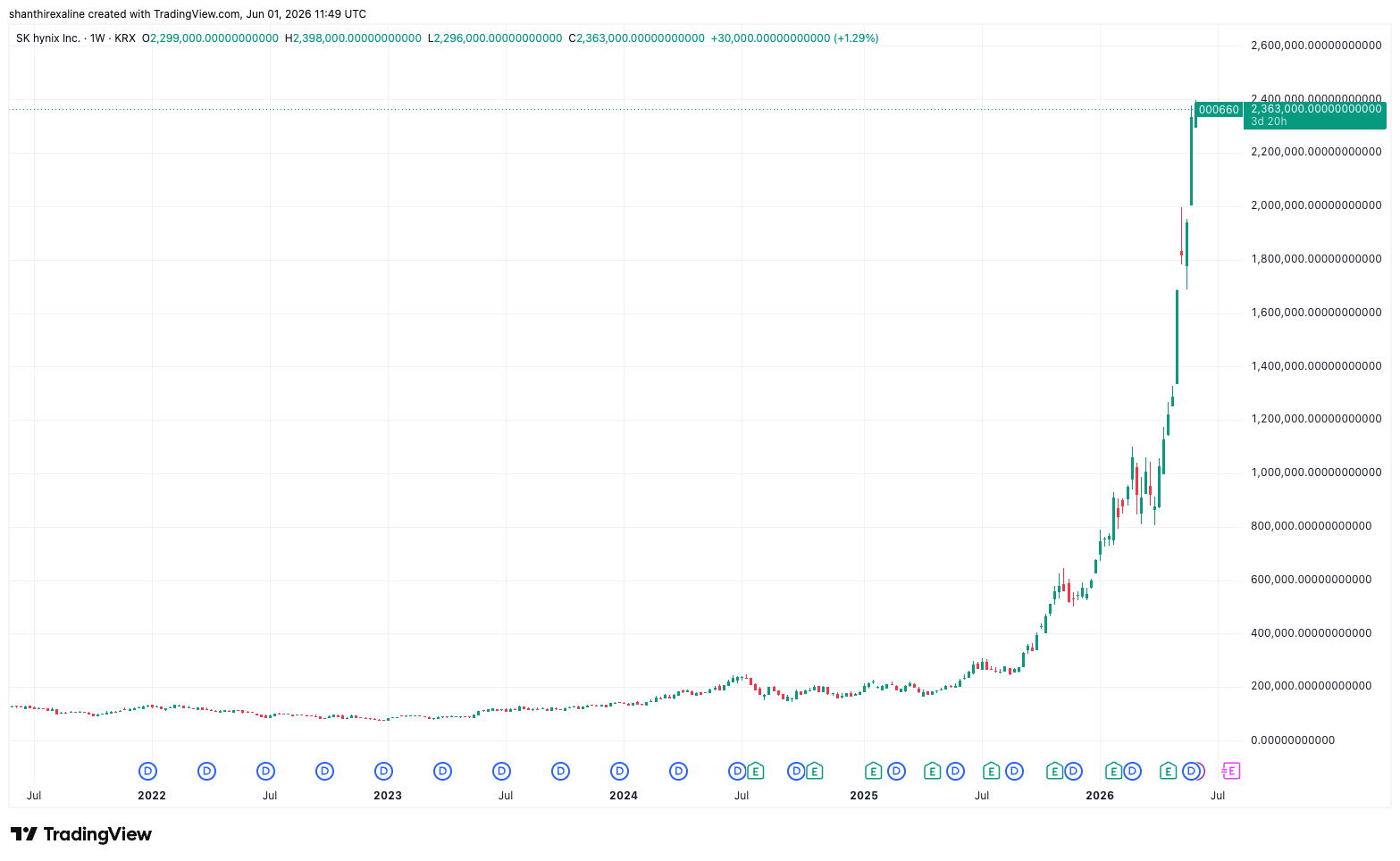
Source: TradingView
Bigger peer Samsung has also come out all guns blazing. The stock closed Monday’s session at a fresh record.
The 71% jump in semi equipment imports by Korea also matters to U.S. investors as these come from U.S. and Dutch suppliers such as Applied Materials, Lam Research and ASML.
What US Futures Are Saying
The Kospi index’s record run, however, hasn't been replicated by Wall Street The Nasdaq 100 futures (NQ) fell modestly in the New York session early Monday, after the underlying asset (the Nasdaq 100 Index) closed at a fresh record on Friday. Nvidia, the world's most valuable company by market capitalization, however, bucked the downtrend with an advance of more than 4% after CEO Jensen Huang made a slew of announcements at the company's GTC 2026 held in Taipei on Monday. The highlight was RTX Spark, a new AI superchip designed for Windows PCs, a direct challenge to AMD and Intel on their home turf in the consumer processor market.
The broader backdrop, however, is constructive. The Nasdaq 100 returned over 9% in May alone, and the tech-heavy Nasdaq Composite gained more than 8% for the month, with all three major indexes posting solid gains and closing at fresh highs on the final Friday of May.
Technical signals across every timeframe from 5-minute to monthly are aligned to the upside, with momentum indicators registering a strong buy on the June futures contract.
The convergence is hard to ignore. Korea's export data validates the demand side of the AI trade in hard dollar terms. U.S. futures are pricing in that the rally has further legs. The question is whether the valuations pricing in that growth leave any margin for disappointment when the calendar turns to earnings season in July.
Read Next: RBOB Gasoline Futures Near Bear Market: Deescalation Trade or Consumer Cracking?


