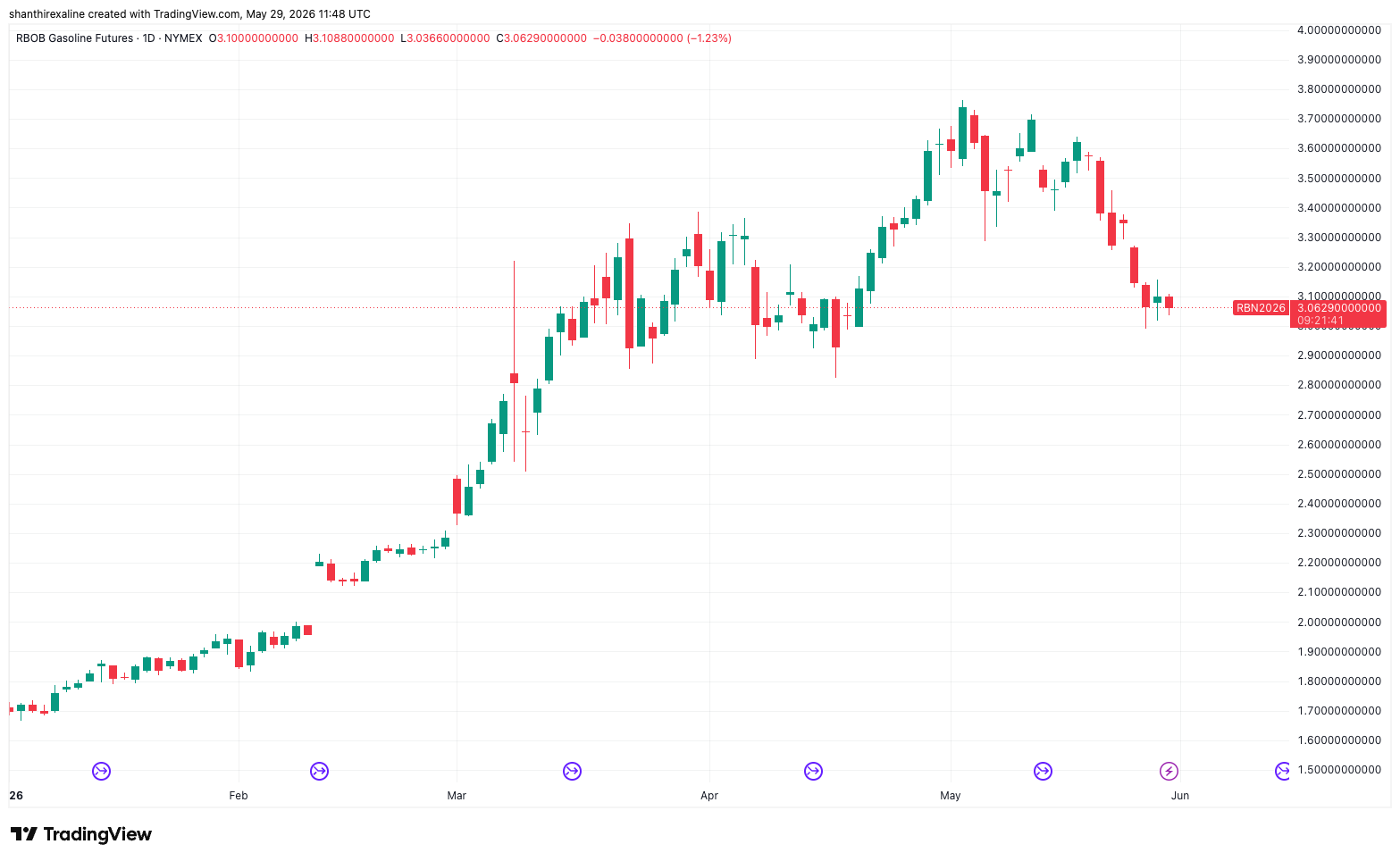
Headlines surrounding a potential U.S.-Iran truce have set a deescalation trade in motion, exerting sustained downward pressure on energy commodities over recent sessions. RBOB gasoline futures on the New York Mercantile Exchange (NYMEX) have not been spared.
From an intraday peak of $3.7610 on May 4, the July delivery contract has pulled back roughly 18% through Thursday. And the losses appear to be extending into Friday's session, which also marks the final trading day of May.
Gasoline Futures (YTD Chart)
Source: TradingView
What’s Weighing Down on Gasoline Prices?
The July contract is now pushing toward bear market territory, conventionally defined as a decline exceeding 20% from a recent peak.
The unwinding of the bullish trade has come despite a lack of clear evidence that the two parties are ready to reach a lasting resolution, one that would reopen the Strait of Hormuz and restore the roughly 25% of global energy supply that has been disrupted since the conflict began.
RBOB gasoline futures currently trade at $3.06, up from pre-war levels of $2.29. That puts the geopolitical risk premium embedded in gasoline at approximately 77 cents per gallon, assuming the entirety of the move is attributable to the conflict.
But this geopolitical risk premium remains vulnerable to rapid reversal. That much has been on full display in recent sessions: ceasefire reports emerge without warning, only to be walked back by one or both sides shortly after. The U.S. President Donald Trump's characteristic unpredictability has added another layer of uncertainty, keeping traders perpetually off-balance.
If the sharp retreat has come despite the lingering geopolitical tensions, a less obvious force may be quietly weighing on prices. One place to look is the American consumers.
The Gasoline-Consumer Link
RBOB gasoline futures are standardized contracts traded on the NYMEX, with wholesale gasoline, a refined by-product of crude oil as the underlying commodity. These contracts serve as the U.S. benchmark for gasoline pricing and are used by refiners, distributors and speculators alike to hedge or gain exposure to price movements in wholesale gasoline.
Retailers typically apply a margin on top of the wholesale price, and add distribution margin, alongside federal and state taxes, to arrive at the retail price. As a result, movements in RBOB futures are often viewed as a reliable leading indicator of changes in prices at the pump.
Beyond Geopolitics: Demand the Real Culprit?
The deescalation trade explains some of the selloff, but the scale and persistence of the retreat in RBOB futures suggests something more structural may be quietly at work: the American consumer is cracking.
Consumer Sentiment Has Collapsed
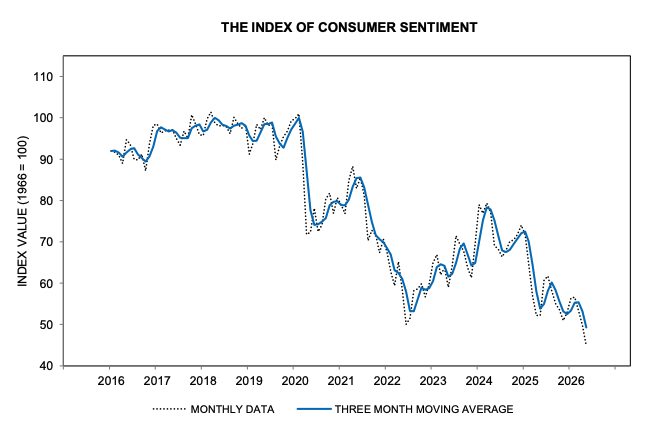
The University of Michigan's final May reading put the consumer sentiment Index at 44.9, the lowest on record. The year-ahead inflation expectations component surged to 4.8%.
Source: UMich
This matters for gasoline specifically because sentiment directly shapes discretionary driving behavior. When consumers feel financially squeezed, they consolidate trips, delay non-essential travel, and in some cases accelerate the shift to remote work arrangements. Gasoline is one of the first places where behavioral demand destruction becomes visible.
The Spending Signals Are Deteriorating
Hard data has also begun to corroborate the softness seen in consumer sentiment.
- Equifax’s Market Pulse Q1 US Consumer Credit Trends showed that consumer debt balances reached an all-time high of $18.19 trillion in March, underpinned by an increase in subprime borrowers opening new bank cards and carrying higher balances.
- Credit-card delinquencies reached their highest level since the 2008 financial crisis, with 90+ day delinquencies climbing to 13.12% in Q1 2026, according to a Wall Street Journal report. Total U.S. credit-card debt has risen to a record $1.25 trillion.
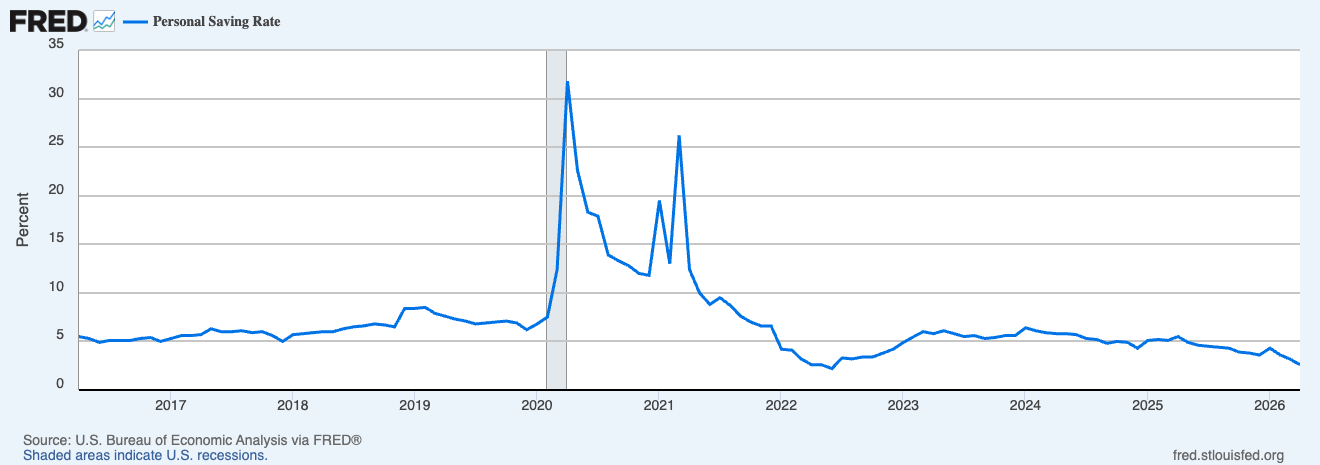
- Personal savings rate dipped to 2.6%, the lowest level since June 2022, limiting the buffer consumers have to absorb further price shocks.
US Personal Savings Rate
Source: BEA data via St. Louis Federal Reserve
Taken together, these data points paint a picture of a consumer who has largely exhausted pandemic-era excess savings and is now navigating an environment of elevated prices, tighter credit, and rising uncertainty about future income.
High energy prices are suppressing real purchasing power, which in turn is weighing on demand for energy itself. It is, in effect, a self-correcting mechanism, but one that extracts a painful toll on economic activity in the process.
If a genuine U.S.-Iran deescalation does materialize and the geopolitical risk premium of roughly 77 cents per gallon begins to unwind, the two forces, i.e. reduced supply risk and weakening demand would be pulling in the same direction, potentially accelerating the move toward and through bear market territory.
Short-term Moving Averages Breached, Support at $3.00 in Focus
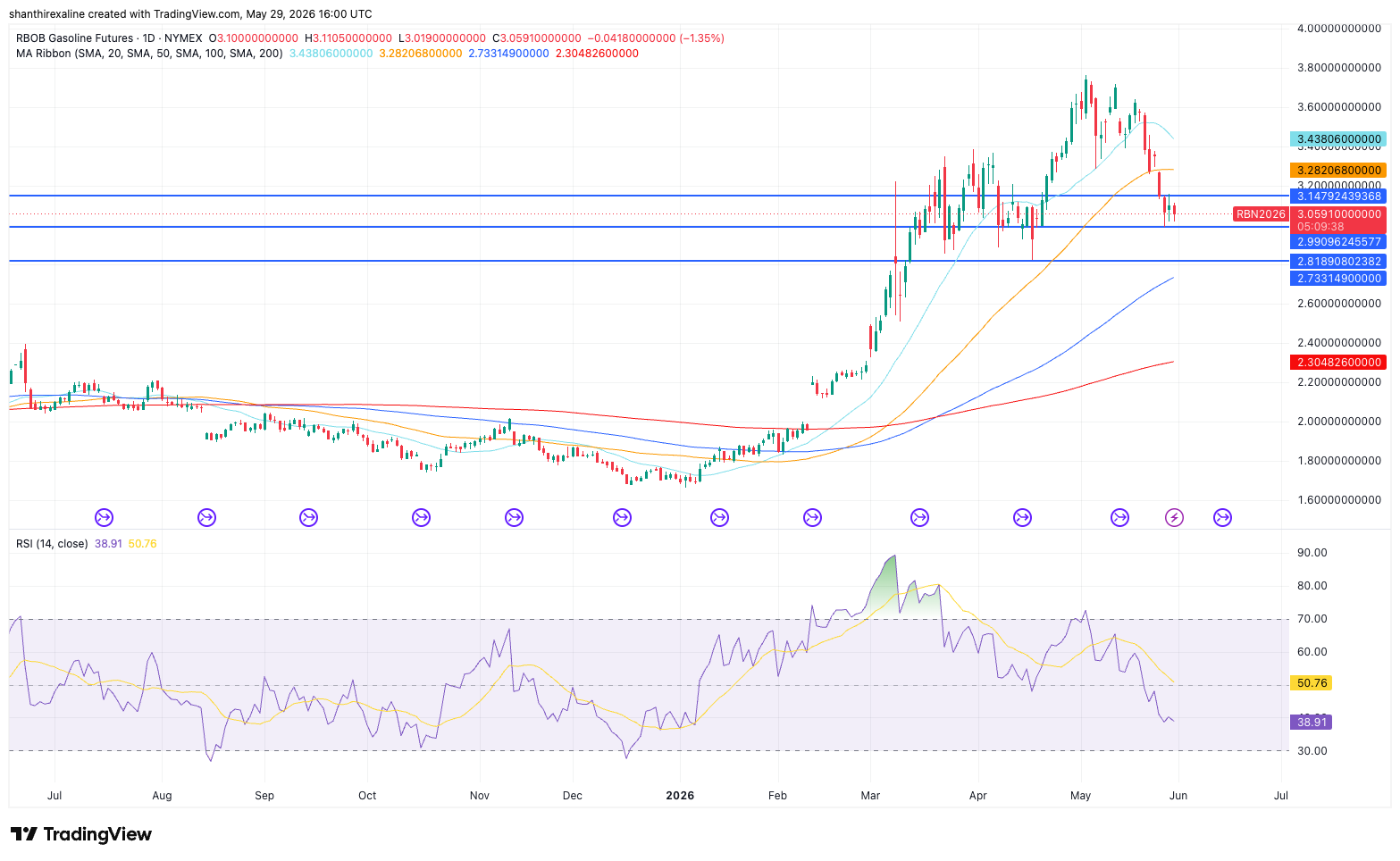
Technically, RBOB gasoline futures appear to be losing momentum after failing to sustain the sharp geopolitical-driven rally seen through March and April. Prices have now fallen below the 20-day moving average ($3.438) and the 50-day moving average near the $3.28 level, while momentum indicators continue to weaken. The RSI has dropped below 39, signaling deteriorating bullish momentum though not yet deeply oversold conditions.
Source: TradingView
Immediate support lies near the $3.00 psychological level, followed by the $2.80 region, while resistance remains around the $3.15–$3.20. The sharp retracement from May highs near $3.70 suggests the market is rapidly unwinding risk premium tied to Middle East tensions, though traders are increasingly watching whether softer gasoline demand expectations are also beginning to weigh on prices.
Read Next: ECB Rate Hike Dilemma: Split Inflation Data, French Q1 Contraction Complicate Outlook


