Preliminary inflation releases from Europe's two largest economies delivered a split verdict ahead of the ECB's June 11 policy meeting, adding another layer of complexity to what is perceived as an already tough decision amid the uncertain geopolitical landscape.
Recession Risk Mounts For French Economy Amid Rising Inflation
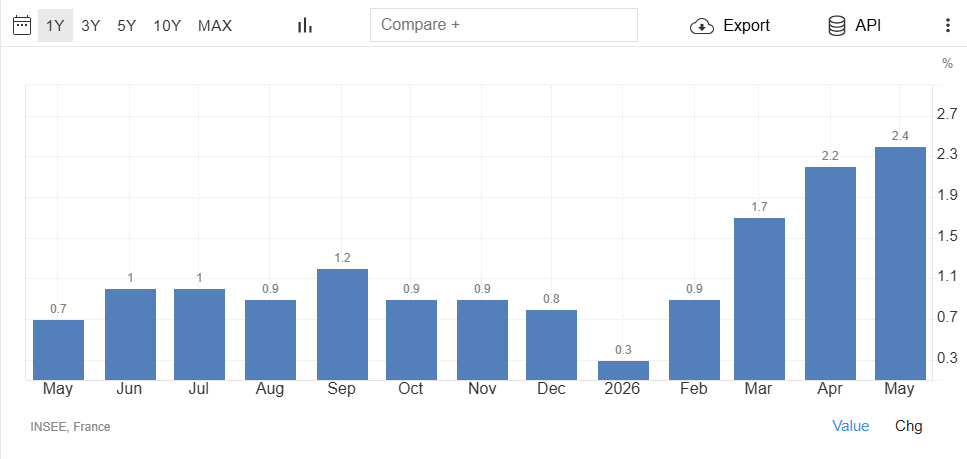
French headline CPI came in at +2.4% year-over-year in May, slightly below the +2.5% consensus, following April's +2.2% reading. On the harmonized measure, HICP printed at +2.8%, also a touch softer than the +2.9% expected.
Source: TradingEconomics
Prices rose just 0.1% from March, a modest print due to slight easing in energy costs relative to the prior month. That said, the headline annual rate is now the highest since February 2024.
The driver is familiar: Energy prices have surged sharply, linked to the ongoing Middle East conflict, with petroleum products a key contributor. The silver lining is that core inflation remains well-contained at 1.2%, and food inflation continues to cool. Services held steady. In other words, the inflationary impulse is largely imported through oil, and not through homegrown demand.
The French economy is currently trapped in a challenging stagflationary environment, characterized by rising inflation and faltering economic growth.
With the first-quarter GDP revised down to -0.1%, and another contraction expected for the second quarter, the French economy could potentially slip into a technical recession. Adding to these woes, a constrained fiscal environment leaves the government with almost no room to provide economic support.
State Data Points to Slight Cooling in German Inflation
The German economy told a slightly different story. State-level CPI readings released Friday showed a broad deceleration across major regions with Bavaria at +2.6% versus +2.9% prior, Saxony at +2.7% versus +3.0%, North Rhine-Westphalia at +2.4% versus +2.7%, and Baden-Württemberg at +2.4% versus +2.6%.
Monthly figures also dipped marginally across all four states, pointing to a slightly softer headline annual inflation at the national level compared to April.
Source: Destatis
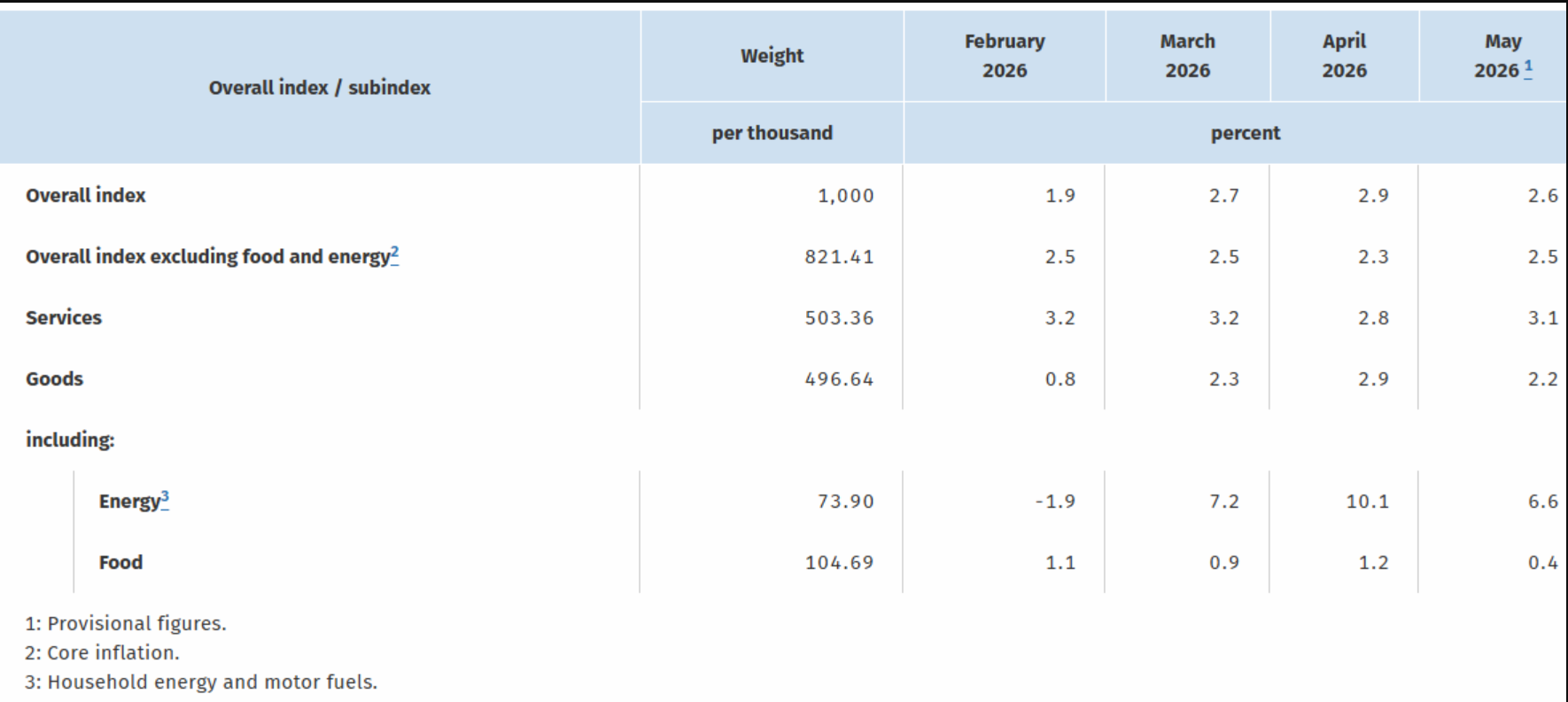
Germany's headline CPI had hit +2.9% in April, its highest since January 2024 driven by a 10.1% surge in energy prices tied to the Iran war.
While the new May data shows a step in the right direction, prices are still higher than they were before the Middle East conflict began. Therefore, there is reason to believe that prices will remain somewhat high and under pressure as the summer months approach.
ECB June 11 Meeting: What the Data Means for Rates
The European Central Bank (ECB) is heading into its highly anticipated June 11 meeting, which is shaping up to be its most critical decision of the year.
Market participants currently expect the central bank to raise interest rates by 25 basis points, with predictions pointing toward at least one more rate hike before the end of the year. At the April meeting, the ECB kept the interest rate steady at 2%. While that pause was unanimous, ECB President Christine Lagarde noted that policymakers actively debated a rate hike due to rising inflation threats and worsening risks to economic growth.
To determine its next steps, the ECB is closely watching how prolonged spikes in energy costs are impacting wages, general prices, and overall economic health. While inflation in Germany has slowed slightly, it remains well above the bank’s 2% target, and France's inflation has officially surpassed it.
Furthermore, the ECB’s own forecasts already predict that average inflation will sit at 2.6% for the year. This leaves hawkish policymakers arguing that current inflation levels justify a June rate hike, though this view comes with significant complications.
The primary challenge is that today's high inflation is being driven by expensive energy caused by the Middle East conflict, rather than strong consumer demand. The ECB has openly admitted that the war has made the economic outlook highly uncertain, threatening to push inflation up while simultaneously dragging economic growth down.
Raising interest rates to fight a supply-driven energy shock while the economy is already weakening presents a difficult dilemma. As a result of this, more cautious members of the Governing Council, especially those representing economically vulnerable nations are likely to fight against aggressive rate hikes.
EUR/USD: Consolidation Could Continue Into the ECB Meeting
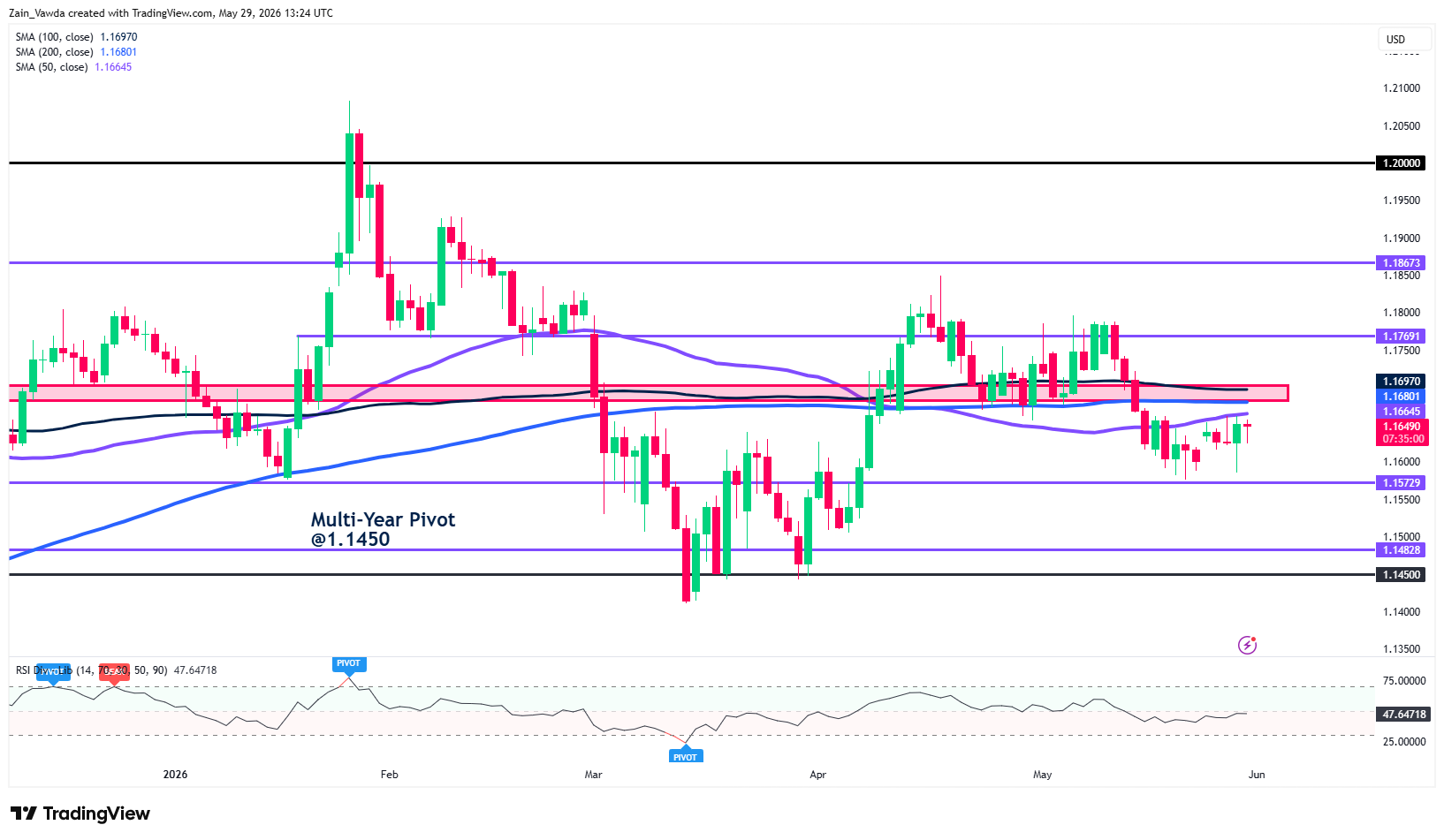
Looking at the EUR/USD daily chart, the pair is trading in a bearish-to-neutral phase, currently hovering around 1.1649.
EUR/USD Daily Chart, May 29, 2026
Source: TradingView
Price action remains trapped below a critical key resistance zone (highlighted in red) between 1.1680 and 1.1700, which aligns tightly with both the 100-day and 200-day Simple Moving Averages (SMAs). The 50-day SMA at 1.1664 is also capping short-term gains.
With the RSI sitting neutrally at 47.6, momentum is weak and uncertainty remains. If sellers maintain control below 1.1680, a retest of support at 1.1573 or the multi-year pivot near 1.1450 is likely.


