
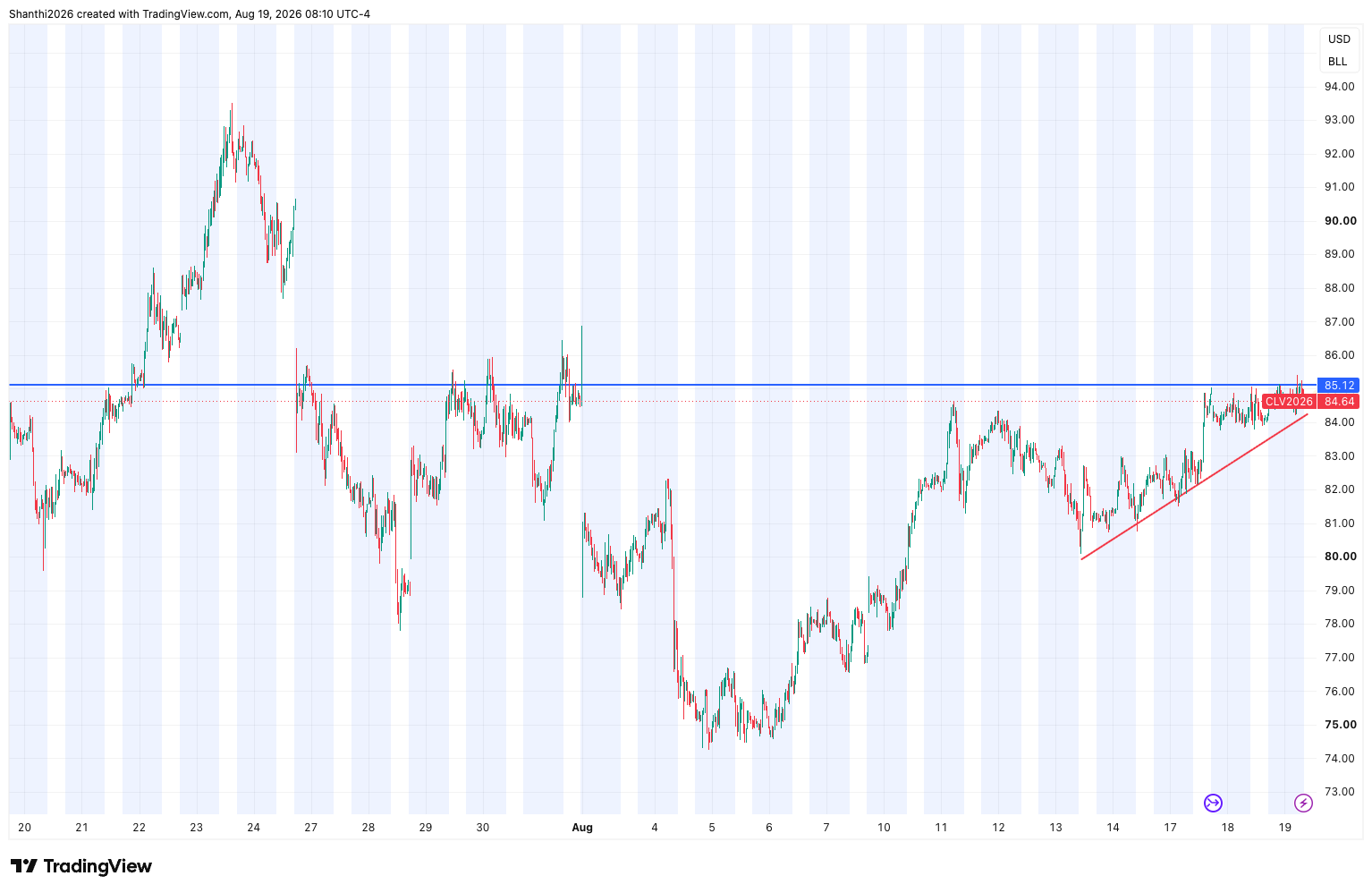
U.S. stock-index futures were already struggling to find direction Wednesday as investors weighed renewed Middle East tensions alongside elevated Treasury yields. Oil, meanwhile, continued to climb, with the West Texas Intermediate crude (CL) hovering just under $85-a-barrel, as uncertainty over shipping through the Strait of Hormuz persisted.
The latest concern is that the conflict could expand beyond the immediate Gulf theater.
According to a Financial Times report, Iranian forces have assessed potential strikes against U.S. military assets in southeastern Europe, including Bulgaria and Cyprus, if President Donald Trump escalates the conflict. Tehran has also reportedly examined attacks on subsea infrastructure in the Strait of Hormuz.
For markets, the significance goes beyond the possibility of another round of military strikes. A wider geographic footprint would raise the probability that the conflict begins affecting more parts of the global energy and financial system.
From a Hormuz Problem to a Broader Supply Shock
The immediate market risk remains the Strait of Hormuz.
Oil prices have already been climbing for three consecutive sessions as uncertainty over the waterway keeps traders concerned about the reliability of exports from the Gulf.
Source: TradingView
That is important because the market is no longer dealing simply with the possibility of a temporary disruption. Prolonged uncertainty over the world's critical energy chokepoint can keep a geopolitical risk premium embedded in crude prices even when physical supply losses are difficult to quantify.
A broader conflict could compound that premium.
If attacks begin targeting U.S. or allied military assets outside the Gulf, the market could start assigning a higher probability to retaliation, additional attacks on regional infrastructure and further disruption to shipping. What is currently being treated largely as a Hormuz supply problem could evolve into a much wider geopolitical risk event.
Why Oil Is the First Market to Watch
Crude is likely to remain the most direct expression of the escalation risk. Reuters reported Wednesday that traffic through the waterway had slowed and that conflicting statements from Washington and Tehran were keeping traders on edge.
The next leg higher in oil, however, would depend less on the headline itself and more on whether the conflict threatens additional physical supply.
There are several potential transmission channels:
Shipping: Any increase in attacks on commercial vessels or threats to maritime infrastructure would raise insurance, freight and delivery costs.
Production: Damage to oil facilities in the Gulf could turn a transportation problem into a genuine supply shortage.
Infrastructure: Reported consideration of attacks on subsea infrastructure adds another layer of risk because damage to communications or energy-related infrastructure could complicate efforts to restore normal shipping.
Retaliation: The biggest risk is a feedback loop in which an Iranian strike triggers a U.S. response, which then produces another Iranian response.
That last scenario matters most for crude because traders would have to price not just today's disruption but the possibility of a prolonged loss of supply.
MarketFramework’s Top Traded Contracts tool shows that the Micro WTI Crude Oil (MCL) contract has attracted strongly bullish sentiment among futures traders over the past seven sessions. However, the split between winning and losing traders is relatively balanced, suggesting that the bullish positioning is not translating into a clear performance advantage for either group.
The Equity Problem Is Oil, Not Just War
For stocks, the transmission mechanism is different.
The immediate concern is not simply that geopolitical tensions are rising. It is that higher oil prices can become an inflation and growth problem at the same time.
A sustained rise in crude raises transportation and energy costs for businesses and households. If companies pass those costs on to consumers, inflation could become more persistent. If they absorb the costs, profit margins come under pressure.
That creates an uncomfortable combination for equities: higher inflation, weaker growth and less room for central banks to ease policy.
The market is already dealing with elevated bond yields. The 30-year Treasury yield was around 5.28% Wednesday, close to its highest level since 2007, while renewed Middle East tensions were adding to the pressure on risk assets.
A further oil shock would therefore arrive at an especially sensitive moment.
Why NQ Could Be More Vulnerable
The Nasdaq-100 and E-mini Nasdaq-100 futures (NQ) could be particularly sensitive if an oil-driven inflation shock pushes Treasury yields higher.
Technology and growth stocks are highly sensitive to changes in discount rates because a greater portion of their valuations depends on earnings expected further into the future. Higher yields can therefore compress valuation multiples even when corporate earnings remain solid.
That dynamic has already been visible. Treasury yields and renewed Middle East tensions contributed to a technology-led selloff, with semiconductor stocks particularly weak.
A further oil surge could reinforce that pressure by making investors less confident that inflation is moving sustainably lower.
ES Faces a Broader Earnings Risk
The E-mini S&P 500 (ES) has a more diversified sector mix, which could make it less sensitive than NQ to any single transmission channel.
But ES would still face pressure if higher energy prices begin to affect the broader economy.
Industrials, consumer companies, transportation businesses and other energy-intensive industries could face higher input costs. At the same time, consumers could have less disposable income if gasoline and other energy costs rise.
That creates a potential squeeze on both corporate margins and consumer demand.
The S&P 500 could therefore shift from treating the conflict as a geopolitical headline to pricing it as a macroeconomic risk if crude remains elevated for long enough.
YM Could Offer a Different Read
The E-mini Dow (YM) could respond somewhat differently because of its greater exposure to industrial and economically sensitive companies.
If the conflict expands without causing a major oil shock, investors could initially view the situation as a regional geopolitical event. But if crude rises sharply and investors begin pricing weaker global growth, economically sensitive Dow components could come under greater pressure.
In that scenario, a widening gap between YM and NQ would be worth watching.
A sharp decline in NQ relative to YM would suggest that the market is primarily responding to higher yields and valuation pressure. A broader sell-off led by YM and other cyclical areas would indicate that investors are becoming more concerned about the real-economy consequences of an energy shock.
The Market Has Not Yet Priced a Full-Scale Escalation
Importantly, the reported Iranian contingency planning does not mean that strikes outside the region will occur.
That distinction matters.
Markets price probabilities, not headlines in isolation. A reported assessment of potential targets is materially different from an actual attack. The financial reaction would likely be much larger if Iran were to carry out a strike against a U.S. target in Europe or against critical infrastructure.
For now, investors are balancing that escalation risk against the possibility that diplomacy eventually prevents the conflict from widening.
That helps explain why U.S. stock futures were mostly flat Wednesday despite oil moving higher. Investors remain cautious, but they have not yet priced a full-scale expansion of the conflict into global risk assets.
The Key Threshold for Markets
The most important question now is whether the latest reports remain contingency planning or become military action.
Three developments could materially change the market reaction:
- An actual strike beyond the Gulf, particularly against a U.S. or NATO-linked target.
- Further disruption to Hormuz shipping or energy infrastructure.
- A sustained move higher in crude that begins feeding into inflation expectations and Treasury yields.
The third may ultimately matter most for equities.
Markets can absorb geopolitical headlines when they remain contained. They have considerably more difficulty absorbing a shock that simultaneously pushes oil prices higher, inflation expectations higher and interest rates higher.
What Traders Should Watch
For futures traders, the relationship between crude, Treasury yields and the major equity contracts could provide a cleaner signal than the headlines alone.
If oil rises while yields remain contained, the equity market may be able to absorb the geopolitical shock.
If oil and yields rise together, the pressure on NQ and ES could become more significant.
And if oil spikes while YM, ES and NQ all move sharply lower, markets would be signaling that the conflict is being repriced as an economic threat rather than simply a geopolitical event.
For now, the Strait of Hormuz remains the central market variable. But reports that Iran is considering targets beyond the Gulf raise the stakes because they introduce the possibility that the conflict's geographic boundaries, and consequently its economic consequences, could expand.
The biggest risk for markets is no longer simply whether Hormuz remains disrupted. It is whether the conflict becomes broad enough to turn an energy shock into a global growth and inflation shock.


