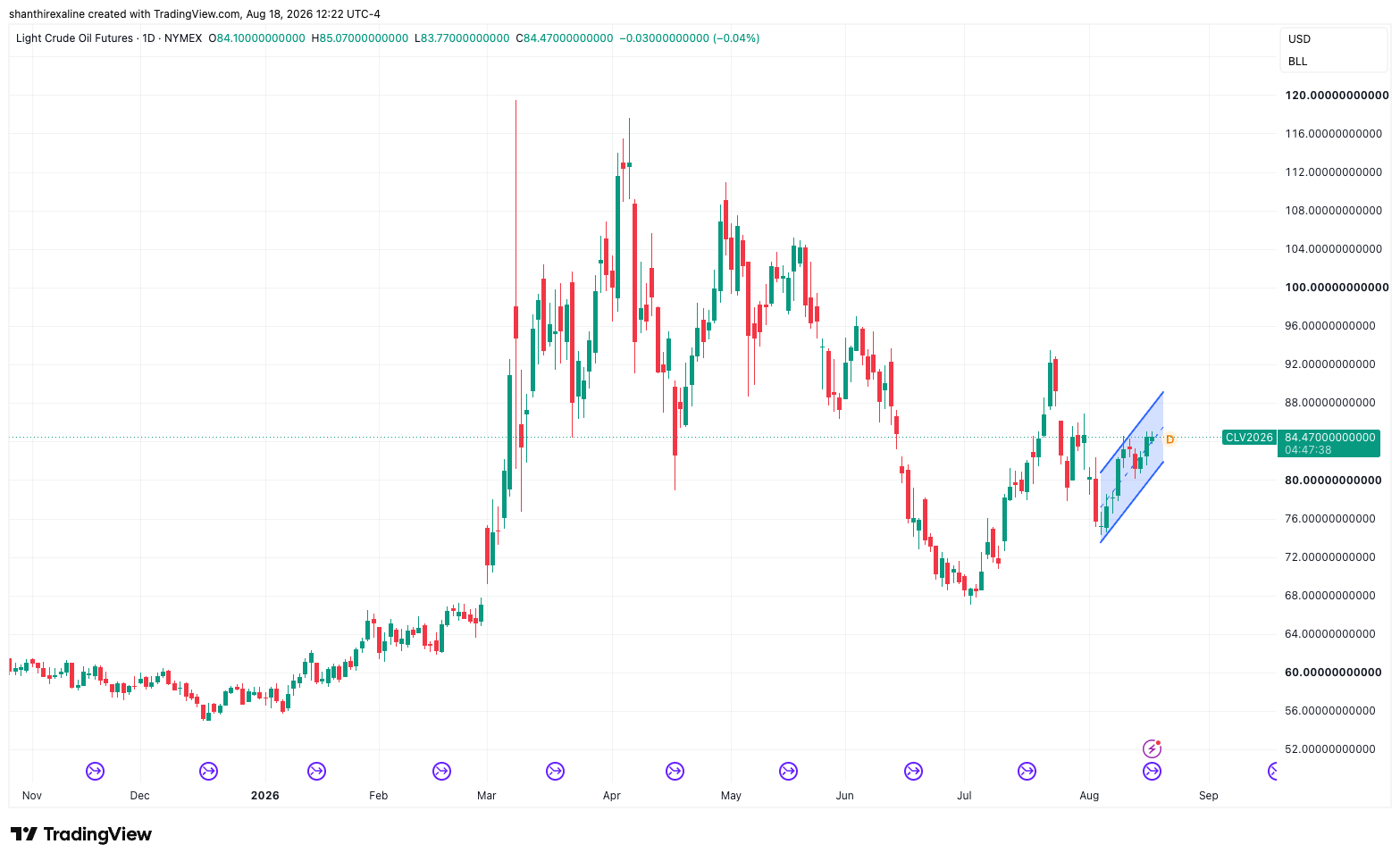
West Texas Intermediate crude oil prices topped $85-a-barrel yet again on Tuesday as the U.S.-Iran ceasefire expired and hopes for a quick agreement to reopen the Strait of Hormuz faded, putting a fresh geopolitical premium into energy markets. Brent crude breached $91 a barrel, with both benchmarks reaching their highest levels since late July.
The move matters beyond the energy market. A renewed oil shock threatens to revive inflation pressures. Higher gasoline, diesel, transportation and production costs could slow the decline in inflation, while a sustained rise in crude could make policymakers more reluctant to ease policy.
Oil Positions In Uptrending Channel
Source: TradingView
The result is a potentially difficult combination for markets: weaker growth may argue for lower rates, but higher oil prices could argue for keeping rates restrictive for longer.
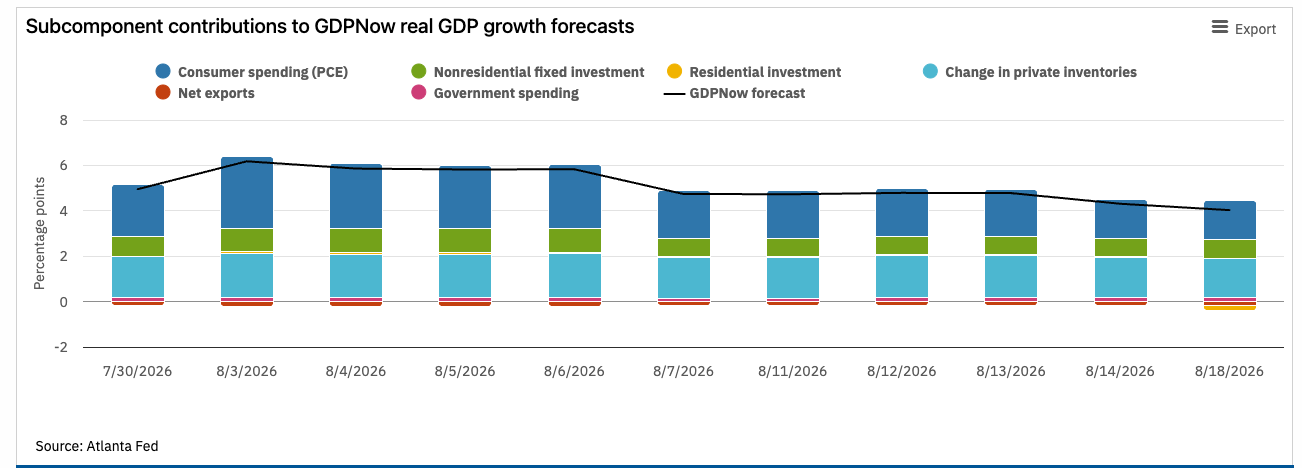
As of now, U.S. economic growth is holding up. The Atlanta Fed’s GDPNow model estimates third-quarter real GDP growth at 4.0%, well above the 1.5% advance estimate for second-quarter growth released in late July. The latest nowcast points to consumer spending and private inventory investment as key contributors to third-quarter growth, underscoring the economy’s resilience even as financial markets grapple with renewed inflation and interest-rate risks.
Source: Atlanta Fed
Hormuz Is Once Again the Market's Fault Line
The immediate catalyst is the Strait of Hormuz, through which a substantial share of global oil and refined-product flows normally pass.
Traffic through the waterway remains severely constrained, with only limited alternative shipments continuing. Merely six vessels carrying primary commodities transited the Strait of Hormuz on Monday, according to preliminary data from Kpler, according to West Asia News Agency. This is down from a 10-day average of 11 vessels per day through the strait.
Iran has indicated that it intends to keep the strait closed until the U.S. honors an interim agreement, while Washington has rejected that framework. The lack of progress has increased the probability that the disruption will last longer than initially expected.
That creates a very different risk for oil traders from a conventional demand-driven rally. The market is not simply pricing stronger consumption; it is pricing the possibility that physical barrels become harder to move at precisely the time when inventories and spare supply matter most.
The EIA has already raised its estimate of Middle East production shut-ins because of continued restrictions on Hormuz traffic. Its latest outlook assumes disruptions of roughly 600,000 barrels a day could persist through the end of 2027, although it expects most regional production to return toward pre-conflict levels in early 2027.
Fundamental Picture More Complicated Than Price Spike Suggests
There is an important counterargument to the bullish crude narrative: global oil fundamentals outside the geopolitical shock are not particularly tight.
The International Energy Agency's (IEA) August Oil Market Report points to a weaker demand backdrop, while the latest estimates from major forecasting agencies show substantial disagreement over the pace of global consumption growth. The IEA has become considerably more cautious on demand, reflecting slower economic activity and high energy costs.
At the same time, non-OPEC supply growth and production outside the immediate conflict zone provide an important buffer. The broader market therefore does not necessarily face a structural shortage of crude.
U.S. commercial crude inventories have also provided some cushion. EIA data showed commercial crude stocks at 424.4 million barrels in the week ended Aug. 7, although that was still about 2% below the five-year average.
This distinction is important: the oil market can be adequately supplied in aggregate while still experiencing a severe regional supply problem.
If Hormuz remains disrupted, the market's ability to move available barrels to where they are needed becomes the critical variable.
The SPR Cushion Is Much Thinner
That is where the U.S. Strategic Petroleum Reserve becomes particularly important.
The SPR has been drawn down dramatically during the conflict and has fallen below 300 million barrels, putting it at its lowest level since 1983, according to recent market reports.
Today's reserve was designed to provide the U.S. with a buffer against severe supply disruptions. Its authorized capacity is about 714 million barrels, and its maximum nominal drawdown capability is 4.4 million barrels a day.
The problem is that a reserve cannot provide the same psychological or physical protection when inventories are already severely depleted.
Washington could still release oil if necessary, but repeated emergency releases become less powerful when the reserve itself needs to be rebuilt. And replenishing the SPR eventually creates another source of crude demand.
That gives today's oil market an unusual asymmetry: geopolitical risk is increasing at the same time that one of the world's most important emergency buffers is unusually thin.
Why the Fed Is Suddenly Back in the Oil Story
For the Federal Reserve, the crucial question is whether the oil shock remains confined to energy prices or begins spreading into broader inflation.
A temporary spike in crude is something policymakers can potentially look through. But a prolonged disruption can affect transportation costs, utilities, petrochemicals, manufacturing and consumer prices. It can also influence inflation expectations.
That creates a difficult policy trade-off.
If the economy continues to weaken, the Fed could still have a reason to pause or lower rates. But if oil remains above $85 and inflation expectations begin rising, it becomes harder to justify such a move.
Oil and Treasury Yields Are the Key Cross-Asset Link
The market is already seeing this transmission mechanism.
Higher crude prices can lift inflation expectations, which can push Treasury yields higher. Geopolitical tensions have pushed long-end yields higher already to cycle highs, pressuring stocks.
Higher yields raise the discount rate applied to future corporate earnings, creating a particularly difficult environment for long-duration technology stocks.
That makes the oil market relevant to Nasdaq-100 futures as well as energy stocks.
A temporary move above $85 would not necessarily derail the equity rally. But if crude continues higher while the 10-year and 30-year Treasury yields also rise, the combination becomes substantially more problematic.
What Would Change the Oil Story?
For crude bears, the biggest catalyst would be evidence that the physical supply disruption is easing.
A credible U.S.-Iran agreement, renewed Hormuz traffic, restoration of shut-in production or a meaningful build in commercial inventories could quickly remove some of the geopolitical premium.
The EIA expects oil prices to eventually moderate as Hormuz traffic improves and disrupted production returns, forecasting Brent to average about $78 a barrel in the fourth quarter of 2026.
But until there is evidence of that normalization, traders are likely to continue assigning a premium to prompt crude.
The market therefore has two competing forces: softening underlying demand and expanding supply on one side, and an unusually severe geopolitical disruption with a depleted U.S. emergency reserve on the other.
For now, the latter is winning the price battle.
MarketFramework’s Top Traded Contracts tool shows an overwhelmingly bullish bias in the actively traded Micro WTI Crude Oil (MCL) contract, with 89% of traders holding long positions over the past seven days. While positioning among losing traders was relatively balanced between longs and shorts, winning traders showed much stronger conviction, with 80% maintaining long exposure. The divergence suggests that recent gains in crude have been driven primarily by traders positioned for higher prices rather than broad-based participation across both sides of the market.
The Bottom Line
The immediate risk of the latest crude surge is that an oil shock keeps rates higher for longer. For traders, the key is therefore not simply whether crude crosses another psychological level. The more important signal is whether oil, Treasury yields and inflation expectations begin moving higher together.
If they do, Tuesday's crude rally could prove to be more than a geopolitical headline. It could become a new constraint on the Fed and another headwind for rate-sensitive risk assets.


