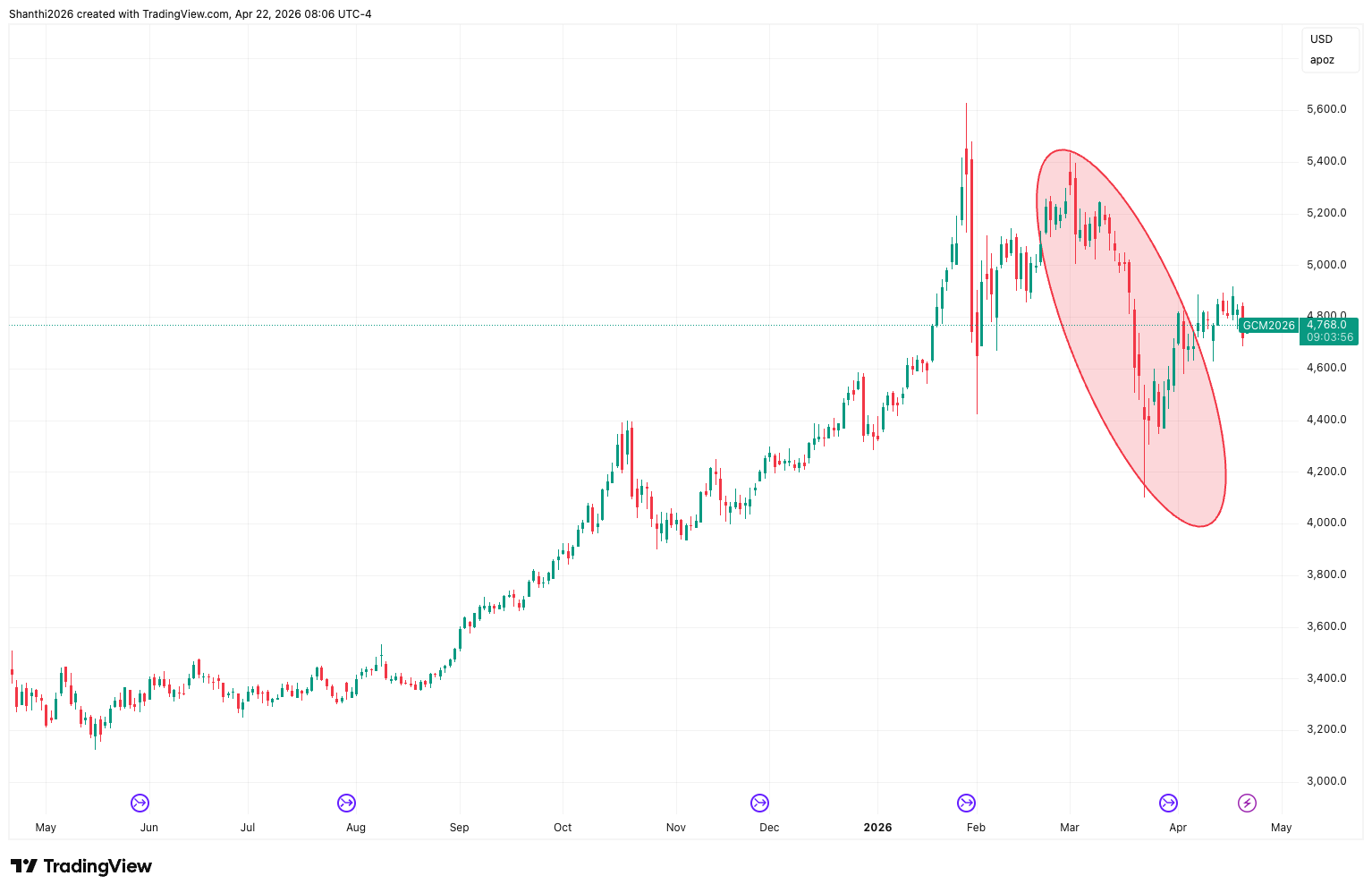
Gold had a rip-roaring year in 2025, advancing over 64% and in the process setting new highs. The upward momentum continued in the new year as the yellow metal breached the $5,000 per troy ounce (oz) mark in late January enroute to a new peak of $5,586.20.
While February saw a consolidation move, gold began to lose its luster with the onset of the U.S.-Iran war.
Gold futures (One-Year Chart)
Source: TradingView
Anomalous Behavior? Making sense of gold’s move lower amid the peak of the conflict, LPL Chief Technical Strategist Adam Turnquist said, at times, the precious metal breaks free of longstanding patterns. According to the strategist, the oil shock that resulted from the Strait of Hormuz lifted the U.S. Treasury yields, pushed out expectations for rate cuts, and strengthened the U.S. dollar. “The collision of these dynamics makes for a notable headwind in gold’s relative attractiveness, which experiences a rising opportunity cost when expectations of higher-for-longer rates increase,” he said, as he pointed out that gold does not pay interest.
Turnquist also flagged profit-taking in assets such as gold in order to cover losses in other areas of the market and meet margin calls as another reason for liquidation.
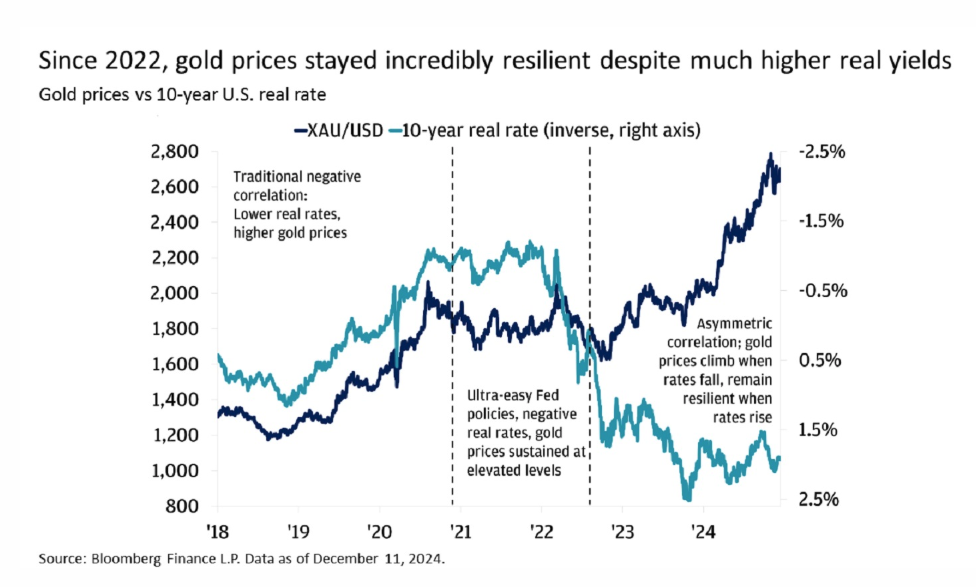
The LPL strategist further highlighted an under-the-surface driver. Gold and real bond yields (inflation-adjusted) typically move in opposite directions because gold rallies when real yields are negative or lower as investors opt for preserving capital.
JPMorgan noted that some of the biggest gold rallies occurred during 2018-2012 and 2019-2021 as real yields fell into negative territory amid global quantitative easing and zero interest-rate policies.
Gold Vs Real Yields
Source: Bloomberg via JPMorgan
This typical relationship was violated and both moved in tandem for a few years, and now gold appears to be reverting to its “theoretically and historically correct negative correlation.”
Gold’s counterintuitive move in March has been widely discussed and the key question now is whether a sustainable rebound is in the cards.
Intermittent signals of de-escalation have done some good for gold as it has rebounded from March 23 intraday low near $4,100.
Since the initial ceasefire was put in place on March 8, the precious metal has largely moved sideways. Is gold priming for a big move higher as the geopolitical noises subside and the focus shifts to underlying fundamentals and the monetary policy outlook?
Bullish Drivers: LPL’s Turnquist described gold’s pullback as a “healthy repricing,” rather than a structural reversal. The current consolidation phase may be setting the stage for renewed upside, supported by several underlying drivers. Key among them are sustained central bank accumulation, resilient physical buying across Asia and the emerging markets, and the ballooning global deficits.
A closer look at these factors can help assess whether gold can break out of its current lackluster phase.
Central Bank Buying: Gold purchases by global central banks exceeded 1,000 tons in each of the three years from 2022 to 2024, before moderating to 863.26 tons in 2025, according to World Gold Council (WGC) data.
Annual Central Bank Net Gold Purchases
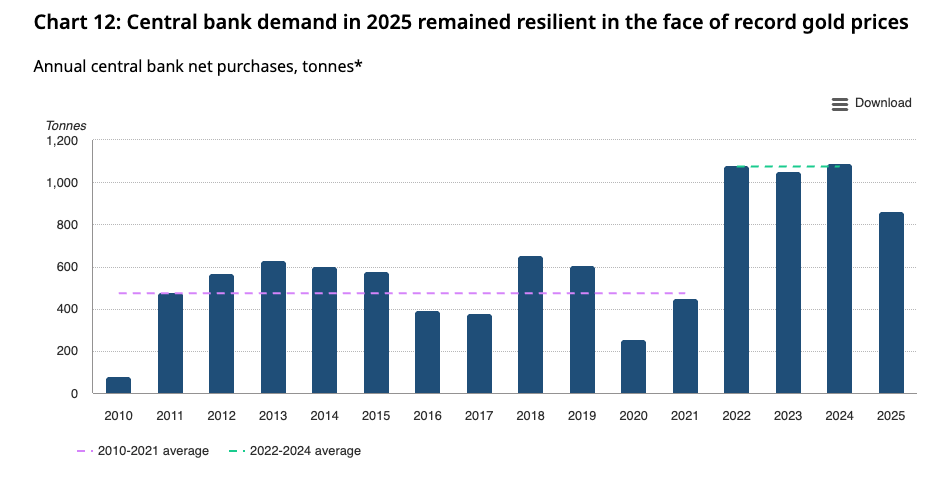
Source: WGC
After a lackluster start to 2026, gold buying picked up pace in February, with net central bank purchases at 27 tons. In a report released in January, Swiss private bank UBP said the consensus put net central bank purchase at around 800 tons in 2026.
“Central bank purchases reflect a long-term portfolio-diversification trend among reserve managers, and we anticipate that this trend still has several years to run, implying that gold will benefit from a solid underlying demand profile.”
Physical Demand and Flows: JPMorgan Head of Base and Precious Metals Strategy Gregory Shearer estimates that per-quarter demand for bars and coins at around 330 tons in 2026. Annual demand from exchange-traded funds (ETFs) and futures is projected at 275 tons, with most front-end loaded, the strategist said.
That said, March saw record outflows ($12 billion) from physically-backed gold ETFs, according to WGC. The first quarter still marked a seventh straight quarter of net inflows.
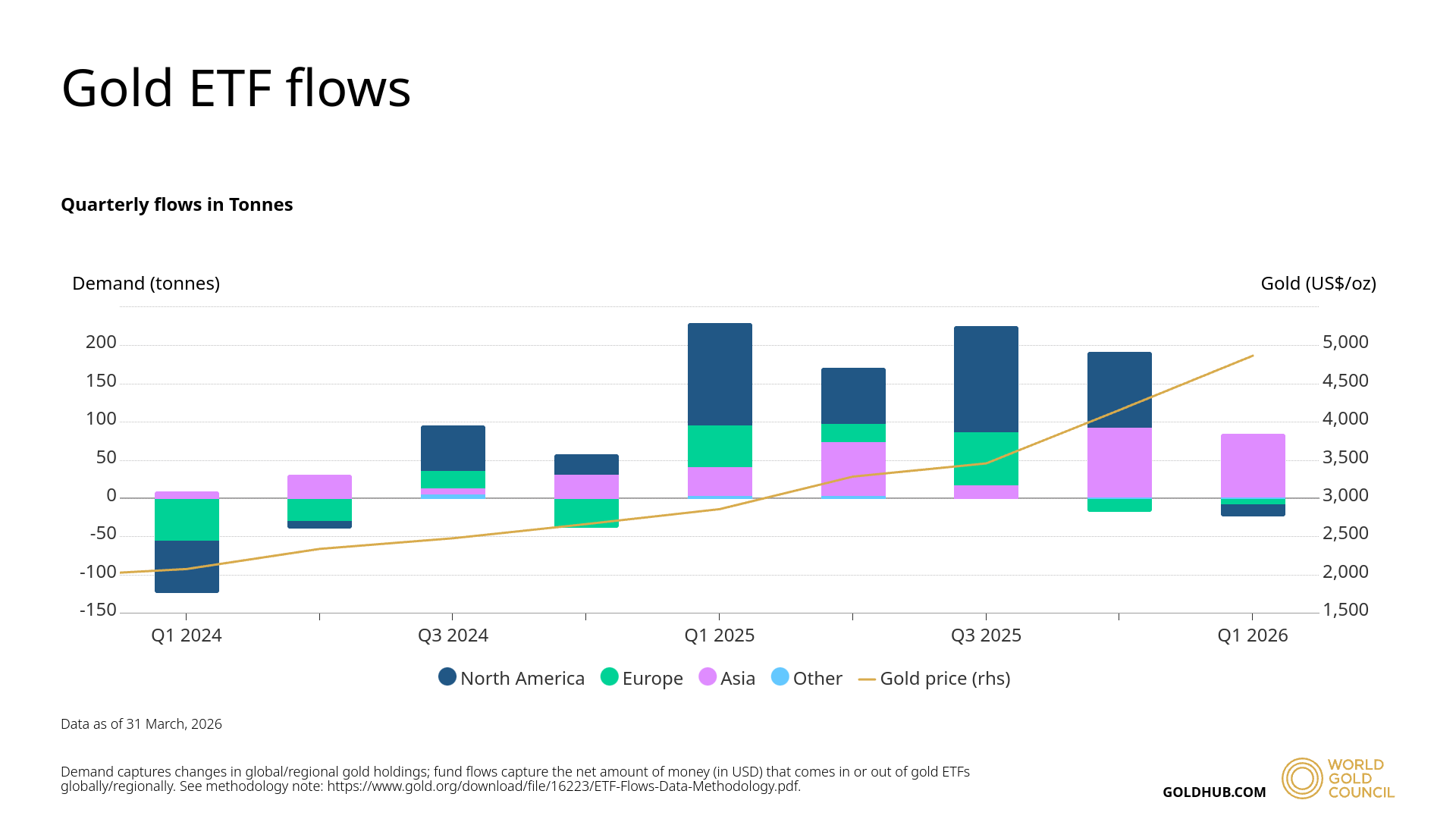
Source: WGC
The latest Commodity Futures Trading Commission (CFTC) Commitment of Traders (COT) report for the week ended April 14 showed that net long positioning in gold among managed money accounts (futures and options combined) rose by 6,704 contracts week-over-week to 99,000 contracts, marking a four-week high.
On a futures-only basis, net long positioning stood at 95,000 contracts. The increase suggests a gradual rebuilding of bullish positioning following the recent liquidation phase, although levels remain below previous peaks. This suggests some of the recent gold weakness may have been driven by positioning unwinds, rather than a deterioration in underlying fundamentals.
Net Long Futures Position Among Managed Funds
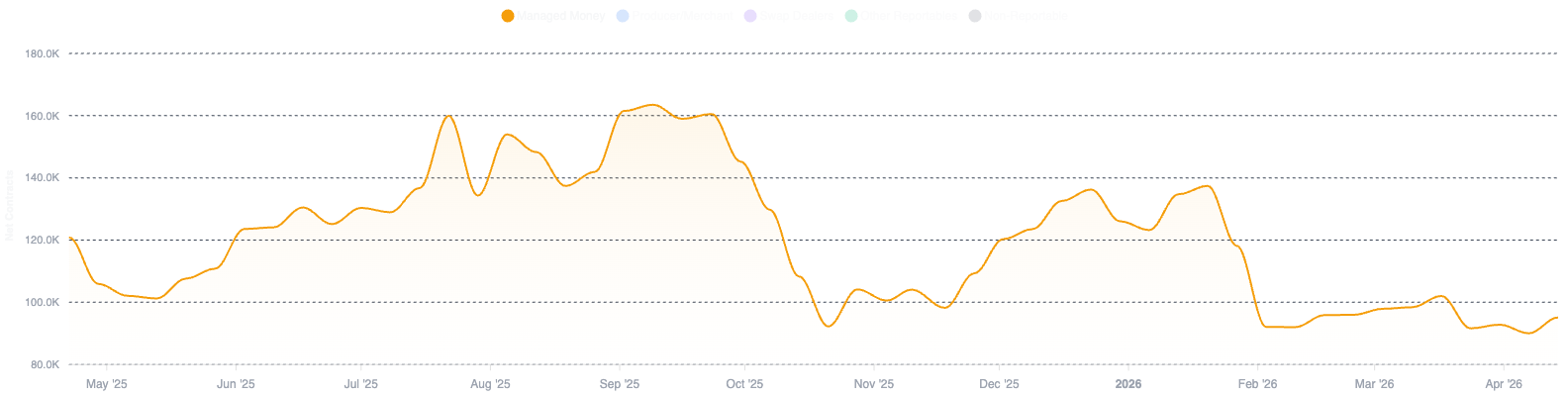
Source: Metal Charts
Fiscal Concerns: WGC Asset Allocation Strategist Jeremy De Pessemier opined that fiscal concerns have also lent support to gold. “When fiscal concerns increase – reflecting worries over US government debt sustainability or deficits – investors may seek the relative safety of gold, driving its price higher,” he said.
The already high fiscal deficit of the U.S. is expected to bloat further amid war spending. The Congressional Budget Office’s 2026-2036 Budget and Economic Outlook projects that the U.S. deficit as a percentage of GDP will rise to 5.8% in 2026, significantly higher than the average of 3.8% over the last 50 years.
In the 2027 budget released Friday, U.S. President Donald Trump has proposed a $1.5 trillion increase in defense spending, suggesting a further worsening.
Bearish Tugs: The bullish case is not a given, as there are a few downside drivers that could dent sentiment toward gold. These include:
Sticky Inflation: Although the oil shock stemming from the Iran crisis has fanned inflationary pressure, policymakers and strategists see the impact as transient. The Federal Reserve still expects inflation returning to its 2% target by 2027.
However, sticky inflation could keep real yields elevated, a deterrent for gold rally.
Persistent Dollar Strength: A stronger greenback could prove to be a headwind for gold. The dollar started 2026 on a weak note, although it has recouped its losses amid the Iran war. Strategists at ING Group note that the dollar is still very strong by historical standards.
Broad, real, trade-weighted dollar
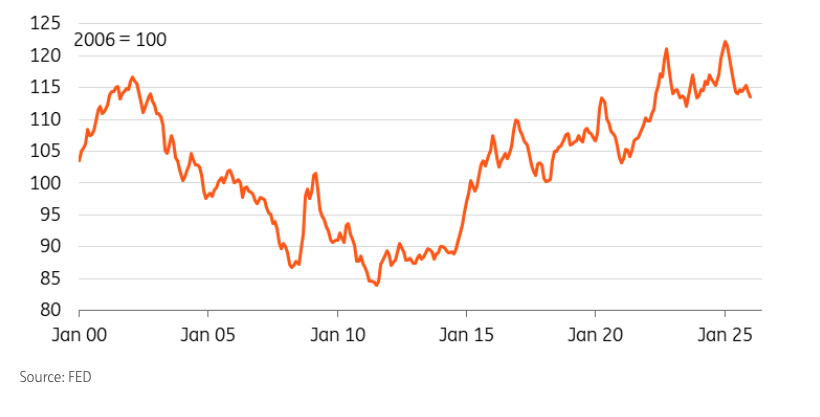
Source: Fed via ING
Based on JPMorgan’s 2026 Long-Term Capital Market Assumptions (LTCMA), the US dollar is still 7% above fair value versus EUR, and 8% versus GBP.
Slowdown in Central Bank Buying: Reduced demand from central banks could dent gold prices, reflecting basic supply-demand dynamics.
What Flips Gold Higher Near-term: The missing piece for a sustained rally is a reversal in real yields and the dollar strength, which contributed to gold’s recent weakness. Any signs of easing inflation-adjusted yields or a shift in Federal Reserve policy expectations could quickly restore gold’s upside momentum.
Gold’s recent pullback is more cyclical, driven by macro factors, rather than structural. With positioning cleaner and long-term demand drivers intact, the stage may be set for a more sustainable rally, provided real yields and the dollar begin to ease.
Read Next: US Stock Futures Rally as Trump Extends Iran Ceasefire; Oil Recovers, Gold Surges