
Gold's recent surge has been driven by exactly the kind of backdrop bulls like to see: softer U.S. economic data, a weaker dollar, and rapidly declining expectations for another Federal Reserve rate hike. Yet after climbing more than 8% this month and touching as high as $4,475, the rally is beginning to show signs of exhaustion.
The key question for traders is whether gold is merely pausing before another leg higher or entering a period of consolidation after a sharp, momentum-driven advance.
The Fed Story Has Turned Constructive
Gold's macro backdrop remains supportive. Recent retail sales, employment, and inflation data have encouraged investors to scale back expectations for additional Fed tightening. Markets now assign only about a one-in-three chance of a September rate hike, a significant decline from expectations just a few weeks ago. A softer dollar and lower Treasury yields have added further support to bullion.
This shift matters because gold tends to perform well when real yields (nominal yields adjusted for inflation) fall and investors believe interest rates are approaching a peak. The upcoming release of the July FOMC minutes could reinforce that narrative if policymakers appear less inclined to tighten policy further.
Why Technicals Are Flashing Caution
The problem for bulls is that prices may have run ahead of fundamentals in the short term.
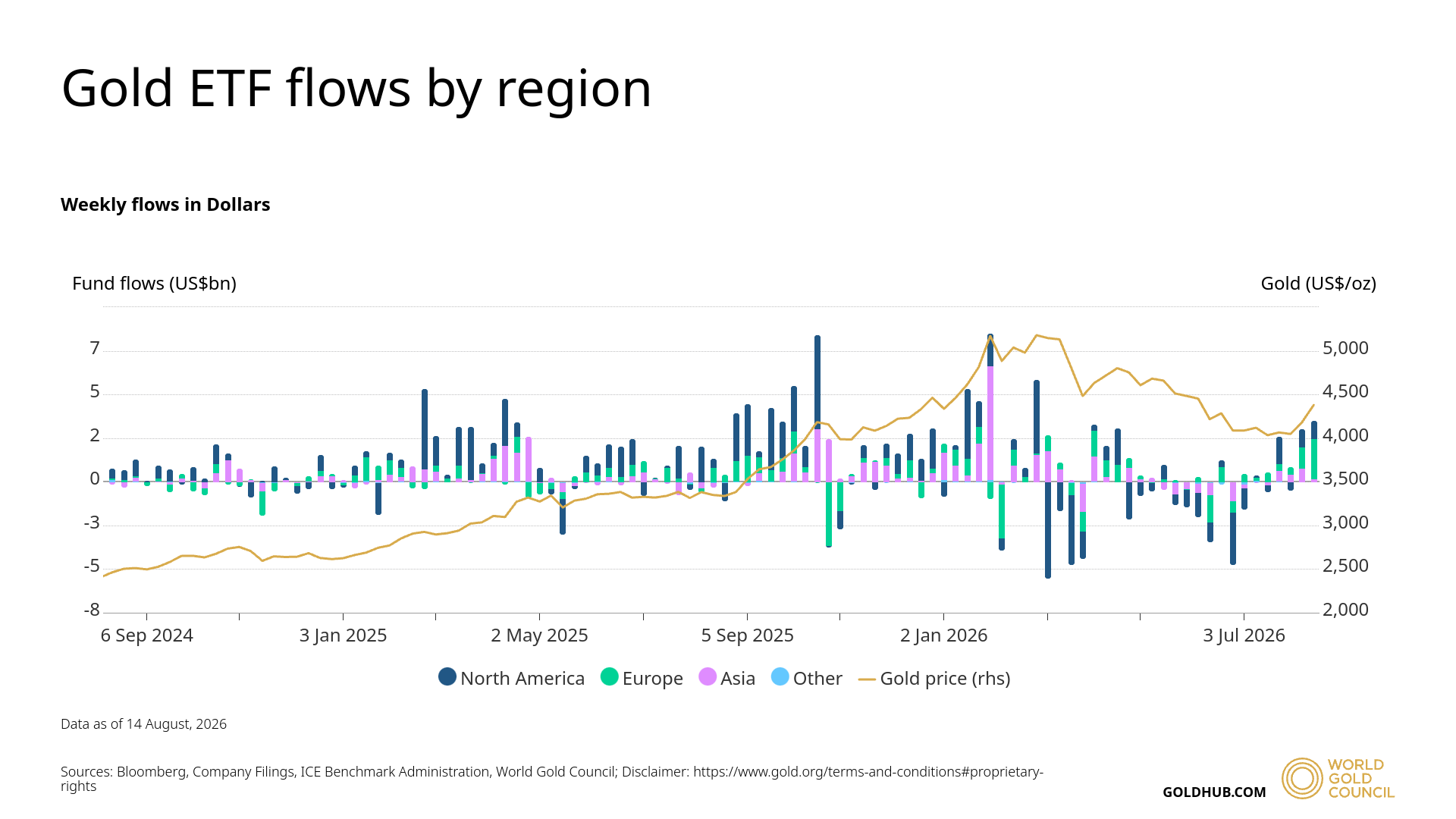
Gold has rallied sharply over the past two weeks, attracting fresh ETF inflows and momentum-driven buying. Gold-backed ETFs attracted an estimated $3.5 billion in net inflows during the week ended Aug. 14, according to World Gold Council data, extending the recovery in investor demand.
Source: World Gold Council
Such rapid advances often leave markets vulnerable to profit-taking, particularly when traders become crowded on one side of the trade.
The latest CFTC Commitments of Traders report for the week ended Aug. 11 shows that speculative interest in gold remains firmly bullish, although positioning is becoming increasingly crowded. Managed money traders, a category that includes hedge funds and commodity trading advisors, held 148,634 long contracts against just 10,972 short contracts, leaving them with a net long position of roughly 137,662 contracts. During the week, managed money added 8,825 new longs while increasing shorts by only 1,929 contracts, indicating that professional speculators continued to add bullish exposure even as gold traded near record levels. This increases the risk of near-term pullback if upcoming Fed minutes or economic data fail to provide fresh catalysts.
Separately, retail positioning in Micro Gold Futures (MGC) remained decisively bullish. MarketFramework datashowed that 75% of profitable trades were long positions, compared with 64.3% of unprofitable trades, creating a 10.7-percentage-point bullish divergence. The gap suggests that traders who have been on the right side of the market are maintaining a stronger conviction in gold's upside prospects than their less successful counterparts, reinforcing the broader bullish narrative even as technical indicators point to the risk of a near-term pullback.
Bullish Breakout Faces Its First Major Test Near $4,500
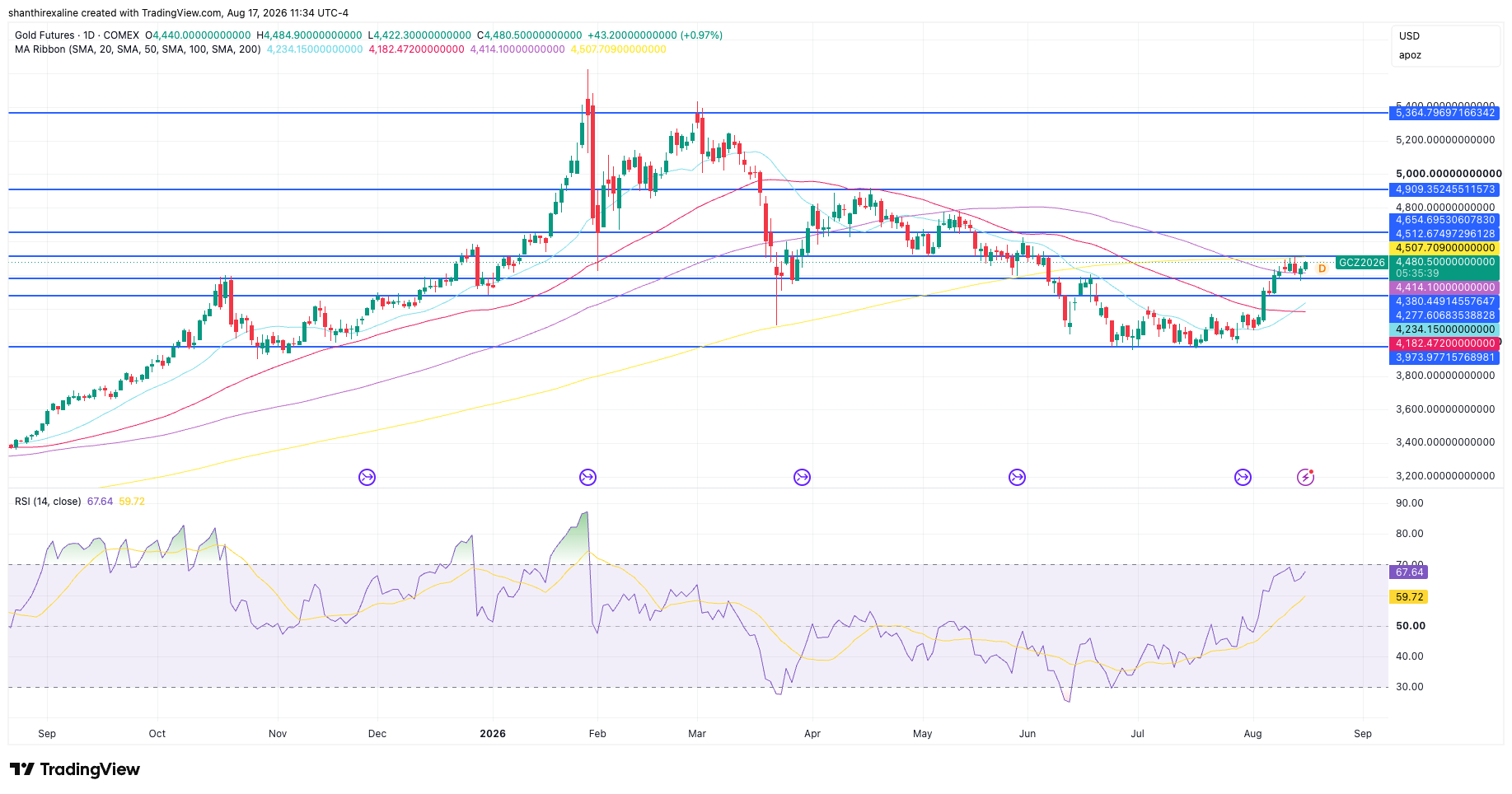
Gold futures have staged an impressive recovery from the July lows near $3,980, reclaiming several key moving averages and breaking above a descending trend structure that had capped rallies since the January peak. The contract is now trading around $4,480, above its 20-, 50-, and 100-day moving averages, while approaching a key resistance band between $4,512 and $4,565.
A decisive close above this zone would strengthen the bullish case and open the door toward $4,903, the next major resistance level on the chart. The recovery has been supported by easing Fed rate-hike expectations, a softer dollar, and renewed investor demand for gold.
Source: TradingView
However, momentum indicators suggest the rally may be getting stretched in the near term. The daily RSI has climbed to roughly 68, approaching overbought territory and nearing levels that have previously preceded periods of consolidation. While the broader trend has improved significantly, the market is now testing an area that served as support in April and resistance during the recent decline. Initial support lies near $4,381, followed by $4,234, where the rising 50-day moving average is located. As long as gold holds above these levels, the medium-term recovery remains intact.
A break above $4,565 would signal continuation toward the $4,900–$5,000 region, while failure to clear resistance could trigger profit-taking and a pullback toward the mid-$4,300s before the next directional move.
The Pullback Scenario
A modest correction would not necessarily damage the bullish outlook.
In fact, many traders would likely welcome a retreat toward support levels as an opportunity to establish or add to positions. The combination of easing rate-hike expectations, persistent geopolitical uncertainty, central-bank demand, and a weaker dollar continues to provide an underlying floor for gold prices.
Unless economic data suddenly reaccelerates or Fed officials signal renewed urgency to raise rates, the fundamental case for gold remains largely intact.
What Could Restart the Rally?
For gold to break sustainably above recent highs, investors will likely need a fresh catalyst.
The most immediate candidates are the FOMC minutes, further evidence of slowing economic activity, or signs that inflation is easing without requiring additional policy tightening. Geopolitical developments in the Middle East could also renew safe-haven demand.
Longer term, continued central-bank buying and renewed institutional inflows into gold-backed ETFs could provide the fuel needed for another push higher.
Lloyd Financial Chief Investment Officer Colin Symons said the ingredients for another move to record highs in gold remain largely in place. Softer economic data, a less hawkish Federal Reserve, a weaker dollar, and easing real yields are all supportive for the metal, although he noted that these factors are closely intertwined.
Symons added that the consumer side of the U.S. economy is showing signs of cooling even as corporate fundamentals remain relatively healthy. "The corporate side still looks good, but the consumer really drives the overall economy, and that's started to look weaker," he said. While he is not yet anticipating a recession, he noted that growth expectations have moderated considerably from the optimistic forecasts seen earlier in the year, a trend that could reinforce expectations for a less restrictive Fed and remain supportive for gold prices.
Based on what we know now, I'd definitely be a buyer on dips. I don't view this move as overly stretched, yet
Bull Case vs. Bear Case
Bull Case
- Fed rate-hike odds continue to fall.
- Treasury yields and the dollar remain under pressure.
- Central-bank buying and ETF inflows support demand.
- Geopolitical risks sustain safe-haven interest.
Bear Case
- The rally has become technically stretched after a rapid advance.
- Profit-taking could emerge near recent highs.
- Any hawkish surprise in the Fed minutes could lift yields and pressure bullion.
- Stronger economic data could revive rate-hike expectations.
Bottom Line
Gold's fundamental story remains constructive as markets increasingly believe the Fed is nearing the end of its tightening cycle. But after a powerful run fueled by falling rate-hike expectations and a weaker dollar, the metal appears vulnerable to a period of consolidation. For now, the longer-term trend remains bullish, but the next move may be lower before it is higher.


