
Second-quarter earnings season begins in earnest this week, with major banks leading the first wave of corporate results. Amid a volatile geopolitical and macroeconomic environment, investors are increasingly looking to earnings for direction, hoping they can provide a steadier anchor for markets grappling with persistent uncertainty. Artificial intelligence (AI)-driven trades have been a key pillar of the market’s advance this year, but rising concerns over stretched valuations and the risk of a bubble have recently fueled sharp swings in sentiment, contributing to heightened market volatility.
Nasdaq Futures Slide as Middle East Tensions Escalate
Reflecting the prevailing risk aversion, E-mini Nasdaq 100 futures (NQ) traded sharply lower (down more than 1%) early Monday as tensions in the Middle East escalated anew. However, retail positioning shows neutral to moderately long sentiment among traders, according to MarketFramework's Trade Validator tool.
After the U.S. carried out fresh strikes on Iranian military and coastal targets over the weekend, Tehran said it had retaliated by targeting U.S.-linked facilities in Bahrain, Kuwait, Jordan, and Oman, while asserting control over the Strait of Hormuz and threatening shipping through the critical waterway.
The flare-up triggered a broad risk-off move across global markets. South Korea’s technology-heavy Kospi Index plunged nearly 9%, prompting the activation of market-wide circuit breakers.
Kospi's June Swoon Has More Legs
Source: TradingView
The sharp decline underscores how quickly sentiment has deteriorated, with investors reassessing risk amid rising geopolitical uncertainty.
Dow Propped Up by Energy
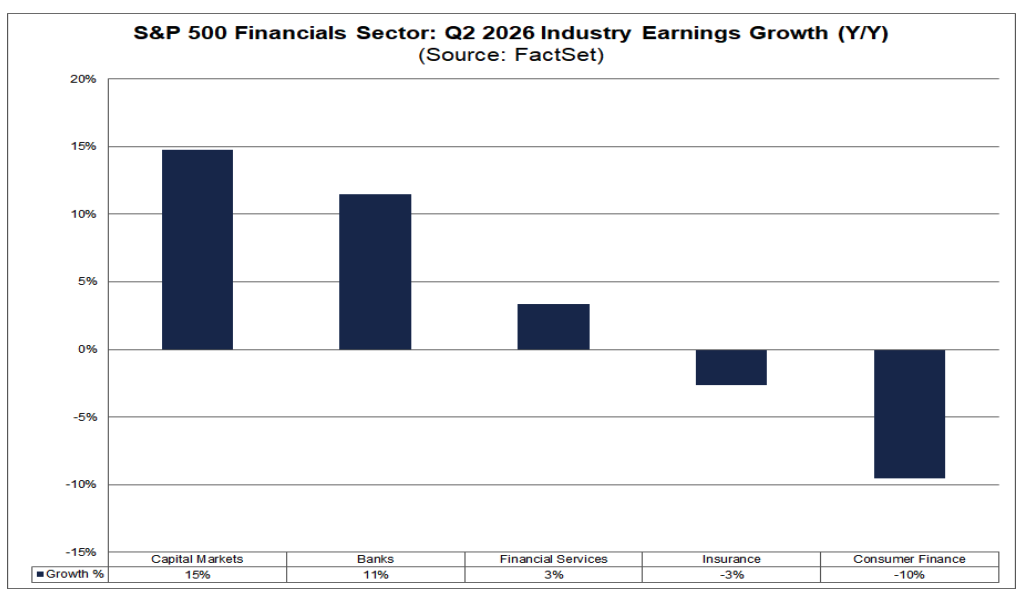
Amid these unsettling developments, the Mini Dow Jones Industrial futures (YM) contract has held its own , rising 0.23%, underlining the diverging trader sentiment toward the two contracts tied to the major stock market gauges. The resilience in Dow futures comes in part from the strength in energy stocks due to oil’s rally. But financial stocks were lower in early trading, with investors positioning ahead of a heavy bank earnings slate Tuesday: Bank of America, Citigroup, JPMorgan Chase, Goldman Sachs and Wells Fargo all report on Tuesday, followed by Bank of New York Mellon, Citi and BlackRock on Wednesday.
What Analysts Are Watching in Bank Earnings
Analysts will be watching bank earnings for early signals on credit quality, net interest income, and trading revenue, particularly given the volatility that has whipsawed markets in recent sessions. Loan growth commentary and any updates on reserve building for potential credit losses will also be in focus, as investors try to gauge how resilient the consumer and corporate borrower remain amid elevated yields and energy-driven inflation risk.
Morgan Stanley U.S. Equity Strategist Michael Wilson has factored in strong loan demand, led by healthy Commercial & Industrial (C&I) and middle market. “However, funding that growth is increasing via deposit costs, with forward-priced Fed hikes and branch expansion expected to add further pressure in 2H26 and 2027, prompting modest EPS estimate reductions.
Source: FactSet
CPI and Fed Testimony Add to the Week's Catalysts
The earnings wavelands at a delicate moment for markets more broadly. Tuesday's Consumer Price Index (CPI) print and Federal Reserve Chair Kevin Warsh's testimony to Congress are set to shape near-term rate expectations, adding another layer of catalysts on top of an already-packed macro calendar. A hotter-than-expected inflation reading could complicate the picture for banks even as earnings come in strong, given the read-through to future rate policy and net interest margins.
Wall Street's Earnings Growth Estimates
Strategists and analysts brace for a strong earnings season ahead. FactSet estimates second-quarter S&P 500 year-over-year earnings growth at 23.6%, marking the second straight quarter of 20%+ growth. Ed Yardeni, however, sounded a note of caution: if the lofty earnings expectations aren’t met, the market could swoon as it did in June. The market analyst, however, expects dip buyers to step in and limit the downside. He expects the S&P 500 to end 2026 at 8,250.
Morgan Stanley estimates second-quarter earnings growth of 19% and revenue growth of 2%. The firm said the bar is slightly higher than it has been typically, given second-quarter earnings estimates have been revised higher by 2% into the quarter
Three Paths for the Week Ahead
With bank earnings, CPI, and Fed testimony all converging on a single week against the backdrop of an unresolved Gulf conflict, traders are weighing three broad scenarios for how the NQ-YM divergence resolves.
Key Catalysts and Potential Market Outcome
| Triggers | Dow-Nasdaq Reaction | |
|---|---|---|
| Bull Case | Banks mostly beat; inflation cools; Gulf tensions stabilize and oil comes off recent high | Gap narrows; tech/AI names catch a bid as yields ease, financials extend gains |
| Base Case | Mixed earnings; in-line CPI; Warsh non-committal at Congressional testimony, no fresh escalation; oil holds in recent range | Gap persists: stock-by-stock rotation between financials and tech |
| Bear Case | Net interest margin pressure flagged by banks; hot inflation; deeper Gulf escalation; oil spikes further | Gap widens; AI/tech hit harder than value-oriented financials |
For traders positioning around NQ and YM futures this week, the divergence captures a broader rotation theme: capital moving out of richly valued AI and semiconductor names and into financials seen as relatively insulated from the chip-sector selloff, at least until Tuesday's results put that thesis to the test.


