
The latest futures action is revealing an important divergence beneath the surface of the U.S. equity rally. While Nasdaq-100 futures jumped roughly 1.10% Thursday afternoon in New York after NVIDIA delivered another blockbuster earnings report, the Dow Jones Industrial Average futures were up about 0.28% and Russell 2000 futures were also modestly higher
Rates Weigh on YM and RTY, While AI Fuels NQ
For YM traders, the relative underperformance is partly a composition story. Nvidia's earnings are providing a powerful lift to technology and artificial intelligence (AI)-related stocks, but that benefit is less evenly distributed across the 30-stock Dow. The Nasdaq is getting a direct boost from Nvidia, Micron, Marvell, Salesforce and other AI-linked names, whereas the Dow's exposure is more concentrated in traditional industrial, financial, healthcare and consumer companies. That leaves YM less sensitive to the earnings-driven AI surge and more exposed to the macro forces that have been holding the broader market back.
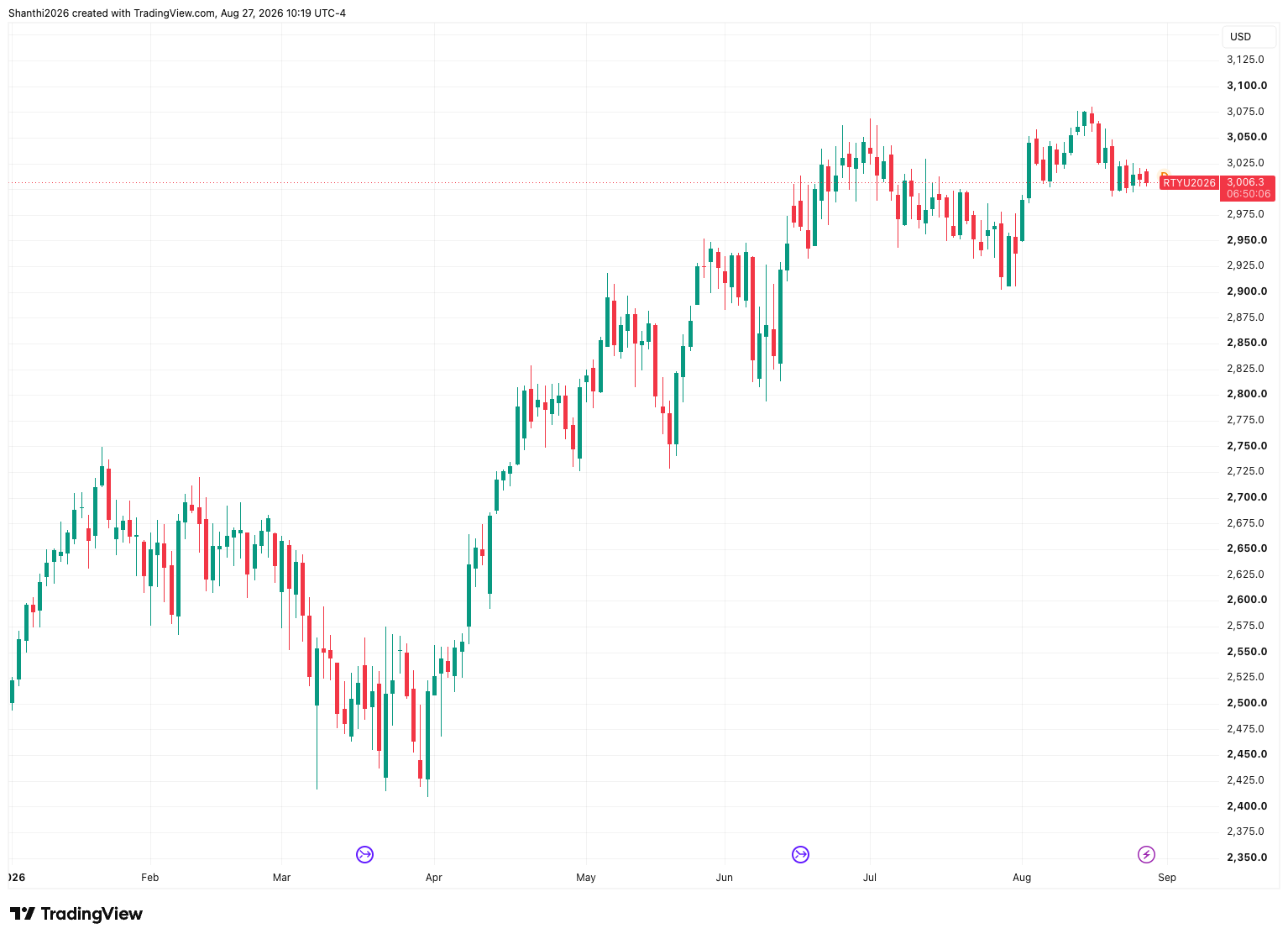
RTY faces an even tougher setup. Small caps are particularly sensitive to borrowing costs because many Russell 2000 companies have weaker balance sheets, less pricing power and greater exposure to floating-rate or refinancing costs. The recent rise in Treasury yields has therefore become a headwind.
Source: TradingView
The 10-year yield remains around 4.66%, while markets continue to debate how restrictive monetary policy needs to remain as inflation stays elevated. The Russell 2000's recent rally stalled after reaching a record in mid-August, with rising long-term yields identified as a key reason for the loss of momentum.
LPL’s Jeff Buchbinder argues that rising Treasury yields are becoming a more meaningful headwind for stocks, particularly as the 10-year yield moves above roughly 4.30%. Historically, rising yields are not necessarily bearish for equities when they reflect stronger economic growth. But once yields rise because of inflation concerns, tighter monetary-policy expectations and higher borrowing costs, they can begin to pressure equity valuations and risk appetite.
The important threshold is 4.30% on the 10-year. LPL’s analysis shows that when yields sustain levels above this threshold, the weekly correlation between yields and the S&P 500 tends to turn negative. With the 10-year around 4.69% when the report was published, LPL says stocks are currently in that negative-correlation regime. The effect is particularly important for small caps, where higher financing and refinancing costs can have a larger impact. LPL, however, expects yields to ease as uncertainty around Middle East oil flows and production improves, with the 10-year forecast to finish 2026 around 4.00%-4.50%.
The key divergence: AI enthusiasm vs. rate sensitivity
This creates an interesting split for futures traders. NQ is trading the earnings and AI-growth story; RTY is trading the cost-of-capital and domestic-economy story; YM sits somewhere in between. That explains why a strong Nvidia report does not automatically translate into equally strong buying across all three contracts.
The divergence is particularly notable because RTY has been one of 2026's strongest performers. The underlying Russell 2000 Index is still up about 21.1% year to date, versus roughly 12.4% for the Nasdaq Composite, 12.1% for the S&P 500 and 11.2% for the Dow. In other words, the current weakness does not necessarily mean the small-cap bull trend has failed; it may instead indicate that traders are taking profits after an unusually strong run while waiting for a clearer signal on rates.
For YM and RTY, the next catalyst may therefore be less about Nvidia itself and more about Treasury yields and Kevin Warsh's Jackson Hole message. A dovish signal that pushes yields lower could revive RTY and broaden the equity rally. Conversely, if yields remain elevated or Warsh sounds hawkish, the current divergence could deepen, with NQ continuing to attract capital while YM and especially RTY struggle to participate.
Trading takeaway
The market is still bullish, but the leadership is becoming narrower. NQ strength alongside flat YM and RTY is a warning that the rally is being driven increasingly by technology and AI rather than broad risk appetite. For YM, watch whether it can reclaim leadership as cyclicals strengthen; for RTY, the more important confirmation remains a sustained decline in Treasury yields.
The key setup
RTY is the cleaner rate trade. If Warsh succeeds in pushing the 10-year yield lower, small caps should have more room to recover because their earnings and valuations are more sensitive to financing costs. Conversely, a hawkish Warsh message that pushes yields higher would likely amplify RTY's underperformance.
YM is less rate-sensitive than RTY but still lacks NQ's direct AI earnings catalyst. That means a dovish speech could help YM through broader equity participation, while a hawkish message could expose its more cyclical and economically sensitive components.
The biggest signal to watch is therefore not simply whether YM or RTY rises after Warsh speaks, but whether they outperform NQ as Treasury yields move. A falling 10-year + rising RTY/YM would suggest the rally is broadening. A rising 10-year + NQ outperforming while RTY/YM lag would indicate that the market remains narrowly concentrated in technology. Current Treasury-market anxiety makes this yield-equity relationship especially important.
YM has bullish positioning going into Jackson Hole, according to MarketFramework’s Top Traded Contract tool. But that optimism could become a liability if Warsh pushes yields higher.


