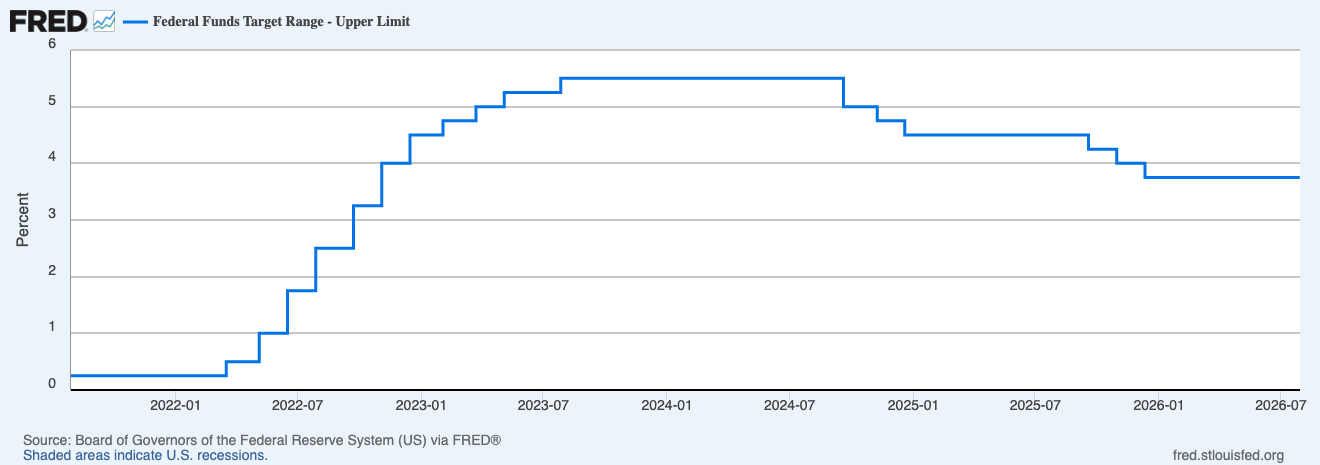
Heading into the Federal Reserve's July decision, traders had one scenario circled as the dollar-bullish outcome: a split committee, with a meaningful bloc of hawks publicly breaking ranks to push for tighter policy. That's almost exactly what happened. The Federal Open Market Committee held its target range at 3.50%–3.75% on a 9-3 vote, with three voting members, namely Boston Fed’s Beth Hammack, Dallas Fed’s Lorie Logan, and Minneapolis Fed’s Neel Kashkari, dissenting in favor of an immediate quarter-point hike, the first dissents of the current chairmanship. By the textbook, that should have sent the dollar higher.
Source: St. Louis Fed
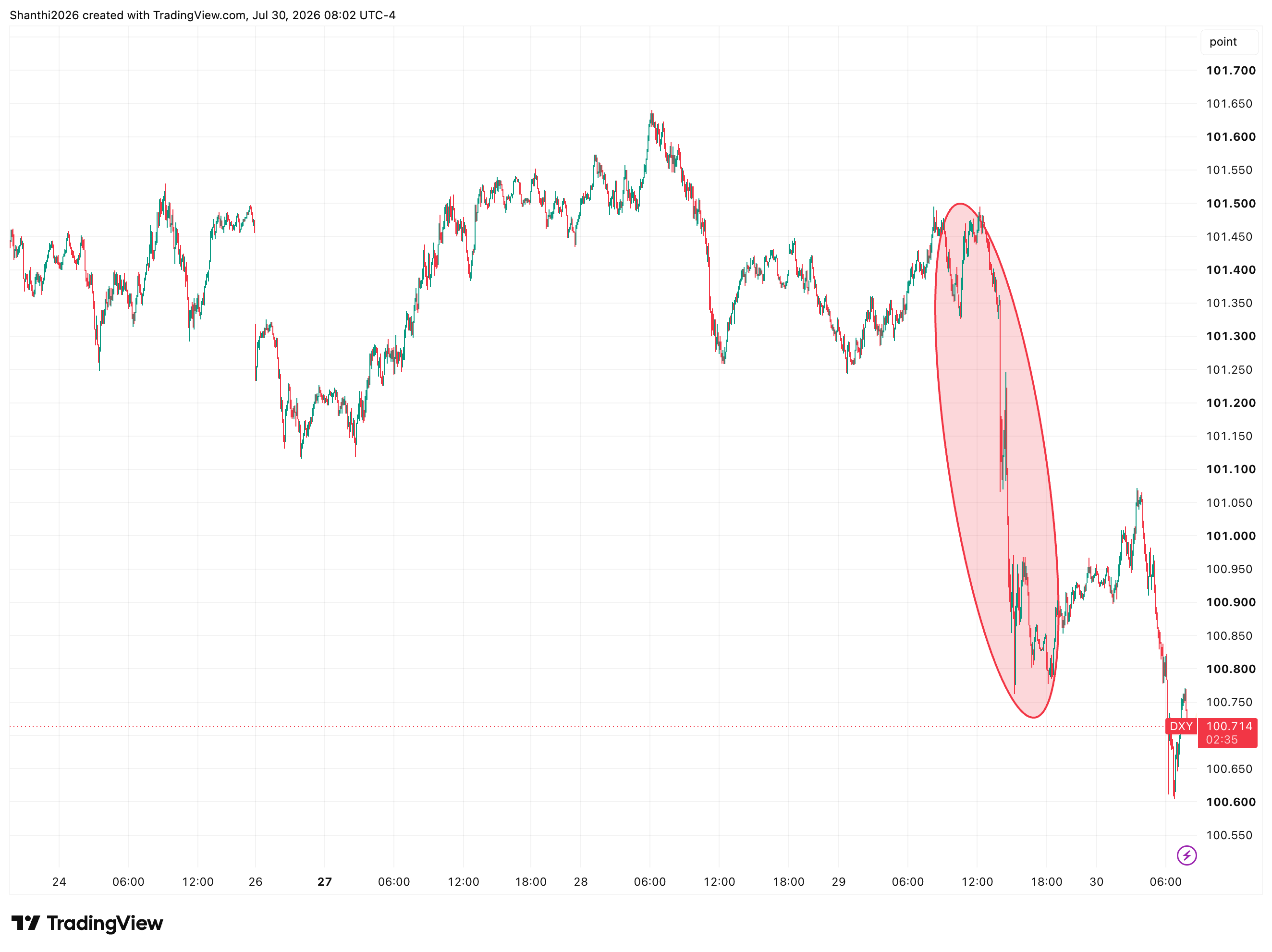
It didn't. DXY lost the 101.00 handle within an hour of the announcement, sliding from a session high just short of 101.50 down to around 100.90. The broader decline ran to roughly 0.5%, as traders concluded that the hold itself cast doubt on whether enough policymakers would ultimately line up behind a hike in September.
DXY Rally Fades Post-Fed
Source: TradingView
Tone Beat Vote Count
The disconnect comes down to what the Fed actually communicated versus how it voted. Markets read the overall message as slightly dovish. The idea that current policy is already "sufficiently restrictive" carried more weight than the dissent itself, and that framing was enough to weaken the Dollar Index. Compounding the ambiguity, this particular meeting came without a Summary of Economic Projections (SEP) or dot plot. So, the dissenting votes had no forward-looking framework to anchor them; nothing to confirm that three hawkish votes today meant a hawkish committee in September.
Crowded positioning made the drop sharper
Part of the story is technical. The dollar had already rallied into the meeting on expectations of a hawkish surprise, leaving long-dollar positioning relatively crowded. So, even a result that matched expectations on paper was enough to trigger profit-taking once the more aggressive outcome failed to materialize.
Why September is the real battleground
The dissent count looks hawkish in isolation, but the committee's composition tells a more complicated story. Nine of eighteen FOMC participants penciled in a 2026 rate hike in June's dot plot but only twelve of those eighteen currently hold a vote, meaning the hawkish camp's actual influence on the next decision is narrower than the headline dissent count suggests. September's meeting restores the dot plot, which will be the first real mechanism to confirm, or undercut the case the three dissenters tried to make this week.
Commenting on the rate move and implicit guidance, Northlight Asset Management Chief Investment Officer Chris Zaccarelli said he saw the probability of the Fed remaining on hold for the rest of the year.
If the upcoming data shows that inflation is moderating – and this is likely given the high values we saw last year, which will be easier to meet or beat this year (i.e.) the year-over-year comparisons become easier) – then we could see a Fed on hold for this entire year (despite 2 rate hikes which are currently priced in) and that would be bullish for the stock market into yearend.
Where it stands now.
The dollar has only partially clawed back its post-Fed losses, trading near 100.76 as of Thursday, with GDP, core personal consumption expenditure (PCE) inflation, and jobless claims data on deck to shape the next move. Until one of those catalysts breaks the standoff, DXY remains stuck between a hawkish vote and a dovish tone, and for now, the market is trusting the tone.