Silver futures are hovering near the $76/oz on Tuesday after coming within a whisker of the 200-day MA in early European trade.
The month of June looks set to follow a familiar path for silver, caught between safe-haven demand and the interest rate anxiety that has defined the white metal's trading environment throughout the US-Iran conflict era.
Silver's Peculiar Position in This Conflict
Silver’s reaction to the war between the U.S. and Iran has been incredibly complex. Unlike gold, which is seen purely as a safe haven during crises, silver is both a precious metal and an industrial material. This dual identity makes it highly sensitive to the wider economic effects of the war.
Since the conflict began, silver and oil prices have moved in opposite directions. Rising oil prices have driven up global inflation, forcing investors to abandon hopes that the Federal Reserve will lower interest rates anytime soon.
This highlights the main challenge for silver in 2026: even though geopolitical chaos should theoretically boost its price, the conflict-driven inflation is actually hurting it. This is because high interest rates make non-yielding assets like silver less attractive to hold.
The overall market environment remains incredibly harsh. After skyrocketing past the historic $100 mark earlier in 2026, silver suffered sharp drops. It now remains highly sensitive to updates on the Middle East conflict, Federal Reserve policies, and global manufacturing health.
Silver’s current price of around $76 is a steep drop from its two-month high of $89.40 in mid-May, showing just how much value silver lost when recent peace talks failed.
What the CoT Data Is Telling You
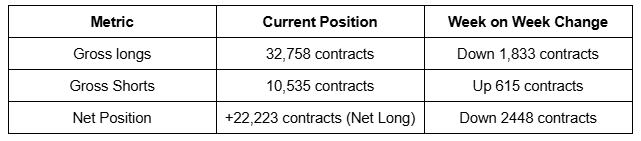
The CFTC Commitments of Traders report for the week ended May 26 released on May 29, adds important context to Tuesday's price action, and the picture it paints is one of a market quietly losing conviction.
CoT Data (Large Speculators)
Created by Zain Vawda using data sourced from CFTC
The 2,448 contract drop in the net-long position was primarily driven by large speculators trimming their longs (down 1,833) rather than aggressively shorting the market (shorts only up by 615).
This indicates that managed funds and hedge funds are choosing to take profits or step to the sidelines during price peaks rather than trying to call a top and trade against the dominant trend.
Commercial traders (producers and swap dealers) remain heavily net short (-42,092 contracts). This is normal behavior for the "smart money" hedgers who automatically add short positions to lock in prices as the market rises. However, because speculative longs aren't at an over-leveraged extreme, the commercial short position isn't acting as a heavy anchor just yet.
Overall, the current COT profile is actually structurally healthy for intermediate bulls. Because large speculators aren't excessively "over-long," the market is not dangerously crowded.
Furthermore, speculators are locking in some gains, but because they aren't aggressively adding short contracts, the broader bullish structure remains intact. Watch for gross longs to start expanding again, if speculators re-engage and push net-longs past the 26,000 level, it could act as the fuel for silver's next major leg higher.
Silver Near-Term Outlook: NFP, the Fed, and the Geopolitical Wild Card
The week ahead is dominated by one release: Friday's US Nonfarm Payrolls for May. The ISM Services Index on June 3 may also stoke some volatility.
The rate market is the gatekeeper for silver right now. Any NFP print that reinforces the case for a Fed hike before year-end, which markets are already assigning meaningful probability to, would likely drag silver prices lower. Conversely, a soft jobs number would provide the dollar relief that silver needs to mount a more credible push higher once more.
Silver Futures (SI1!) Four-Hour Chart, June 2, 2026
Source: TradingView
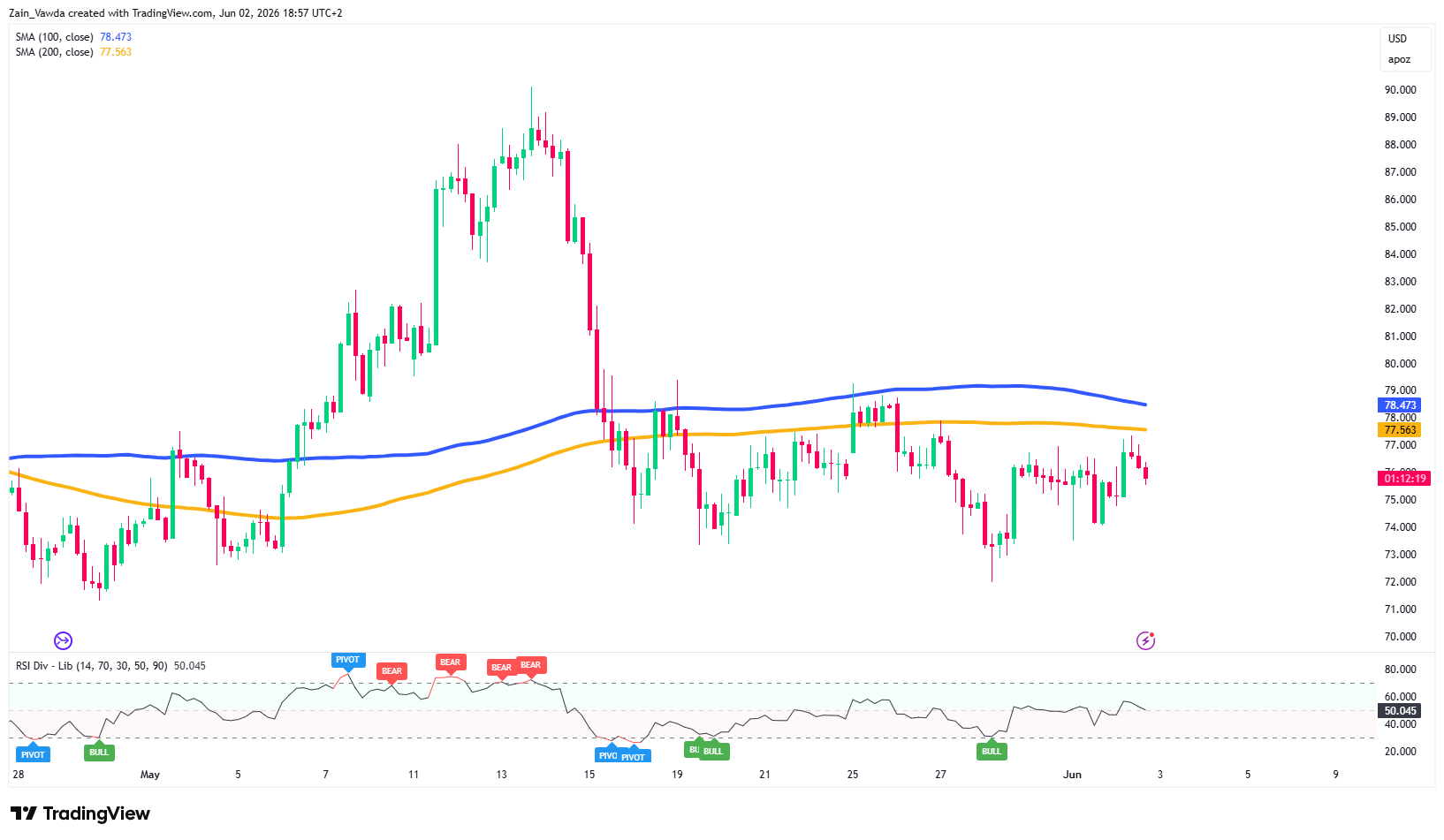
The H4 silver futures chart exhibits a bearish-to-neutral structure as the asset consolidates following its mid-May selloff.
Price action is currently pinned around $76, trading strictly beneath both its 100-day Moving Average (SMA) at $78.47 and its 200-day SMA at $77.56, which now serve as formidable overhead resistance. While a series of higher lows since late May hints at minor bullish accumulation, the recovery lacks momentum.
This is confirmed by the RSI flattening directly at the 50.04 neutral line, indicating a temporary equilibrium before the next major directional breakout attempt.
Lastly, the geopolitical dimension remains alive and, frankly, unpredictable. If Iran and the U.S. see a full ceasefire collapse and a return to Hormuz closure, the inflationary feedback loop reignites and silver faces another sustained leg lower regardless of what the jobs data says.
If Trump's MOU materialises, oil falls back below $85, and the dollar softens, silver has the ingredients to recover meaningfully but the COT data shows the speculative community needs to see evidence before it rebuilds longs.


