
The Nasdaq-100, long viewed as Wall Street's premier technology benchmark, is already heavily tilted toward tech giants. That tilt may become even steeper as new generation artificial intelligence (AI)-focused companies pursue initial public offerings (IPOs), potentially deepening the index's exposure to a single transformative theme.
Concerns about concentration risk have moved to the forefront following Anthropic's confidential filing for an initial public offering. The company, best known for its Claude large-language model, confirmed the filing in a statement on Monday.
Anthropic is controlled by founder siblings Dario and Daniela Amodei, both former OpenAI researchers. E-commerce giant Amazon and Google, alongside venture capital firms and institutional investors, hold minority stakes in the company.
While Anthropic did not disclose the size of the proposed offering, its IPO valuation could exceed $1 trillion. The company was last valued at $965 billion on a post-money basis following its Series H funding round, in which it raised $65 billion.
Floodgates Opening for Tech IPOs
Meanwhile, rival OpenAI remains in the wings. The company raised $122 billion in a funding round completed in March, giving it a post-money valuation of $852 billion. Should OpenAI eventually pursue a public listing, investors could face the prospect of two AI giants entering public markets with valuations rivaling those of some of the world's largest listed technology companies.
Elon Musk-owned SpaceX, which is the parent company of his AI venture xAI, is also set to go public as soon as this month.
Wedbush analyst Daniel Ives said Anthropic’s IPO filing represents an “opening of the floodgates for the IPO market, which has been relatively dormant for a few years, with these three major conglomerates set to go public later this year, but this has turned into a race to reach public markets over the coming months.”
Before delving into how the AI heaviness will impact the Nasdaq 100 Index, here’s a look at how its current composition is. Sector-wise breakdown shows technology heavily weighted at 67.52%, followed by consumer discretionary (17.19%).
Sector Breakdown of Nasdaq 100
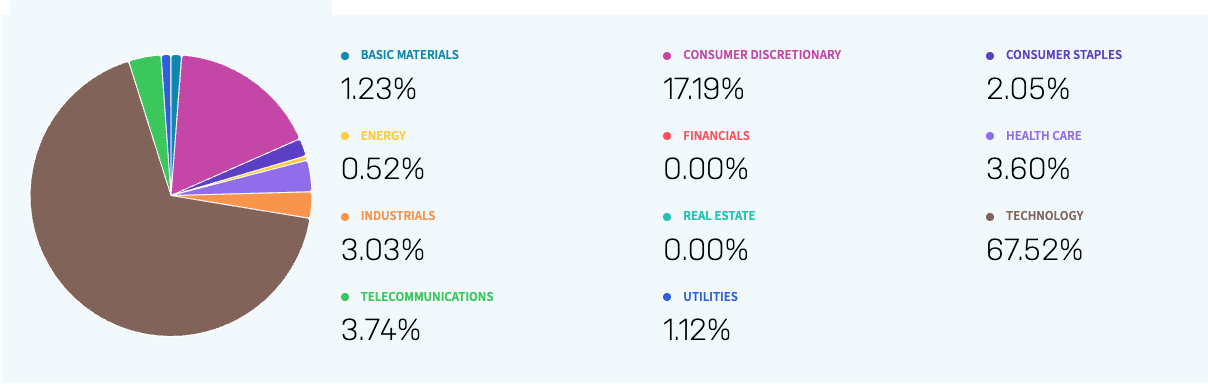
Source: Nasdaq
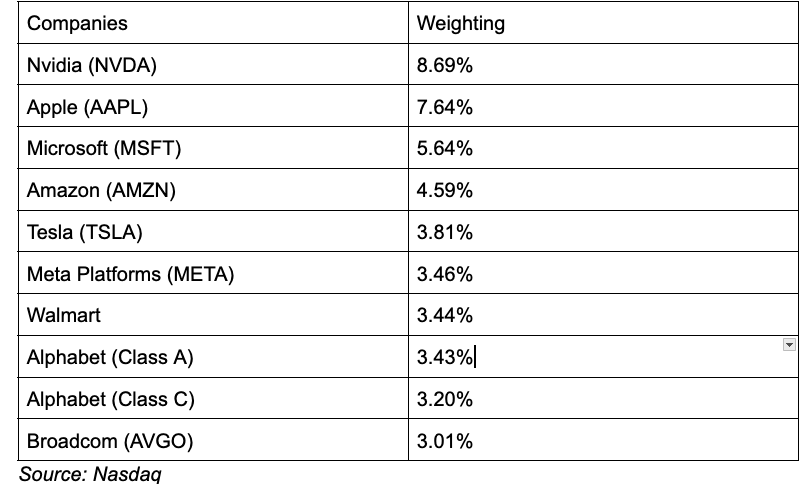
AI-levered high-profile names accounted for nine of the top 10 names, accounting for more than 40% of the index as of March 31 in terms of weightings.
Handful of Giants Command the Nasdaq-100 (data as of March 31, 2026)
Mega-Cap Dominance: Strength and Vulnerability
The heavy concentration in these names has proven to be a double-edged sword. AI-driven optimism inflated their valuations by billions, propelling the Nasdaq 100 to multiple record highs over the past two years. Nine out of the top 10 companies by valuation are part of the Nasdaq 100 Index and all of these have market capitalization in excess of $1 trillion.
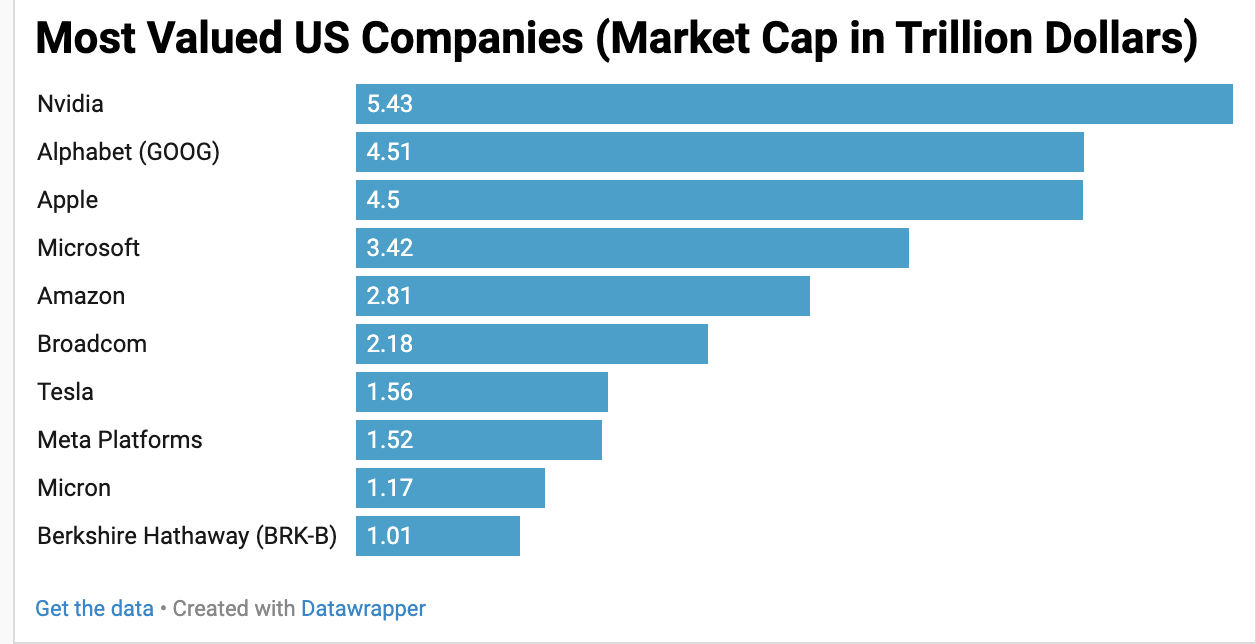
Chart by Shanthi Rexaline via Datawrapper
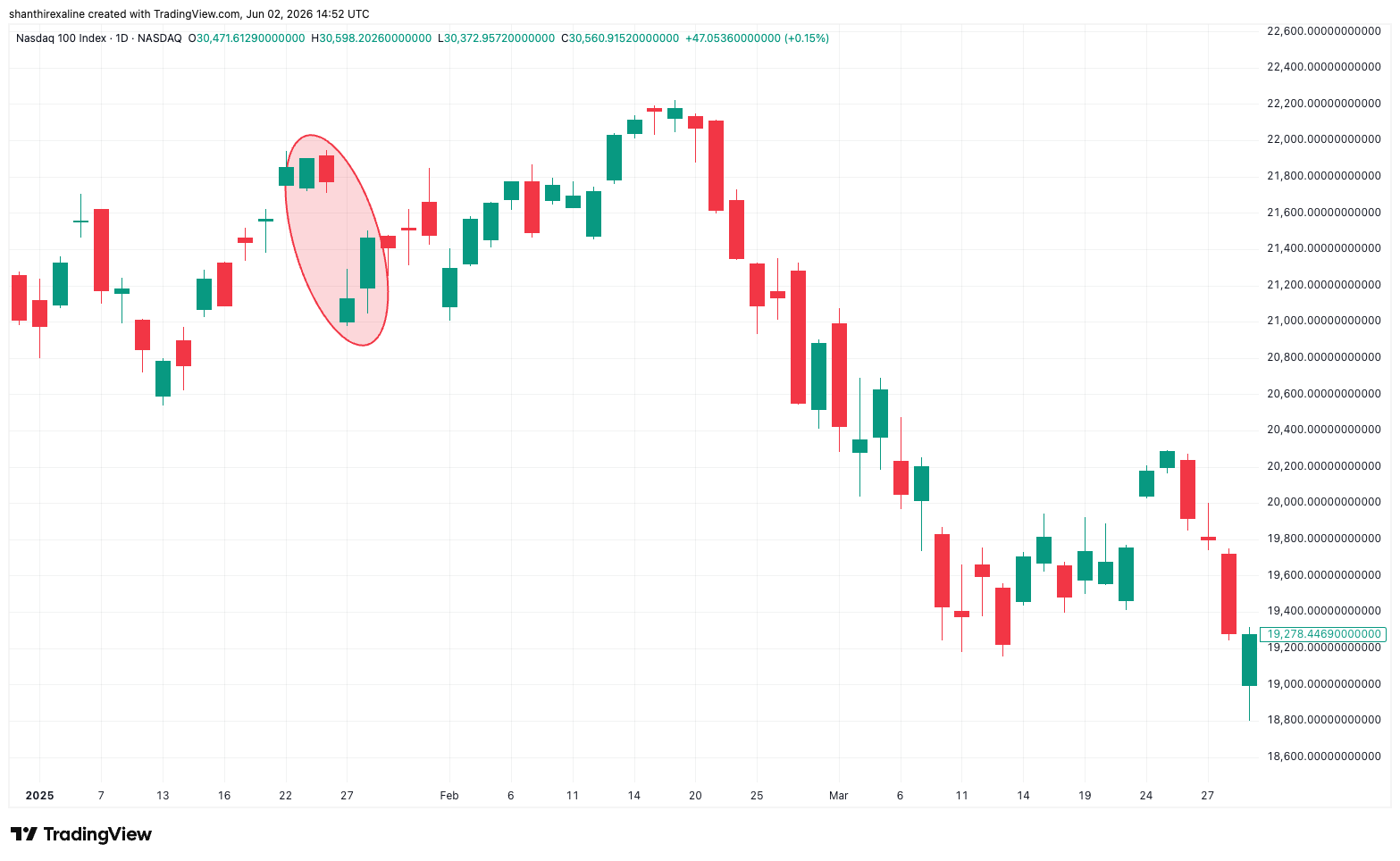
However, this top-heaviness is a liability. The Nasdaq-100's heavy reliance on megacap technology stocks means that disappointing earnings, regulatory actions, product delays, or shifts in AI spending by just one or two companies can trigger outsized declines in the broader benchmark. Investors received a stark reminder of the dynamic in early 2025 when the release of low-cost LLM models by China’s DeepSeek triggered a sell-off in the Nasdaq 100 Index.
DeepSeek Sell-off (Late Jan’25)
Source: TradingView
The Nasdaq 100 lost 3% and Nvidia, the poster child of AI, shed a whopping $589 billion in market cap, all in a single day. Fortunately, the rebound was rapid.
More AI, More Concentration
The structural reality is that the Nasdaq-100 has become increasingly reliant on a relatively small group of companies whose valuations are closely tied to the AI narrative. Should Anthropic and OpenAI maintain their lofty valuations after going public and satisfy the index's eligibility requirements, their inclusion in the benchmark may be only a matter of time.
With private-market valuations approaching $1 trillion each, Anthropic and OpenAI would rank among the largest publicly traded technology companies from the moment they debut. Their eventual addition to the Nasdaq-100 would further increase the index's exposure to AI-related themes.
How Soon Could They Make the Cut?
- To qualify for inclusion in the Nasdaq-100, a company must:
- Be listed exclusively on a Nasdaq-affiliated U.S. exchange;
- Rank among the 100 largest eligible non-financial companies by market capitalization
- Have a three-month average daily trading value of at least $5 million.
However, Nasdaq's Fast Entry rule could significantly accelerate the process.
Under this provision, a company that is not already part of the index can be added on an expedited basis if its market capitalization ranks within the top 40 current Nasdaq-100 constituents. For newly listed companies, eligibility for Fast Entry is assessed after just seven trading sessions.
Given their reported valuations, both Anthropic and OpenAI would likely clear the market-cap hurdle with ease. That raises the possibility that, rather than waiting for the index's annual reconstitution, either company could find its way into the benchmark within weeks of a successful public debut.
Concentration by theme poses a huge risk. The addition of either of these companies will deepen the index’s exposure to a single investment narrative, Investors who buy Nasdaq-100 are already making an implicit bet on AI through Nvidia and its ilk. The listing of Anthropic and OpenAI will add two more pureplay AI companies to the mix, further tying the index performance to developments in LLMs, data center spending, chip demand and AI adoption.
Index inclusion would also mean automatic buying by index-tracking exchange-traded funds (ETFs) and mutual funds, siphoning billions of dollars into these AI plays, irrespective of their fundamentals. OpenAI's fundamentals are precarious, with the company expected to rake up losses of about $14 billion by 2026 and bleed through 2028 due to its heavy investment commitments. Anthropic's financials are slightly better. In an exclusive report published last month, the Wall Street Journal said last month that it generated $4.8 billion in sales in the first quarter and is set to record operating profit of $559 million in the June quarter.
Also, the inclusion of new AI heavyweights will likely amplify the feedback loop of rising valuations leading to increasing index weights, in turn attracting more passive capital.
As Anthropic, OpenAI and other AI leaders move toward the public markets, investors may need to confront a fundamental question: Is the Nasdaq-100 still a broad technology benchmark, or is it increasingly becoming a concentrated bet on the future of artificial intelligence?


