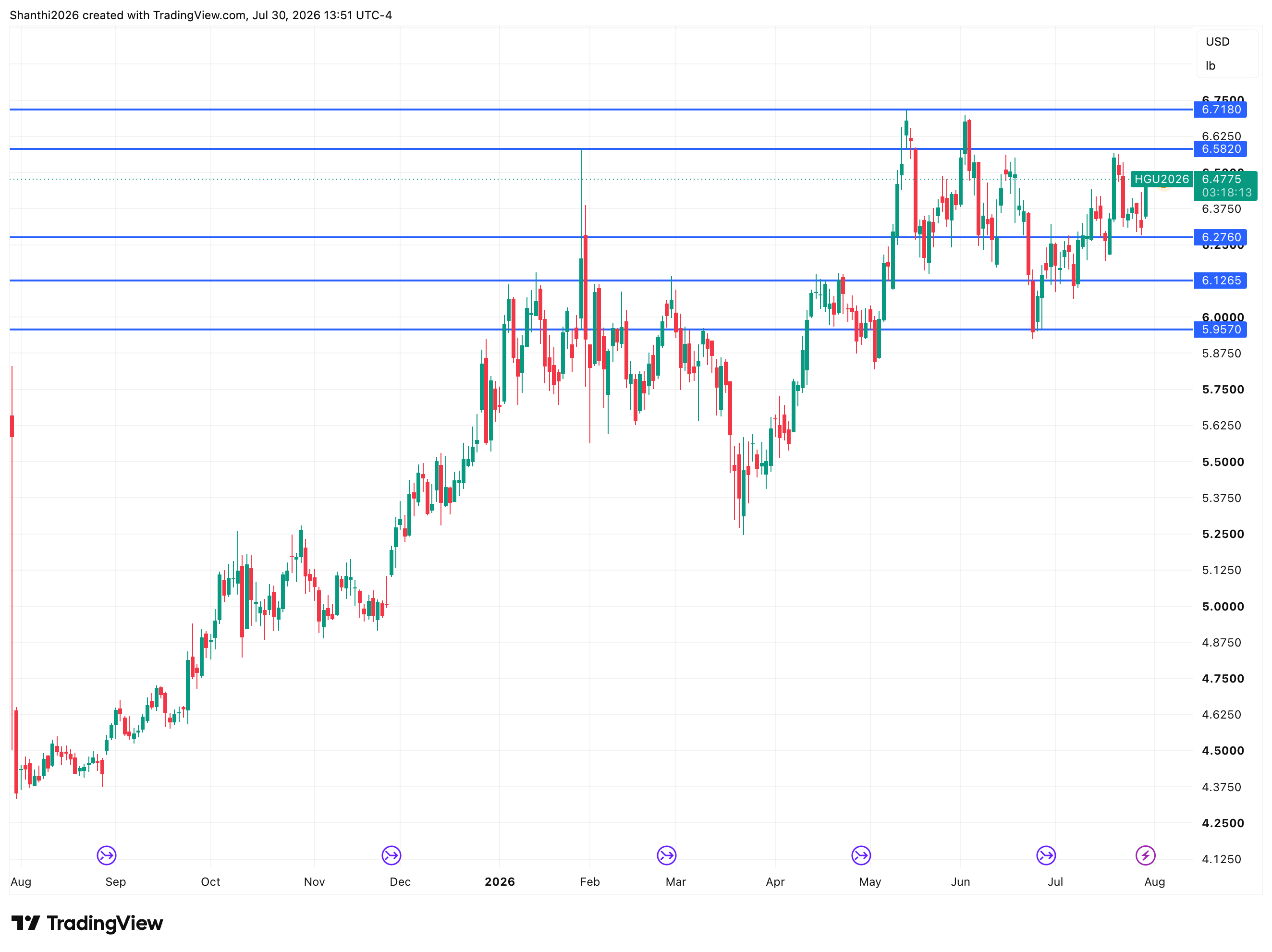
Copper surged toward record territory on Thursday, gaining as much as 3% on Comex to touch $6.501 a pound, as three separate forces converged — a Federal Reserve rate decision that unwound a near-term overhang on risk assets, a physical market that keeps signaling it doesn't have enough metal to go around, and a policy pledge out of Beijing's Politburo that had already landed hours before US trading even got underway.
The move puts the most-active September contract within roughly 2.3% of the record set in early June, and extends copper's year-to-date gain past 15%.
Source: TradingView
But scratch beneath the headline number, and Thursday's rally is really three separate stories moving at three separate speeds — one likely to fade within days, one that's been building for weeks, and one so fresh its full weight hasn't even been priced in yet.
Catalyst One: Fed Relief Fuels the Near-Term Spike
The immediate trigger was straightforward. The Fed held its benchmark rate steady,removing the rate-hike threat that had weighed on copper and other dollar-denominated commodities in the prior session. Copper gapped higher at the open and built on those gains through the day.
The decision wasn't unanimous. Three FOMC members dissented in favor of a hike, and Fed Chair Kevin Warsh was careful to note that holding rates steady shouldn't be read as a sign of policy inertia. That nuance matters: this was not a clean dovish signal from the Fed, just enough certainty removed from the table to trigger a classic relief rally across risk assets and commodities priced in dollars.
This is the most fragile of the three catalysts. Relief rallies built on a single data point or decision tend to lose momentum once the news is fully digested — they reflect positioning and sentiment more than a change in underlying fundamentals.
Catalyst Two: The Physical Market Tells a Tighter Story
Running alongside — and largely independent of — the Fed-driven pop is a supply story that has been building for weeks. On the London Metal Exchange, copper gained 1.3% to $13,581 a tonne, while the premium commanded by US prices over the global LME benchmark widened. That widening premium is a classic signal of regional tightness: buyers in the US market are paying up for metal that isn't as readily available as it is elsewhere.
Industry estimates on the size of the underlying shortfall vary widely — some analysts point to a swing from what had been forecast as a modest surplus earlier in the year to a meaningful deficit, driven by refinery bottlenecks, project disruptions, and demand that continues to outpace new supply. Unlike the Fed relief rally, this is not a one-day phenomenon. It's the catalyst most likely to persist regardless of what the Fed decides at its next meeting.
Catalyst Three: China's Politburo Sets the Table Early
The third catalyst was already in the market well before Comex trading opened. China's Politburo, the Communist Party's top decision-making body, wrapped its meeting Thursday, and pledged to step up macro policy support and shore up capital-market resilience for the rest of the year, vowing to accelerate fiscal spending after second-quarter growth momentum cooled and global equity volatility picked up.
That's a more supportive stance than markets had penciled in heading into the meeting, where expectations had leaned toward Beijing relying on existing measures rather than announcing anything new. The pledge itself remains light on specifics — the Politburo language calls for "practical and effective incremental measures" without quantifying scale — so how much of that early tailwind persists depends on whether Beijing follows through with concrete numbers in the weeks ahead.
How Far Is Too Far?
With copper trading in the $6.45–$6.49 range, the metal is closing in on levels not seen since its June peak. Wall Street forecasters have largely stayed bullish through the run — Citi, for one, has reiterated a three-month target near $14,500 a tonne and a year-end target of $15,000, implying the bank sees further room to run even from here.
But Thursday's rally raises a harder question for traders than "how high can copper go." If the Fed-relief bid unwinds in the coming days as the decision gets fully absorbed, and China's pledge proves light on specifics, does copper give back today's gains even if the physical tightness story remains fully intact? Separating the durable catalysts from the transient ones is the key task for anyone positioning in copper futures right now, rather than treating the day's move as a single, uniform signal.
Some portion of Thursday's move reflects capital chasing a well-known narrative (AI-driven data center demand, global electrification, EV adoption, and now a China policy tailwind) rather than purely tracking tonnes in and out of warehouses.
Untangling Three Catalysts Into Next Week
That leaves copper traders with three threads to pull apart heading into next week: a fading Fed relief bid, a durable physical-tightness premium, and a vaguely worded — China policy pledge. Each carries a different shelf life, and each will be tested differently: the Fed bid by how markets digest the decision over the coming sessions, the supply story by whether LME premiums keep widening or start to ease, and the China pledge by whether Beijing follows through with specifics rather than broad language in the weeks ahead. Which of the three ends up carrying the rally past Thursday — and which prove to be one-day pops — will be the real test of copper's next leg.