
COMEX copper futures have pushed to record territory as traders price the possibility of a broader U.S. tariff on refined copper, even though that tariff has yet to take effect. Traders have now factored in a 15% U.S. tariff on refined copper from Jan. 2027, with the rate potentially rising to 30% in 2028.
The market is effectively putting a value on copper already inside the U.S. because metal imported before a future duty could become more valuable relative to copper that faces the tariff.
JPMorgan Head of Base and Precious Metals Strategy Gregory Shearer also subscribes to this view.
In our view, a material component of the rally in copper over the last six months is an embedded tariff uncertainty, which has created a tug of war between the U.S. and China for copper units. Globally, the refined copper market is pretty well supplied. But China, who is net-short and still needs to import copper, is being challenged by the flow of copper going into the United States, which has raised China’s buying floor.
That expectation has helped create a powerful incentive to move copper into the U.S. ahead of any policy change. The result is an unusual market dynamic. The anticipated tariff is changing physical trade flows before the tariff itself becomes reality.
That distinction matters for futures traders. The rally is not simply a bet that tariffs will raise the cost of imported copper. It is also a bet that the policy will continue to distort where copper is available globally.
The COMEX Premium Tells the Story
The clearest evidence is the divergence between U.S. and overseas copper markets.
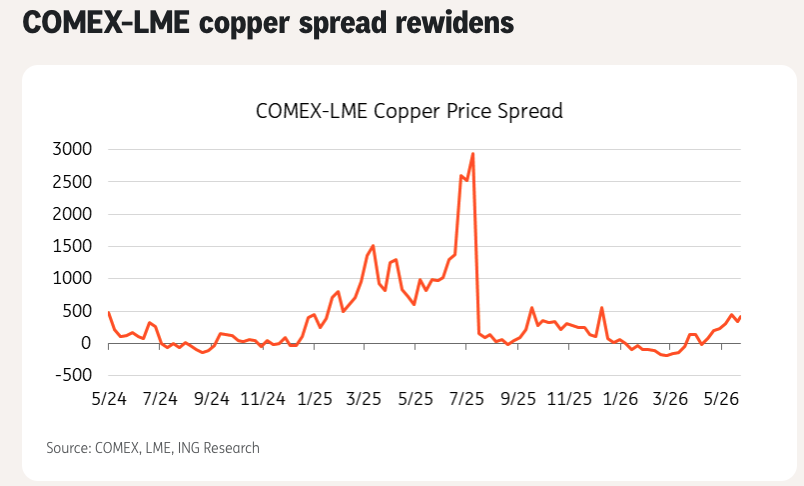
COMEX copper has attracted metal into U.S. warehouses as traders and physical participants prepare for the possibility of tariffs on refined imports. ING noted in a mid-June report that the COMEX-LME spread had widened to $400 per ton as tariff-driven stockpiling accelerated, while LME and SHFE inventories declined as copper was redirected toward the United States.
Source: ING
The spread has narrowed since and is currently around $340 per ton.
The wider COMEX-LME spread creates a feedback loop.
Tariff expectations → U.S. stockpiling → tighter non-U.S. availability → higher global prices → stronger incentive to secure copper in the U.S.
The market therefore does not need the tariff to actually arrive for it to influence prices.
But This Isn't Only a Tariff Trade
The biggest risk to the headline thesis would be treating tariffs as the entire explanation for the rally.
Copper supply is also becoming increasingly constrained. Global mine production fell 1.1% in the first half of 2026, while concentrate production declined 2.6%, with disruptions in major producing countries including Chile, Indonesia and the Democratic Republic of Congo. At the same time, long-term demand from power infrastructure, data centers, electrification and AI remains supportive.
That combination gives copper a fundamental floor beneath the tariff trade.
Also, JPMorgan notes that the Middle East conflict is also adding to the upside pressure on copper prices. The region is a major supplier of sulfur and sulfuric acid used for copper leaching, and shortages of these have kept copper prices inflated.
There is, however, an important contradiction. Refined copper production has been running ahead of consumption, leaving a reported global surplus of about 131,000 tons. That means the market is not necessarily facing an outright shortage of refined copper. Instead, the problem is increasingly one of location and availability.
The US Is Pulling Copper Away From the Rest of the World
The redistribution is already visible in trade flows.
U.S. copper imports from the Democratic Republic of Congo reached a record 53,290 metric tons in July, with Congo accounting for nearly 24% of U.S. copper imports that month. The price advantage of LME-based Congolese copper relative to the elevated U.S. market has made those shipments increasingly attractive.
That is one of the most important signals in the copper market right now.
The U.S. does not necessarily need to consume dramatically more copper to support higher prices. It only needs to pull enough available metal into the country to tighten supply elsewhere.
The Risk: What Happens If the Tariff Disappoints?
This is where the record rally becomes vulnerable.
The market has spent months anticipating a broader tariff on refined copper. If the eventual policy is delayed, reduced, exempted or otherwise less restrictive than traders expect, some of the incentive to accumulate copper in the U.S. could disappear.
Goldman Sachs has previously highlighted this risk, arguing that once tariff uncertainty fades, attention could return to the global refined-copper surplus and put downward pressure on prices.
That creates an asymmetric setup for futures traders. The tariff doesn't have to be imposed immediately to push copper higher, but a disappointing policy outcome could remove part of the premium that has already been priced in.
Copper Tests a Multi-year Ceiling Right Where Channel Runs Out of Room
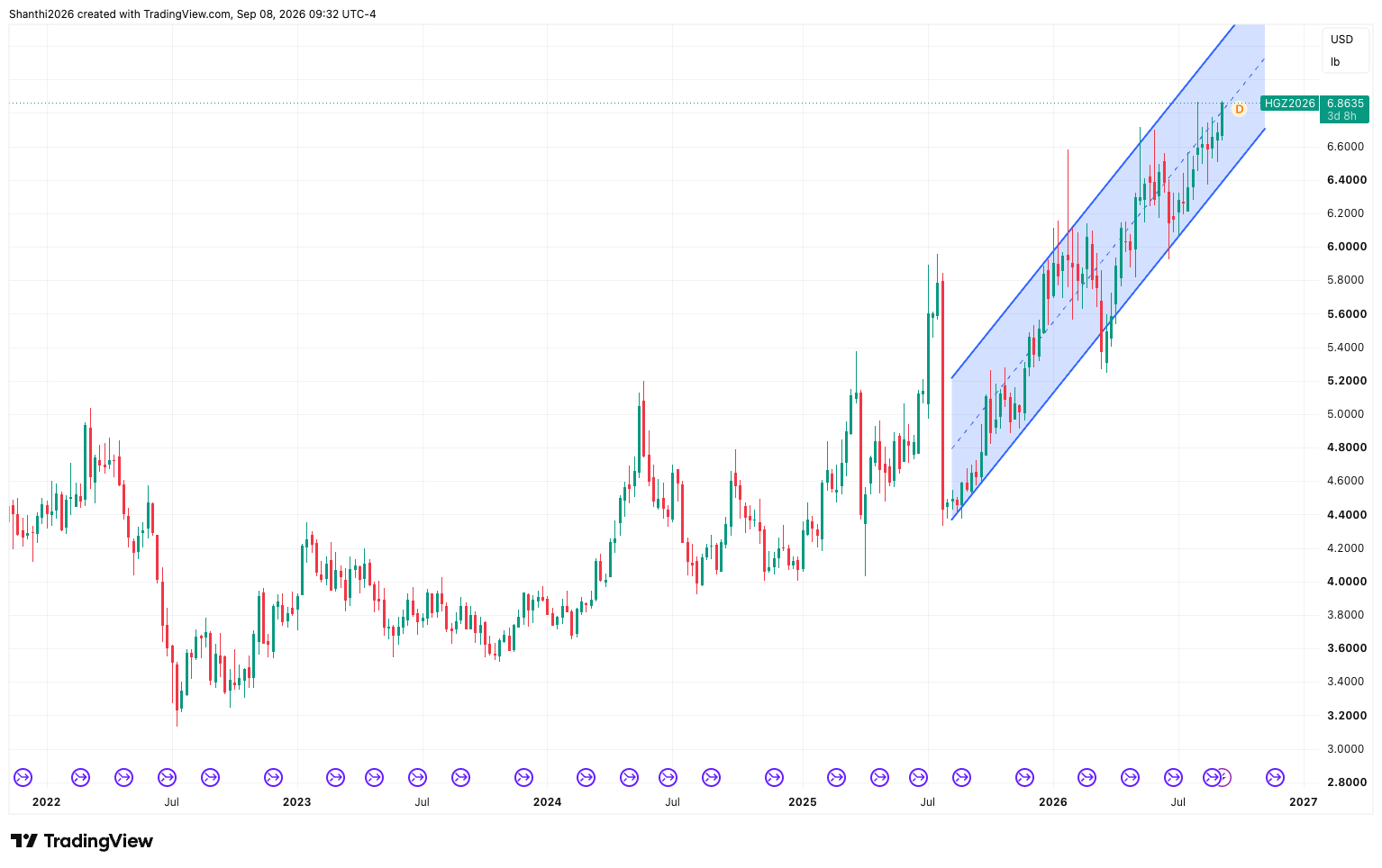
The December copper contract is trading above $6.85 level, pushing against the upper boundary of a well-defined ascending channel that has held since the sharp breakout from the $4.40 level in mid-2025. The channel has guided prices higher in an orderly, higher-lows structure for well over a year now.
A clean breakout and hold above $6.86-$6.90 would put copper in uncharted territory, opening the door to a measured move based on the channel’s width projected from the breakout point. A rejection here, however, would likely see the price pull back toward the channel's midline or lower rail, currently intersecting somewhere in the mid-$6, without necessarily breaking the broader uptrend.
Source: TradingView
Record High, Bigger Test Ahead
For now, the rally has momentum because three forces are working together: tariff-driven stockpiling, constrained mine supply and structural demand from electrification and AI infrastructure.
Copper's move to a record therefore cannot be dismissed as purely speculative. But the price is also increasingly carrying a policy premium.
That leaves the market facing a simple question: how much of today's copper price represents the metal's underlying fundamentals, and how much represents a tariff that has not happened yet?
As long as traders believe the U.S. will eventually impose a meaningful tariff on refined copper, the incentive to secure supply early remains intact. But once policy clarity arrives, the market may have to separate the copper shortage story from the tariff-arbitrage story.
That could be the next major test for the record rally.