For about an hour on Tuesday morning, it looked like Treasury yields were finally going to catch a break.
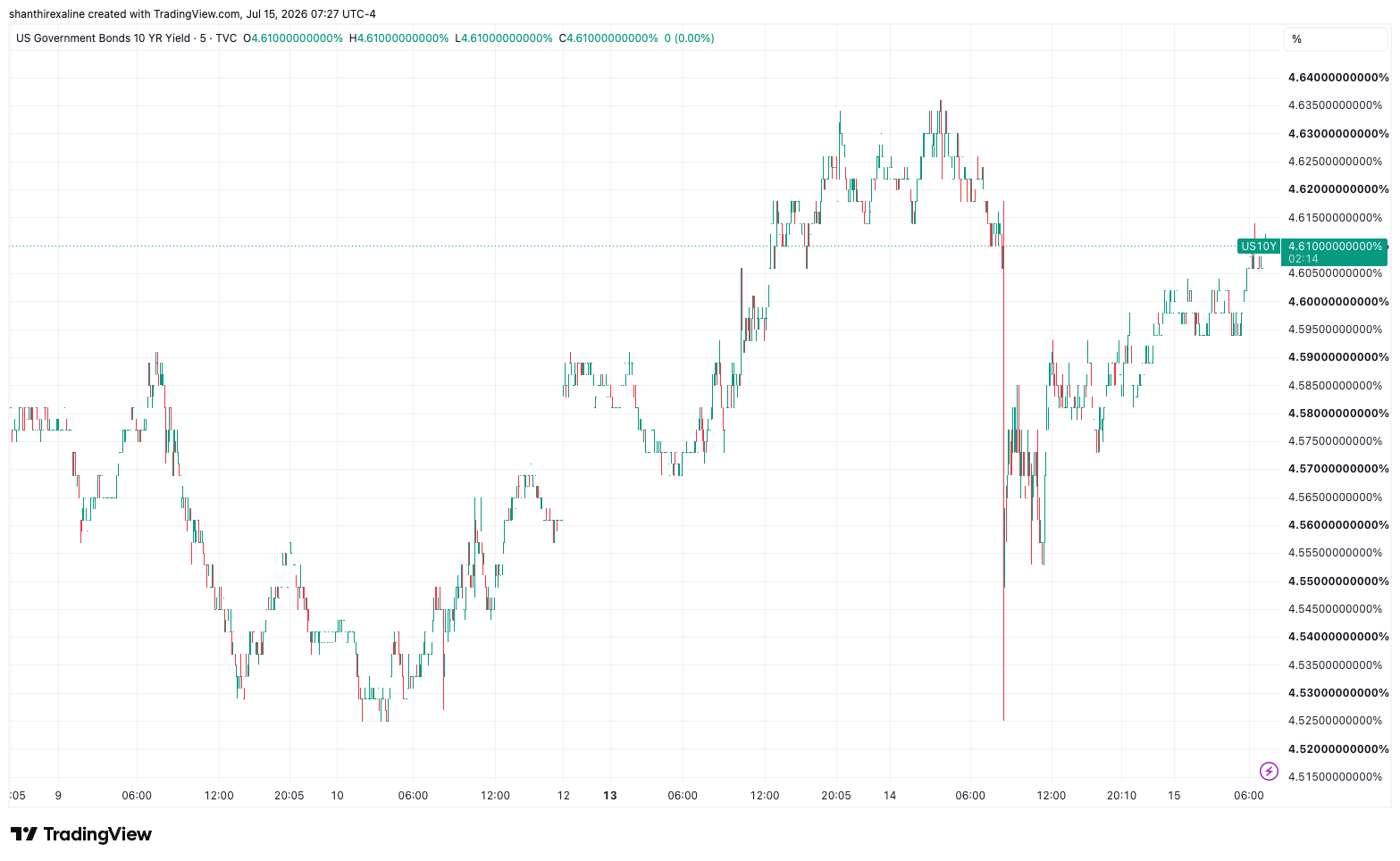
June's Consumer Price Index (CPI) inflation landed well below forecast. Annual headline inflation cooled to 3.5% versus the 3.8% economists expected, and the monthly reading actually fell 0.4%. In a knee-jerk reaction, the 10-year and 2-year yields fell as traders slashed the odds of a July Fed hike from 42% to 17% almost instantly.
Then the bond rally died and yields resumed their climb
By the end of the session, the 10-year had round-tripped back above to near 4.6%, and by Wednesday morning it topped the mark for the first time since May 21. For a futures desk watching ZN, the message was clear: Good data isn't enough to move this market right now. Something else is setting the price.
The Dip and the Reversal
Source: TradingView
The oil bid is stronger than the data surprise
That something else is crude. U.S. and Iranian forces have exchanged strikes for over a week, and the Strait of Hormuz, the corridor carrying roughly a fifth of the world's seaborne oil, has become the single biggest swing factor in the rates market. Iran has at various points declared the strait closed to shipping; the U.S. has countered with plans for a 20% cargo fee and a renewed naval blockade of Iranian ports. Since then U.S. President Donald Trump has thawed his stance, stating that he would replace the levy with inbound investments into the U.S. by its Gulf allies.
The conflict continues to aggravate, as the U.S. Central Command confirmed on its X account that at 6 a.m. ET, the U.S. forces launched a wave of strikes against Iran designed to “further degrade military capabilities Iranian forces have used to attack commercial shipping in the Strait of Hormuz.”
WTI crude oil, which has larged remained bid this week, climbed as high as $81.27 a barrel on Tuesday before ending below the $80 psychological level. The energy commodity traded just below the mark amid the fresh attacks on Wednesday.
That matters to bond traders for one reason: energy is the fastest-moving input into headline inflation, and the market is pricing the risk of the next three CPI prints, not just the one that already happened. A cool June reading doesn't offset a crude market that could hand back a hot July and August if the strait stays contested.
Waller set the trap before the data even landed
On Monday, a full day before CPI, Fed Governor Christopher Waller warned that the central bank would need to "consider tightening monetary policy in the near term" if CPI and PPI came in hot that week. It was a hawkish anchor dropped in ahead of the print, not a reaction to it.
When the data came in cool instead, it should have deflated that warning. Instead, the market treated Waller's framing as the more durable signal. The June FOMC minutes released July 8 showed officials dropping their easing-bias language and a few participants openly floating a hike. And rising oil prices justify their stance.
Supply and term premium are doing the rest
Even without the Iran conflict, there's a structural floor under yields right now. A 30-year Treasury auction earlier this month drew the highest yield in nearly 20 years, a sign that investors are demanding more compensation to absorb the sheer volume of government debt being issued. Layer on a rising term premium, which is the extra yield investors want for the uncertainty of holding duration through an unstable inflation regime, and you have two forces that simply won’t be swayed by any single CPI print.
What this means for positioning
For futures traders, the message is not to ignore inflation reports. Instead, it's that oil is currently having a bigger influence on rate expectations than the latest inflation data. As long as there is uncertainty around the Strait of Hormuz and energy prices remain elevated, markets are likely to stay focused on crude.
The Fed's recent hawkish comments have reinforced this view, allowing traders to price in higher yields even as inflation readings show signs of easing. For now, oil prices are having a greater impact on market direction than a single favorable CPI report.
Retail positioning shows, futures traders have been strongly short the CL contract over the past seven days, although 76% of the winning traders have been long, according to MarketFramework's top traded contract tool. The heavy short positioning in crude oil futures suggests many traders are betting that recent price gains will reverse. However, the fact that 76% of profitable traders have been long indicates that the prevailing upward trend has continued to reward bullish positions, raising the risk of a short squeeze if oil prices remain elevated.
The producer price inflation (PPI) report due shortly before the market open may not dent yields permanently, going by the logic that it is outdated data that doesn’t factor in the recent energy price resurgence. However, a hotter print could buoy yields further on the premise that the pipeline inflation will seep down at the retail level. New York Fed Chair John Williams is due to speak after the PPI print.
The producer price inflation (PPI) report due before the market open may have only a limited and temporary impact on Treasury yields, as it reflects a period before the recent rebound in energy prices. However, a stronger-than-expected reading could push yields higher by reinforcing concerns that rising input costs will eventually feed through to consumer inflation. Investors will also be watching remarks from New York Fed President John Williams later in the day for clues on how policymakers are assessing the inflation outlook and interest-rate path.


