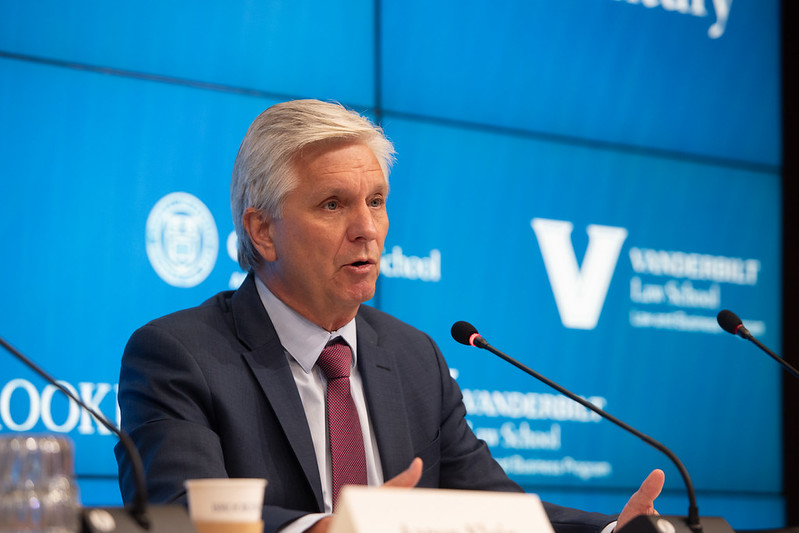
Federal Reserve Governor Christopher Waller said on Monday that inflation and monetary policy are at a crossroads, even as the broader U.S. economy remains on solid footing. Speaking at the New York Association of Business Economics, Waller warned that a stronger-than-expected June inflation reading could force Federal Reserve policymakers to consider tightening monetary policy in the near future.
The closely watched June Consumer Price Index (CPI) reportis scheduled for release at 8:30 a.m. ET on Tuesday. Economists expect consumer prices to decline 0.1% month-over-month after rising 0.5% in May, while core inflation is projected to remain steady at 0.2% on a monthly basis. Annual headline CPI is forecast to ease to 3.8% from 4.2%, with core CPI expected to hold at 2.9%.
Waller Wants Sustained Improvement in Inflation
Waller said the June CPI and Producer Price Index (PPI) reports, both due this week, will provide a reliable estimate of the Federal Reserve’s preferred inflation gauge, the Personal Consumption Expenditures (PCE) index.
While he expressed hope for a softer core inflation reading, Waller stressed that a single favorable report would not be enough to convince him that inflation is on a sustainable downward path. Instead, he said several months of lower inflation readings would be needed before policymakers could gain confidence that price pressures are easing.
If that scenario materializes, Waller said maintaining the federal funds rate within its current 3.50%-3.75% target range would be a reasonable policy outcome.
Click MarketFramework’s Trade Validator tool for insights into futures market traders’ positioning.
Broad-Based Inflation Pressures Remain a Concern
The Fed governor highlighted persistent strength in core inflation, noting that price pressures are not being driven by any single category. Both core goods and core services inflation remain well above levels seen when inflation consistently hovered around the central bank’s 2% target.
According to Waller, tariffs, elevated energy costs, and spillover effects from growing investment linked to the artificial intelligence (AI) boom are contributing to the renewed inflationary pressures.
Fed Must Avoid Policy Mistakes
Waller emphasized the importance of balancing inflation risks without repeating past policy errors.
“We need to avoid making the mistake of fighting the last war and reacting too soon to tighten inflation, merely because we waited too long last time. But we also must avoid repeating the same mistake we made in 2021 and 2022 by waiting too long to respond,” he said.
At its June 16-17 meeting, Fed under its new Chair Kevin Warsh voted 12-0 to hold the federal funds rate, marking the fourth straight meeting without a change. The easing bias was removed from the statement and the accompanying projections told a more hawkish story, with the median policymaker now expecting rates to end 2026 higher than current levels and 17 of 18 officials seeing inflation risks tilted to the upside.
Nine of nineteen participants penciled in at least one rate hike this year, pushing the median year-end funds rate projection to 3.8%, up from 3.4% in March. The next FOMC meeting is scheduled for July 28-29, with the rate decision due July 29. This week's CPI and PPI data will be among the last major inflation readings policymakers see before that gathering.
Strong Consumer Spending Supports Economic Outlook
Despite ongoing inflation concerns, Waller expressed confidence in the resilience of the U.S. economy. He noted that consumers have successfully navigated a series of challenges, including the inflation surge of 2021, elevated interest rates between 2022 and 2024, import tariff shocks in 2025, and higher energy prices stemming from Middle East tensions.
Recent declines in energy prices, he said, should help support consumer spending and economic growth going forward.
Geopolitical Risks Could Rekindle Energy Inflation
However, Waller acknowledged risks to that outlook from the continuing U.S.-Iran conflict. Although a preliminary peace agreement reached in mid-June temporarily eased disruptions through the Strait of Hormuz, repeated ceasefire violations have renewed uncertainty.
Oil prices have resumed their upward climb in response to the escalating tensions, raising the possibility of renewed inflationary pressure through higher energy costs.
Labor Market Remains Near Full Employment
Waller also downplayed concerns raised by June’s softer nonfarm payrolls report. He pointed out that the U.S. economy has added an average of 111,000 jobs per month over the past three months, a pace he described as consistent with strong labor demand relative to supply.
While he acknowledged a decline in labor force participation, Waller suggested the weakness could prove temporary, noting that broader measures of labor underutilization have improved.
“I believe employment is close to its maximum sustainable level, neither a source of concern for the strength of the six-year economic expansion nor a source of inflationary pressure,” Waller said.
Markets Await Inflation Verdict
With inflation data due this week and policymakers closely monitoring price trends, investors will be watching whether June’s CPI and PPI reports provide evidence that inflation is cooling or reinforce concerns that price pressures remain stubbornly elevated. The outcome could significantly influence expectations for the Federal Reserve’s next policy decision.


