The U.S. economy is entering the second half of August with a labor market that continues to show resilience, while manufacturing activity is signaling a potentially stronger growth outlook.
Initial jobless claims fell in the latest week, while the Philadelphia Federal Reserve's August manufacturing survey showed an acceleration in current activity, stronger hiring and an unusually upbeat six-month outlook. The combination suggests that economic momentum remains intact even as the labor market gradually normalizes.
For the Federal Reserve, however, the mix presents a complicated picture: labor-market conditions are not deteriorating sharply enough to demand an aggressive response, while manufacturers' expectations point to stronger growth and potentially persistent price pressures.
Jobless Claims Fall More Than Expected on an Unadjusted Basis
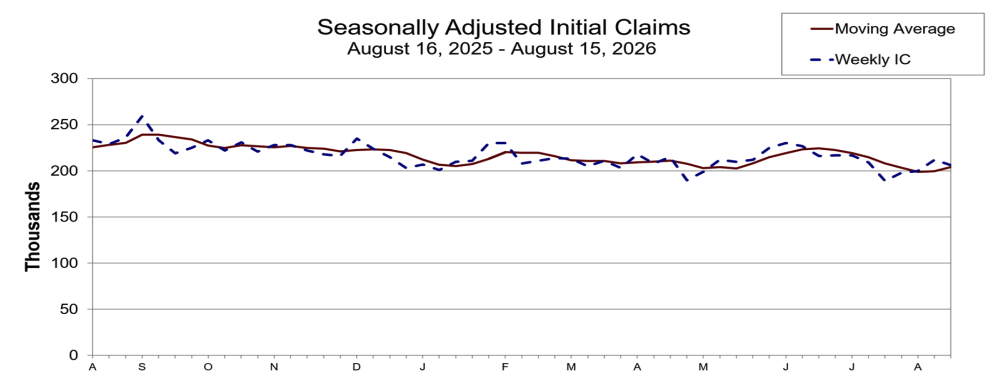
The advance number of seasonally adjusted initial claims fell 6,000 to 206,000 in the week ended Aug. 15, according to the U.S. Department of Labor. This was below the consensus estimate of 210,000. The previous week's figure was revised higher to 212,000 from 209,000.
Source: DOL
The four-week moving average increased to 204,000, from a revised 199,750, indicating that the underlying trend has softened somewhat despite the latest weekly decline.
Continuing Claims Also Point to Stability
The unadjusted insured unemployment picture was similarly constructive.
The advance unadjusted level of insured unemployment under state programs rose to 1.799 million in the week ended August 8 from 1.781 million in the previous week. The insured unemployment rate remained unchanged at 1.2%.
That suggests that although the labor market is no longer as tight as it was during the post-pandemic recovery, there is still little evidence in the claims data of a broad-based deterioration.
Philadelphia Fed Survey Delivers a Strong Growth Signal
The labor-market resilience comes alongside a surprisingly strong manufacturing reading from the Philadelphia Fed.
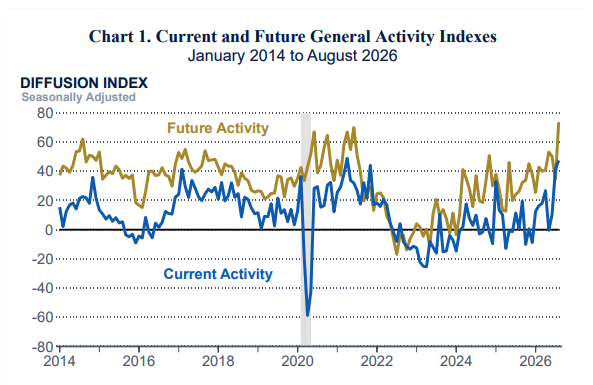
The general activity index jumped to 47.4 in August from 41.4 in July, marking its highest level since April 2021. This was sharply higher than the expected reading of 24.1. Nearly 57% of firms reported higher activity, compared with just 10% reporting decreases.
Source: Philadelphia Fed
New orders remained firmly positive at 30.1, although they eased from July's exceptionally strong reading. The shipments index also remained solidly expansionary at 27.7.
The survey therefore points to continued momentum in the manufacturing sector rather than merely an improvement in sentiment.
Manufacturers Are Hiring Again
The employment component provides another important signal.
The Philadelphia Fed's employment index surged 18 points to 27.9, its highest reading since April 2022. Nearly one-third of firms reported increases in employment, compared with only 13% in July.
The average workweek index also jumped to 26.5 from 14.0.
That is particularly significant when viewed alongside the jobless-claims data. Rather than showing widespread layoffs, the latest numbers suggest that businesses continue to add workers and increase labor utilization in at least some parts of the economy.
The Outlook Is Even Stronger
The most striking part of the Philadelphia Fed report may be the expectations data.
The future general activity index soared 39 points to 73.6, its highest reading since August 1983. Almost three-quarters of manufacturers expect activity to increase over the next six months.
The future new orders index climbed to 66.0, while future shipments reached 63.5.
Businesses are also planning to increase investment. The future capital expenditures index jumped to 48.2, its highest level in 53 years.
That combination suggests that manufacturers are not simply experiencing a temporary improvement. They are becoming significantly more confident about the economic outlook.
Inflation Is Still the Complicating Factor
The manufacturing survey does contain some encouraging inflation signals. The current prices-paid index fell to 40.9 from 53.9, while the prices-received index declined to 17.7 from 27.4.
But forward-looking price measures remain elevated.
The future prices-paid index rose to 62.9, while the future prices-received index climbed to 59.8. Meanwhile, 80% of firms expecting changes in industry costs said they anticipate competitors raising prices.
That could become increasingly important if stronger economic activity translates into firmer demand and higher input costs.
What It Means for the Fed
The latest data reinforce the case for a resilient but less overheated economy.
The claims numbers show no obvious deterioration in employment conditions. Initial claims remain relatively low, and the unadjusted insured-unemployment level is considerably below a year ago.
At the same time, the Philadelphia Fed survey suggests that businesses are becoming more optimistic about growth, employment and investment.
For the Fed, the ideal outcome remains clear: a labor market that stays stable while price pressures continue to ease. But the Philadelphia Fed's historically strong expectations for activity, hiring and capital spending suggest that the growth side of that equation may be stronger than policymakers would prefer if inflation remains sticky.


