Crude Oil markets have been heavily whipsawed over the past 48 hours as volatile headlines regarding a potential US-Iran peace deal continue to trigger sharp intraday swings.
The West Texas Intermediate crude oil futures (CL) have steadied neat $97 barrel mark, going into the New York session, after rolling over from Thursday's highs around $102.46 as market participants digest conflicting reports over how close Washington and Tehran are to finalizing an agreement.
The Geopolitical Seesaw: Reopening the Strait of Hormuz
Oil prices felt significant downward pressure following reports that a US-Iran deal could move "within hours." The market has been highly sensitive to these headlines, as an agreement would not only unlock sidelined Iranian barrels but also significantly reduce the geopolitical risk premium associated with shipping through the Strait of Hormuz.
At the moment the "Daily Throughput" sits at just 309.0K DWT (Deadweight Tonnage), which is a staggering 97% drop from the historical daily average of 10.3 million DWT. Furthermore, only 31 ships have transited the strait in the last 24 hours. This is just 3.3% of the normal 60-ships-per-day baseline.
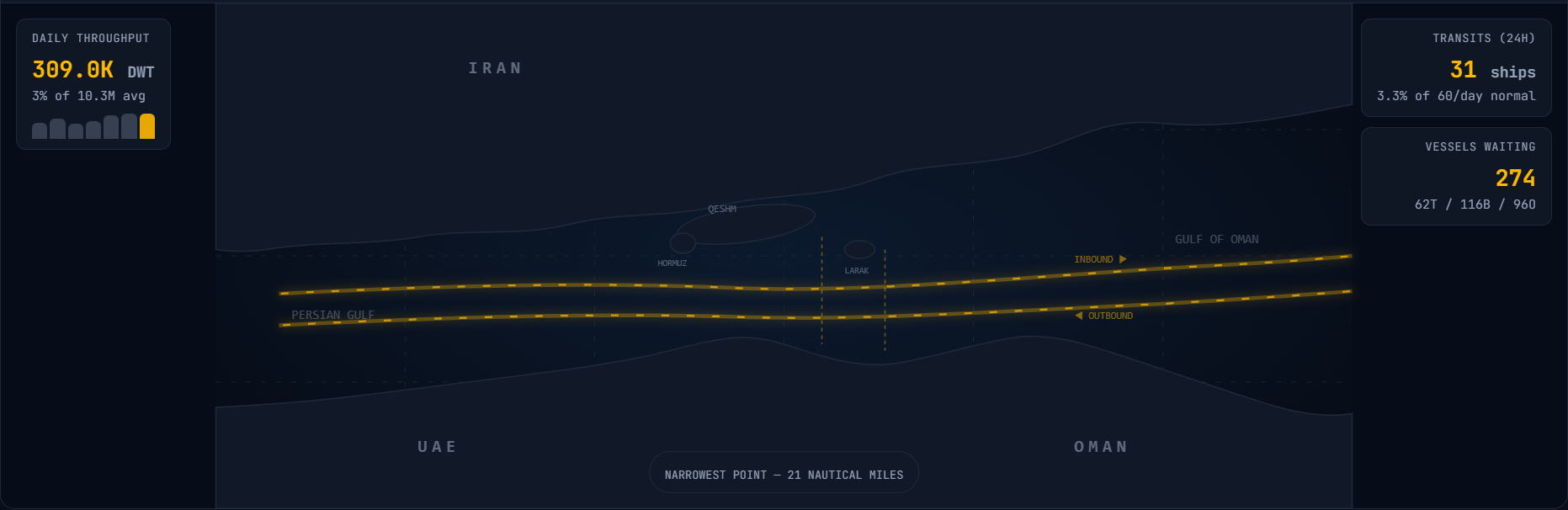
Source: Hormuzstraigtmonitor.com
While the removal of this logistical bottleneck and the injection of Iranian supply are structurally bearish on paper, the physical realities of the broader oil market are likely to limit the downside.
Let us unpack the physical realities a bit more.
The Inventory Crisis: A Looming Shortage Scenario
The primary reason a lasting collapse in oil prices remains unlikely is the precarious state of global stockpiles.A structural oil shortage scenario is looming large over the energy sector. Global inventories have been drawn down extensively, leaving a remarkably thin safety cushion to absorb any future supply disruptions or demand spikes.
For now it appears inventory drawdowns are modest with estimates from Kpler placing the number at 60 million barrels since late March, which leaves 3 billion barrels still in storage or whatever fraction of that volume is accessible.
According to the IEA, global oil supply is dropping much faster than demand: supply is falling by 3.9 million barrels per day, while demand is only dipping by 420,000 barrels per day.
At the end of the day consumers can only cut back on fuel so much thus global fuel inventories are shrinking at record speeds. Saudi Aramco warns that these stockpiles are the market's only remaining safety cushion. Once they run out, supply will crash directly into demand, causing oil prices to skyrocket.
Compounding this issue is the long-term underinvestment in upstream exploration. For years, capital expenditure in traditional fossil fuels has lagged behind historical averages, meaning that global spare capacity is concentrated in the hands of only a few producers. Even if Iran increases its output to maximum capacity, it may only act as a temporary band-aid on a deeply undersupplied global market.
This raises another interesting question, has the changes in demand and supply dynamics set a new floor for Oil prices?
Why Oil Prices Could Have a New Floor
The oil market is heading into a situation where sticky demand and structurally constrained supply means that the market remains highly vulnerable to tight conditions.
With this in mind there is a possibility that oil prices may have a new floor with the price levels seen prior to the US-Iran war (67.40/barrel) not to be seen for a while.
The simple reason for this is the time it would take for global supply and inventory levels to return to pre-war levels. In the case of a US-Iran deal, the return of Iranian barrels might not create a surplus; instead, it may merely replenish critically low global reserves back to safer operational levels.
Bulls Stall at the 100-Day Moving Average
From a technical perspective, Crude futures rallied yesterday but failed to close above the 100-day MA. The 100-day SMA ($100.54) has flattened out above current spot prices, acting as immediate overhead resistance and capping recent short-term recovery attempts.
Crude Oil Futures Chart, May 22, 2026
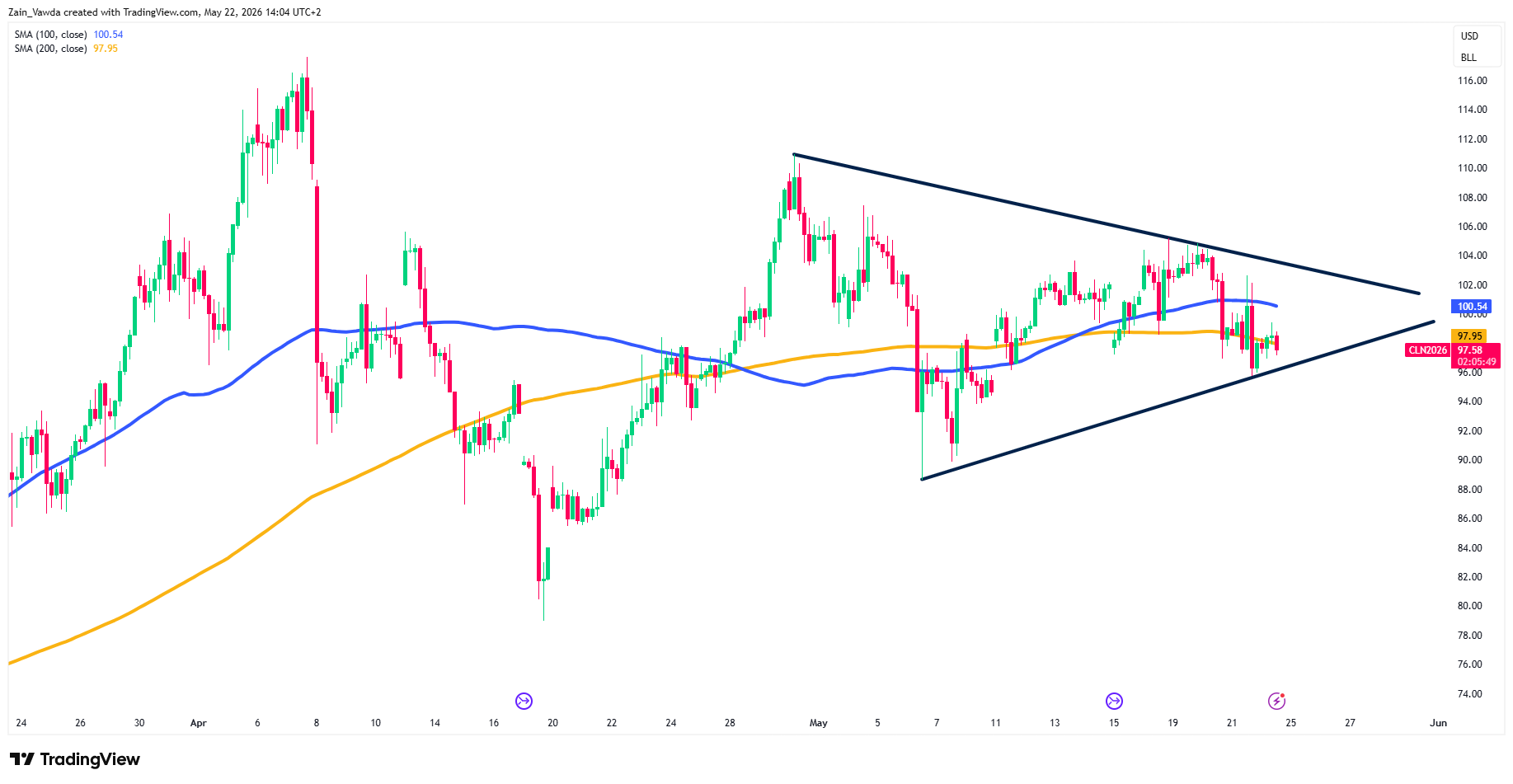
Source: TradingView
The recent sell-off has pushed prices back toward a crucial congestion zone between $98.00 and $96.00.
A decisive breakout is looming. A daily close below the $96.40 handle (triangle support) could spark a sharp liquidation toward $94.00.
Conversely, bulls need to reclaim the 100-day SMA to trigger a retest of the upper descending trendline near $102.00.
Final Thoughts
While headlines of a US-Iran peace deal will continue to trigger algorithmic selling and short-term volatility, smart money is looking at the underlying fundamentals. The reopening of the Strait of Hormuz may remove a layer of geopolitical friction, but it cannot instantly fix years of underinvestment and critically low global stockpiles.
Once the initial sentiment-driven sell-off runs its course, the reality of tight physical supplies may likely take center stage. Rather than triggering a bear market, the resolution of Iranian tensions could simply facilitate the transition into a healthier, highly supported market structure, solidifying a new, higher floor for oil well above historical averages.


