Manufacturing activity in the U.S. continued to expand in June, albeit at a slower pace than anticipated, according to two separate reports released Wednesday. The figures offer an early read on how factories are navigating a mix of tariff pressures, elevated input costs, and softening demand from abroad, and they arrive just a day before the closely watched non-farm payrolls report.
Two Surveys — Same Message
The Institute of Supply Management’s (ISM) manufacturing Purchasing Managers’ Index (PMI) was at 53.3 in June, down from the May reading of 54 and also trailing the consensus estimate of 53.8. The expansion spree, however, continued for the 20th month in a row. A reading above 50 indicates expansion, while a reading below 50 signals contraction.
Separately, the final results of S&P Global’s June survey showed that the manufacturing PMI came in at 53.9, revised down from the flash estimate of 55.7. The June reading also slowed from May’s 55.1, signaling a moderation in manufacturing expansion to a three-month low, although it remained firmly in expansion territory.
The slowdown in the headline manufacturing index reflected a deceleration in the pace of the expansion in most key components.
ISM, S&P Global Manufacturing Indices
| ISM June Survey | Change Vs. May (in points) | S&P Global June Survey | |
|---|---|---|---|
| New Orders | 56 | down 0.8 | rose at fastest pace since May |
| Production | 52.2 | down 2.1 | expanded, albeit at slower pace |
| Prices | 73 | down 9.1 | Input prices elevated but eased from May's pace; Output price inflation eased to 3-month low |
| Employment | 49.7 | Up 1.1 | Contracted for a 2nd month |
Sagging Export Orders
Despite expanding new orders, new export orders fell 2.1 points, retreating into contraction territory, ISM’s survey showed. Thus, of the four demand indicators, new orders and backlog of orders showed expansion, but the customers’ inventories contracted at a faster pace and new export orders also contracted. The plunge in customer inventories, however, can be viewed positively for the future production.
The supplier deliveries index, which is the only inverted index, was at 57.4 in June, suggesting a slowdown, although it eased 3.2 points from May. The divergence between demand and labor indicators suggests manufacturers remain willing to expand production but are becoming increasingly cautious about hiring.
Meanwhile, S&P Global’s survey found that the expansion was due to new product launches and pre-orders placed to protect against rising prices. New orders and output, though easing a bit, remained above trend. The firm’s survey corroborated the weakness in export orders relayed by ISM, with exports falling for a 12th month. Firms attributed the export weakness to tariffs and subdued international growth, in part linked to the Middle East war.
Inflation Pressures Ease, But Stay Elevated
The surveys also painted a mixed inflation picture. Although both ISM's Prices Paid index and S&P Global's measures of input and output prices eased from May levels, they remained elevated by historical standards. The moderation suggests that cost pressures may be peaking, but not yet receding sufficiently to provide policymakers with confidence that inflation is returning sustainably toward target.
Factory Employment Hits a Multi-Year Low
Employment was a sore spot, with the employment falling for a second time in three months, and at the steepest rate since May 2020. S&P Global Market Intelligence Chief Economist Chris Williamson attributed the weak job market to firms sharply cutting workforce to offset the rising cost of energy and raw materials.
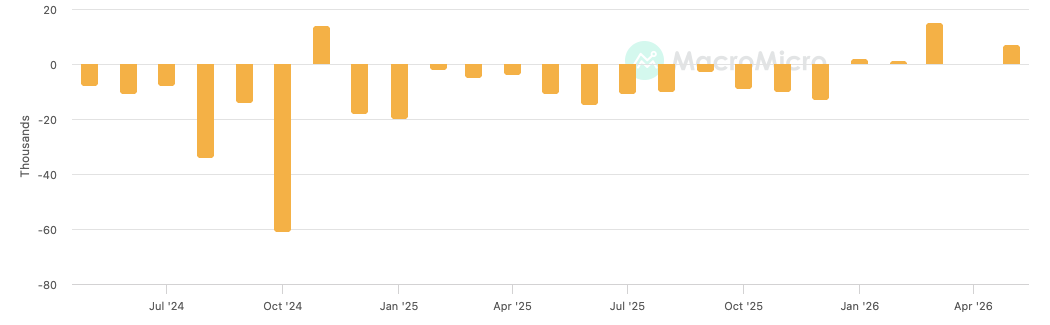
Manufacturing job growth has remained anemic for an extended period, going by the NFP data. In May, the sector added merely 7,000 jobs even as the services sector’s tally was at 92,000.
Manufacturing Job Growth
Source: MacroMicro
Williamson also warned about trouble ahead. “Despite the recent drop in energy prices and brighter outlook for shipping, business confidence has fallen sharply, in part reflecting concerns that an end to war-related inventory building could start to act as a drag on sales,” he said.
All Eyes on Thursday's Payrolls Report
The manufacturing surveys arrive just ahead of Thursday's closely watched non-farm payrolls (NFP) report, which is expected to provide a broader assessment of labor market conditions. While manufacturing represents only a modest share of total U.S. employment, the deterioration in factory hiring adds to recent signs of cooling labor demand, including softer private payrolls, massive tech layoffs and a gradual rise in continuing unemployment claims.
Economists will be watching whether the weakness evident in manufacturing employment is beginning to spill over into the wider economy. A softer-than-expected payrolls report could reinforce expectations that labor market momentum is slowing, while a resilient reading would suggest that hiring remains sufficiently strong to support household spending and economic growth.
For Federal Reserve officials, the combination of moderating manufacturing growth, easing but still-elevated price pressures, and signs of labor market cooling presents a complicated policy backdrop. A strong payrolls report would likely keep policymakers cautious about easing policy too quickly, whereas a material downside surprise could strengthen the case for interest-rate cuts later this year.


