U.S. business activity held steady in May, buoyed by the strength in manufacturing activity, according to S&P Global’s preliminary purchasing managers’ survey results released Thursday. This contrasted with a regional manufacturing survey's results released earlier on Thursday, which showed a contraction.
The results of S&P Global’s survey are based on responses collected between May 12-20.
Composite PMI Holds Its Ground, But Three-Month Trend Flashes Caution
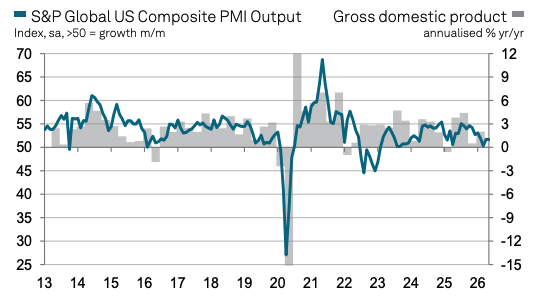
The flash composite purchasing managers’ index (PMI) was at 51.7 in May, unchanged from April, as improved manufacturing activity countered the sluggishness seen in the services sector. The growth of the manufacturing and services sectors, combined, over the past three months since the outbreak of the Middle East has been the weakest since the start of 2024.
S&P Global Flash US Composite PMI
Source: S&P Global
Manufacturing PMI Hits 4-Year High — But Stock-Building Does the Heavy Lifting
The manufacturing PMI climbed to a four-year high of 55.3, up from 54.5 in the previous month, with the expansion spree continuing for a 10th month. The May preliminary reading defied the consensus expectation for a slowdown (53.8). That said, the sector’s strength was due to temporary stock building.
Services Sector Loses Steam, Dented by Rising Prices, Uncertainty
The services PMI slid to a two-month low of 50.9, trailing the consensus of 51.1.The services sector remains on course for its weakest calendar quarter since late 2023 as new business inflows rose only modestly. S&P Global noted that service providers reported subdued demand reflected rising prices and uncertainty, notably among consumer-facing businesses and for exports. Service exports fell at the sharpest rate for six years.
The Middle East war had kept order book growth for both the services and manufacturing sectors somewhat subdued, especially in terms of export sales. Input costs jumped at the fastest pace since late 2022 due to rising war-related supply constraints and steep energy cost increases. This contributed both steeper job losses and a further rise in selling price inflation to the highest since Aug. 2022.
Economist’s Take — GDP Struggling to Top 1%
Commenting on the data, S&P Global Chief Economist Chris Williamson said, “Coming on the heels of a subdued April reading, the May PMI indicates that the economy will struggle to manage annualized GDP growth of much more than 1% in the second quarter.” He raised doubts regarding the sustenance of even this subdued growth pace.
“On average, over the past three months order book growth has slowed to its weakest for two years, and a boost from precautionary stock building due to concerns over further price hikes and supply delays will not last forever.”
The economist also expects demand to cool down in response to rising prices. “The survey price gauges therefore indicate that inflation looks set to rise further just as the economy cools,” he added.


