
Consumer sentiment fell for a third straight month, final results of the University of Michigan’s survey for May showed, with elevated gas prices in the wake of the Strait of Hormuz blockade blamed for the receding confidence. The U.S. dollar continued to push higher amid the data release and the S&P 500 Index pared back some of its gains before resuming its climb.
Inflation Worries Hit Consumer Morale
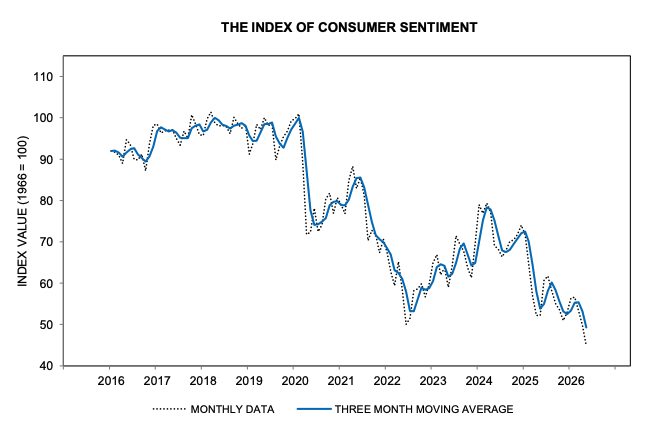
The headline consumer sentiment index fell five points to 44.9 in May, revised down from the preliminary reading of 48.2 and missing the consensus estimate of 47.8. The May reading marked a record low, coming in below the previous trough recorded in June 2022.
US Consumer Sentiment Index
Source: UMich
Consumers were mainly worried about the cost of living, with more than half of the respondents mentioning that it eroded their personal finances. Gas prices topped $4 a gallon in the aftermath of the Middle East conflict, with the nationwide average regular grade gas prices currently at $4.552, according to AAA.
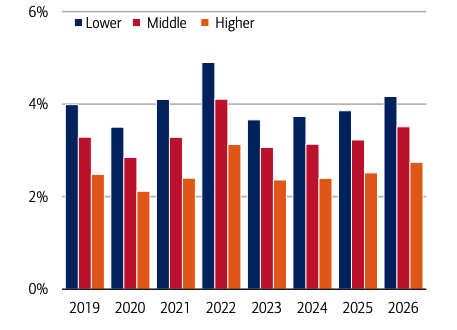
A Bank of America report states that the median lower-income household spent 4.2% of their income on gasoline, up from 3.9% a year earlier.
Proportion of Income Spent on Gas by US Households
Source: BofA
The negativity was more acute for current conditions than that of the future.
- The current economic expectations index fell 12.8% to 45.8 in May from 52.5 in April.
- The consumer expectations index dipped a more modest 8.3% to 44.1 from 48.1.
Inflation Expectations Tick Up
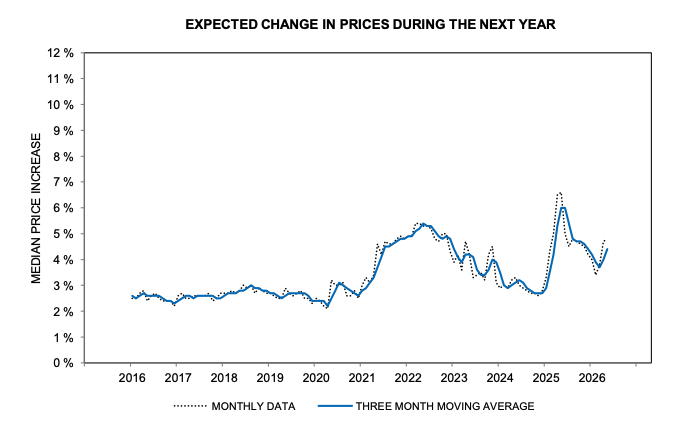
The survey found that the year-ahead inflation expectations inched up to 4.8% from 4.7% in April, markedly higher than the 3.4% rate seen in February before the Iran conflict started. The May level matched the reading seen in Aug. 2025 and was the steepest rate since June 2025.
Near-term Inflation Expectations
Source: UMich
Rising gas prices will begin to show up in reduced consumer discretionary spending elsewhere, including for vacation, dining out, apparel, electronics, entertainment etc. Historically, these adjustments do not appear instantly in economic data. There is often a lag of roughly 60 to 90 days before the pressure becomes visible in retail sales, credit card spending patterns and corporate earnings guidance from consumer-facing companies.
Longer-term inflation expectations also increased to 3.9% from April’s 3.5%. The rise in longer-term inflation expectations to 3.9% may attract particular attention from Federal Reserve officials, as policymakers closely monitor whether temporary energy shocks begin feeding into broader consumer psychology and wage-setting behavior.
A persistent rise in long-run expectations could complicate the Fed’s efforts to ensure inflation returns sustainably toward its 2% target.
Why Rock Bottom Consumer Mood is Bad for Economy
Consumer spending is the main engine of growth for the U.S. economy, accounting for roughly 66% or two-thirds of the GDP. Prolonged weakness in sentiment is a potential warning sign for broader economic momentum.
While confidence readings do not always translate directly into weaker spending, sustained pessimism could eventually weigh on discretionary purchases, particularly among lower-income households already strained by higher fuel and food costs.
The combination of weaker sentiment and rising sentiment is expected to revive worries concerning stagflation.
Fed Cornered by Growth-Inflation Collision
Three data points are now converging ahead of the June 11–12 FOMC meeting: consumer sentiment at record lows, year-ahead inflation expectations at 4.8%, and national gasoline prices averaging $4.55 a gallon. Together, they point toward an increasingly stagflationary backdrop where growth signals weaken even as inflation pressures remain elevated.
That creates a particularly difficult environment for the Federal Reserve. Weakening confidence argues for a more accommodative policy stance, but rising inflation expectations and higher energy costs reduce the Fed’s flexibility to pivot dovish too quickly.
Policymakers are especially sensitive to any signs that inflation expectations may become unanchored, as sustained increases can feed into wage demands, pricing behavior and broader financial conditions.
For markets, the combination implies reduced policy visibility and heightened sensitivity to incoming macro data. Investors should expect elevated volatility around every major inflation, labor market and consumer spending release leading into the June 11 meeting.
Read Next: US-Iran Deal vs Oil Supply Reality: Why Crude Prices Won't Crash Despite Hormuz Reopening


