South Korean memory-chip maker SK Hynix is set to make its highly anticipated Nasdaq debut on Friday, an event that could serve as an important test of investor appetite for the artificial intelligence (AI)-driven semiconductor trade. The key question is whether this catalyst can help the Nasdaq 100 Index (NDX) extend its two-day rebound, potentially pushing the benchmark above the psychologically important 30,000 level and into record territory.
Early signs are encouraging. The NDX moved firmly higher in late-afternoon trading, with semiconductor stocks providing much of the momentum even as several members of the Magnificent Seven lagged. Leading the advance was SK Hynix's U.S. rival Micron, which surged nearly 8%, underscoring renewed investor enthusiasm for memory-chip names. Boise, Idaho-based Micron also benefited from the positive headline regarding augmented (+$3 billion) U.S. investment to boost its supply chain domestically.
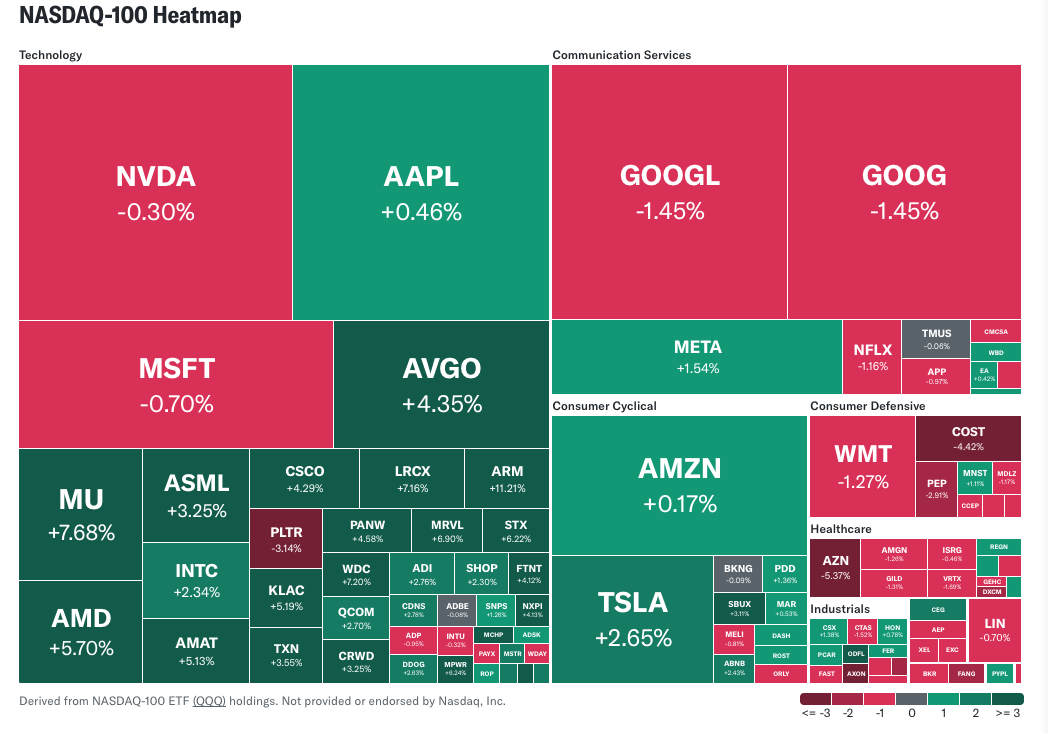
Source: Yahoo Finance
However, some caution is warranted. The recent rebound in Micron shares and those of some of the other chipmakers follows a sharp sell-off triggered first by a negative market reaction to Micron's otherwise solid earnings report and then by concerns surrounding Samsung Electronics' weaker-than-expected second-quarter preannouncement. As a result, part of the latest rally may reflect bargain hunting and position adjustment rather than a decisive improvement in sentiment toward the sector.
SK Hynix's debut therefore carries significance beyond a single stock listing. It could serve as a referendum on investor confidence in the AI infrastructure and memory-chip story that has helped drive much of the technology sector's gains this year. If demand for the shares is strong, it may reinforce the bullish case for semiconductors and provide another tailwind for the Nasdaq 100.
What You Should Know About SK Hynix’ US Debut
SK Hynix's Nasdaq listing looks less like a straightforward valuation-arbitrage play than the initial pitch suggested. By early July, Micron's own forward P/E had compressed to roughly 6.1x, essentially converging with SK Hynix's 6.2x, narrowing the very gap the listing was supposed to close. That raises a sharper question for NQ traders: is SK Hynix’s debut still a bullish re-rating catalyst, or is it walking into a market where the 'cheap versus Micron' thesis has already partly resolved itself?
According to an amended F-1 registration statement filed with the SEC this week, SK Hynix plans to offer up to 17.79 million new common shares in the form of American Depositary Shares (ADSs), with each ADS representing one-tenth of a common share. The offering would amount to approximately 2.5% of the company's outstanding common stock prior to the issuance.
The memory-chip maker has also secured strong early backing, with cornerstone investors committing to purchase a combined $7 billion worth of ADSs, providing a significant vote of confidence ahead of the listing.
SK Hynix has applied to list the ADSs on the Nasdaq under the ticker symbol SKHY.
While the final offering price will be determined in consultation with the underwriting syndicate, it is expected to be broadly linked to the market price of SK Hynix shares listed in South Korea. Based on the underlying shares' last reported closing price before the filing, the implied value works out to roughly $158 per ADS, although the final pricing could differ depending on investor demand and market conditions.
The relatively modest size of the offering, combined with substantial cornerstone investor participation, suggests the listing is aimed more at broadening the company's global investor base and enhancing its profile among U.S. technology investors than at raising capital on a transformative scale.
No immediate index-weight impact on NQ
SK Hynix's Nasdaq debut is unlikely to have an immediate impact on the Nasdaq 100 Index. The company is not expected to qualify for inclusion in the index right away, as membership typically requires a substantially larger U.S.-listed market capitalization and free float than the roughly $29 billion offering currently on the table. The more realistic opportunity for inclusion would come during the annual Nasdaq-100 reconstitution in December 2026.
That means Friday's listing should be viewed primarily as a company-specific event rather than a catalyst for index-related buying or rebalancing activity. However, investors should not dismiss its broader significance. A successful debut could reinforce confidence in the AI and semiconductor investment theme, benefiting other chip stocks and helping sustain positive sentiment across the technology sector. In that sense, while SK Hynix may not move the Nasdaq 100 through index mechanics, it could still influence the index indirectly by shaping investor appetite for one of its most important growth drivers: semiconductors and AI infrastructure.
Watch Related Chip Stocks, Not Just SK Hynix
Because SK Hynix is not yet part of the Nasdaq 100, any immediate impact on the index is likely to come through related semiconductor names rather than the stock itself. Investors should keep an eye on Micron, SK Hynix's closest U.S.-listed peer, as well as semiconductor ETFs such as SOXX and SMH, which have significant overlap with the Nasdaq 100.
If investors assign SK Hynix a valuation closer to Micron's, it could reinforce bullish sentiment toward the memory-chip sector and provide support for semiconductor stocks more broadly. Conversely, a disappointing debut could weigh on Micron and other chipmakers through sympathy selling.
Market Impact of Multi-Scenario SK Hynix Debut
| Debut Performance | Tech Sector | Broader Market | |
|---|---|---|---|
| Strong debut | ADS opens above $158-$166, hold gains through the session; strong institutional uptake | Modest semi-concentrated outperformance; since not an index component, effect short-lived | Mildly supportive for ES futures due to it being risk-appetite signal |
| Muted/In-line debut | ADS opens near reference price, stays rangebound, substantial volume, but largely arbitrage-driven | Non-event for NQ; chip industry's move better explained by macro rather than SKHY debut | bearish if hyped listing fails to excite; could come off as a AI trade exhaustion |
| Weak debut | ADS priced at or below low end of range and/or sells off on debut | Volatility risk for NQ, acute especially if compounded by risk-off macro; chip-led underperformance could ensue | Talks of AI trade cracks strengthen; broader risk-off sentiment damage |
Friday's macro backdrop (Iran headlines, Treasury yield direction) will amplify whichever scenario plays out. A strong debut in a risk-off tape gets muted, while a weak debut in a risk-off tape gets amplified.
Earnings and Market Sentiment Will Be Key
The timing of the listing adds another layer of uncertainty. SK Hynix is scheduled to report second-quarter earnings on July 29, just weeks after its Nasdaq debut. At the same time, broader market sentiment remains sensitive to macroeconomic and geopolitical developments, including tensions in the Middle East.
As a result, the stock's initial performance may depend as much on the prevailing risk environment as on company-specific fundamentals. A strong risk-on backdrop could amplify investor enthusiasm, while a risk-off market could overshadow an otherwise successful debut.
Click hereto access MarketFramework's Trade Validator tool that gives retail's positioning on various futures instruments.
Expect Volatility Rather Than a Clear Market Signal
Investors should also be prepared for elevated volatility in SK Hynix shares following the listing. Differences between the ADR price in New York and the underlying shares traded in Seoul are likely to create arbitrage opportunities for hedge funds and institutional traders, leading to short-term price swings.
However, these dynamics are likely to remain largely confined to SK Hynix and the semiconductor sector. Unless the listing materially shifts investor sentiment toward AI and chip stocks, the broader Nasdaq 100 is unlikely to experience a significant direct impact. The more important signal for the index will be whether the debut strengthens or weakens confidence in the AI-driven semiconductor trade.


