
SK Hynix opened at $170 on the Nasdaq Friday, a 14% pop over its $149 pricing, as U.S. investors finally got direct access to South Korea's second most valuable company and the dominant supplier of the high-bandwidth memory inside Nvidia's AI accelerators.
The $26.5 billion raise, 177.9 million American depositary shares, each representing one-tenth of a Seoul-listed common share stands as the largest-ever U.S. listing by a foreign company, surpassing Alibaba's 2014 debut, with institutional demand reportedly exceeding available shares more than seven times over.
But traders punching in the ticker Friday found something odd: the stock isn't trading as SKHY. It's trading as SKHYV — and that fifth letter is not a typo. It is a settlement mechanism most retail traders have never had to think about, and it matters for anyone trading the debut.
What 'When-Issued' Actually Means
SKHYV is a when-issued ticker, the trailing 'V' is Nasdaq's designation for a security trading on a 'when, as and if issued' basis. The ADSs sold in the offering have been priced and allocated, but the offering itself has not formally closed and settled.
Until it does, the shares technically do not exist yet in investors' accounts. When-issued trading lets the market establish price discovery immediately - Friday, the first session after Thursday night's pricing while the legal plumbing of issuance completes behind the scenes.
Every trade in SKHYV is therefore a conditional contract: it settles when, and only if, the underlying ADSs are formally issued. Per Nasdaq's data-technical notice to market data distributors, the symbol is expected to convert to SKHY on Monday, July 13, with all SKHYV trading history carrying over to the permanent ticker.
Practically, for traders, Friday's session is real price discovery with real money — the conditionality is a formality in a deal this oversubscribed — but it explains why options are absent (Cboe is expected to list them two business days after the debut).
Why the Structure Was Necessary
The when-issued bridge is a byproduct of what this deal is: not a conventional IPO, but a cross-border ADR offering layered on top of a company that has traded in Seoul since long before most of its new U.S. shareholders knew its name.
Each ADS must be created against deposited Korean common shares, a custody chain that adds settlement steps a domestic IPO doesn't have.
As Schwab's Kevin Hincks noted ahead of the open, the ADR structure makes this debut different from a standard IPO and primed for a volatile first session — the pop-and-fade risk is amplified when the arbitrage anchor is a live Korean share price rather than a banker's estimate.
Speaking on the listing, Chey Tae-won, Chairman, SK Hynix, said "It's a kind of dream, and now it's a dream come true.” in a conversation with CNBC.
The Nasdaq Read-Through
For index futures traders, the debut is a sentiment referendum on the most crowded trade in the market.
SK Hynix's valuation has risen more than sevenfold in a year to roughly $1 trillion as the memory shortage sent prices to records, and its chairman told CNBC that customers responded to a planned five-year capacity doubling by asking for more.
A debut that holds its opening premium validates the AI-hardware complex that has driven NQ's outperformance over YM; a fade below the $149 issue price would echo the sell-the-news pattern that followed last month's SpaceX IPO and pressure the semis complex that carried Thursday's tape.
Monday adds a second layer: leveraged single-stock ETFs tied to the name are expected to launch alongside the SKHY conversion, injecting fresh derivative flow just as the when-issued training wheels come off.
Nasdaq Four-Hour Chart, July 10, 2026
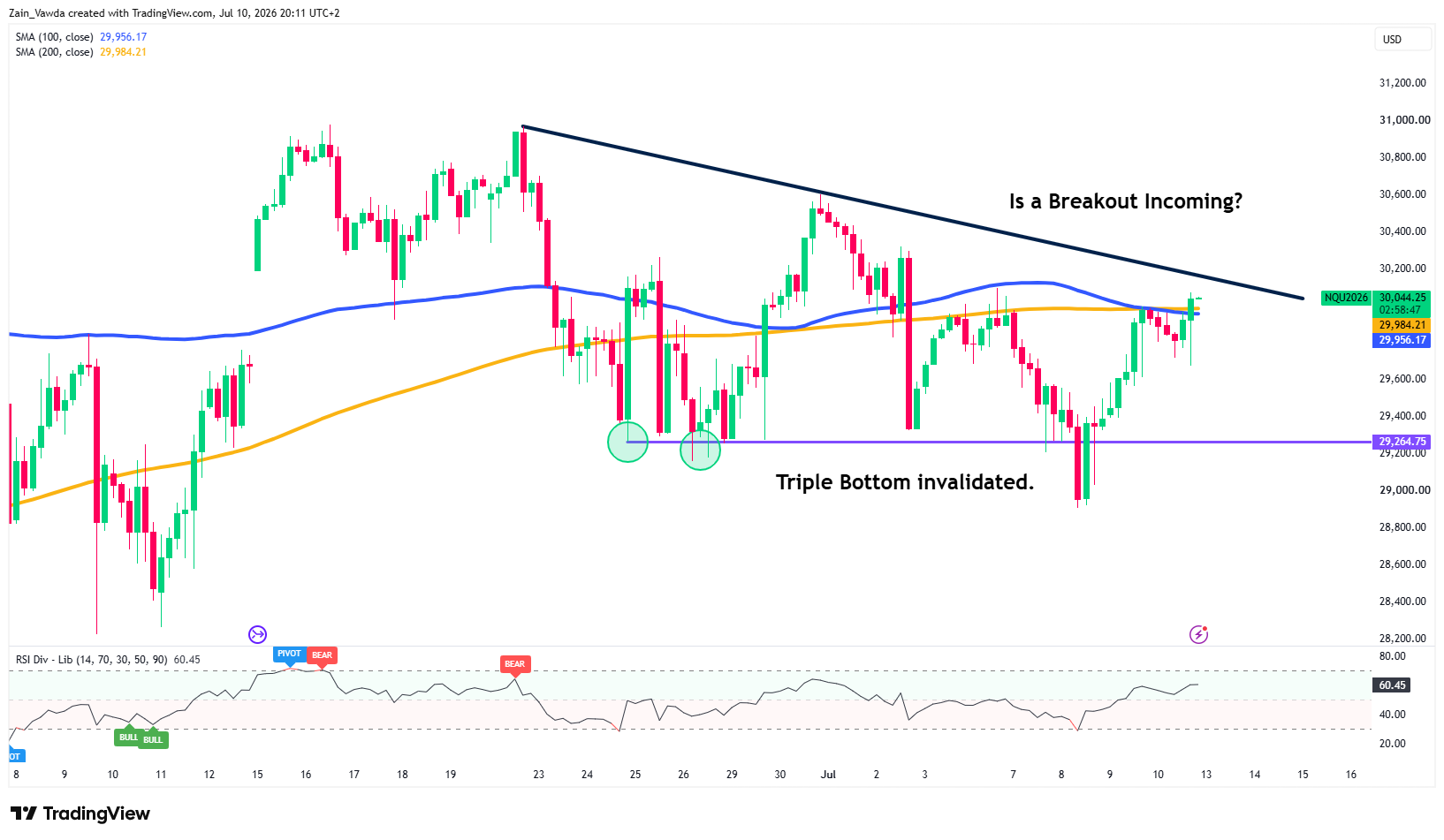
Source: TradingView
What to Watch Into Monday
Three markers. First, whether SKHYV closes above the $170 open, an allocation-chase signal from the seven-times-oversubscribed book.
Second, the Seoul-ADR spread: each ADS represents a tenth of a common share, so any persistent premium to the Korean close is pure US scarcity, and arbitrage desks will compress it once regular-way settlement begins.
Third, Monday's ticker conversion itself, index-inclusion speculation and the ETF launches make the first regular-way session, not Friday's conditional one, the cleaner tell on institutional commitment.


