
Two independent data released Thursday are telling the same story: the era of aggressive corporate layoffs is fading. Whether that translates into a strong jobs report Friday is a separate question but the risk of an outright bad one just got smaller.
The claims data: three weeks, one direction
The Labor Department's weekly claims report showed initial jobless claims at 188,000 for the week ending July 18, then 197,000 for July 25, then 199,000 for the week ending August 1. That's three consecutive prints under 200,000, pulling the four-week moving average down to 202,750 , among the lowest readings of the past year.
Subdued Claims
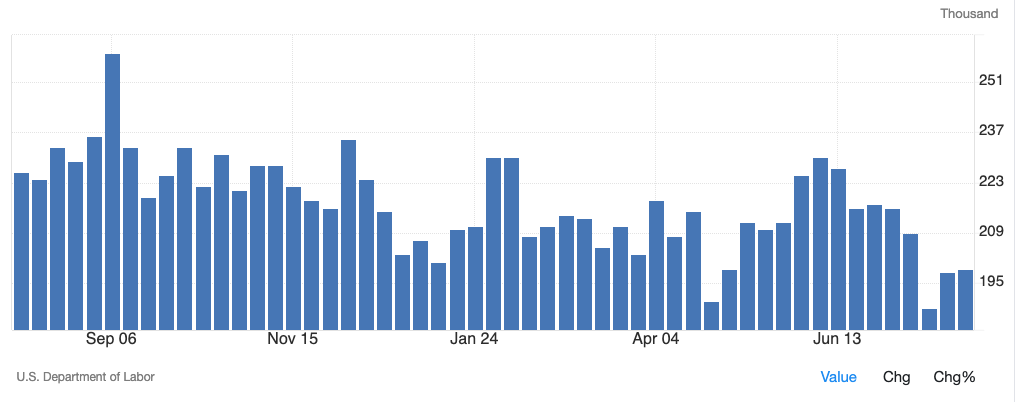
Source: Chart courtesy of Trading Economic; Data Source: DOL
Continuing claims, which track people still receiving benefits, have held near 1.78–1.8 million, also close to cycle lows. That series matters because it's less noisy than the weekly initial claims number and tends to track the broader trend in slack more reliably.
Neither number is a guess about the future. They're a direct read on how many people are being separated from jobs right now. And right now, not many are.
Challenger confirms it from the employer side
Thursday's Challenger, Gray & Christmas report put U.S. employers' announced job cuts at 33,429 in July — down 27% from June and the lowest monthly total in two years. Year-to-date cuts are down 41% from the same point in 2025.
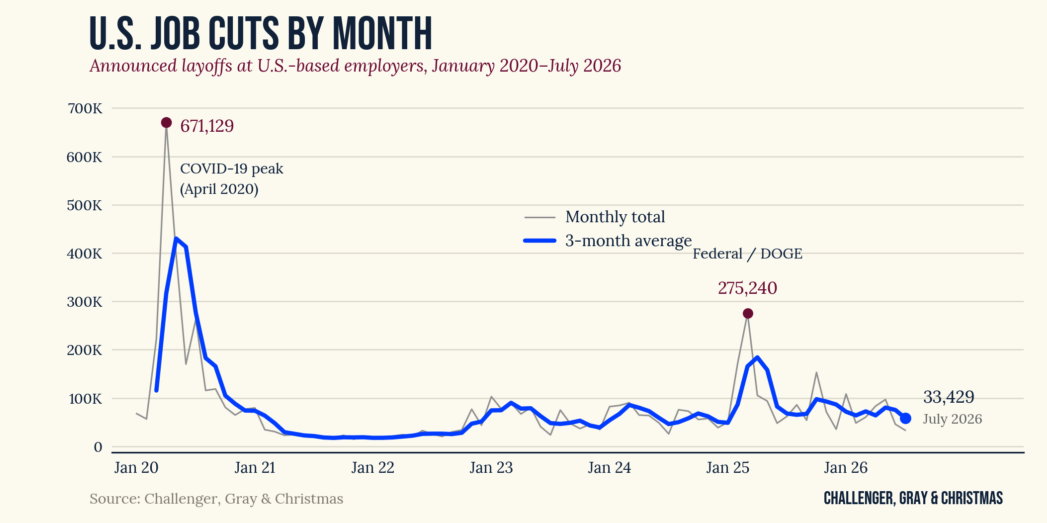
Source: Challenger, Gray & Christmas
Some of that decline is a base effect: government-sector layoffs are down 93% from a year ago, simply because last year's federal workforce reductions were unusually large and are now falling out of the comparison. But even excluding that distortion,18 of the 30 industries Challenger tracks have announced fewer cuts than at this point last year, pointing to a genuine slowdown in corporate cost-cutting via headcount.
Technology remains the exception. It's still the single largest source of cuts this year, at 149,023 through July, up 67% from the same period in 2025, with artificial intelligence (AI) cited as the leading reason for layoffs for a fifth straight month. But that's a concentrated, sector-specific story, not a broad-based one.
Why this caps NFP's downside, not its upside
Here's the trade logic. Initial and continuing claims are the closest thing to real-time evidence on layoffs since they update weekly, they're not subject to the kind of large revisions that plague the payrolls survey, and historically, spikes in claims have preceded soft or negative payroll prints by weeks. When claims are this low, a surprise negative non-farm payrolls (NFP) print, the kind driven by a wave of layoffs the market didn't see coming, becomes much less likely. Click here to read our preview on July jobs data.
But claims and Challenger data measure firing, not hiring. And that's the piece that's been missing. Challenger's own hiring-plans data, a proxy for employer hiring intent, not actual placements, showed employers announcing 16,095 planned hires in July, up sharply from a depressed 3,200 a year ago, but still below where the same month sat in 2022 (25,506). The improvement is real; the base it's improving from is weak.
Claims and layoffs protect against a downside surprise, but they say almost nothing about whether payroll growth will beat expectations. A soft-but-in-line NFP print is arguably the most likely outcome under this data, not because the labor market is falling apart, but because employers are neither cutting nor expanding at any real pace. Traders positioning for a strong beat on the back of low claims are extrapolating from the wrong half of the labor market equation.
ADP July data also complicates the picture. Private payrolls added just 44,000 jobs, well below the 68,000 consensus and a sharp deceleration from June's downwardly revised 95,000, the weakest monthly gain since January.
Nearly all of the growth came from a single sector: education and health services contributed 36,000 of the 47,000 services-sector gain, while goods-producing industries shed 3,000 jobs and leisure/hospitality lost 11,000. That's not the picture of a broadly firming labor market.
What to watch in Friday’s release
- The unemployment rate, which tracks more closely with continuing claims than the headline payroll number; A tick down here would corroborate the claims signal.
- Revisions to prior months, which have been a bigger market mover than the headline print itself over the past year.
- Sector composition, specifically whether hiring is showing up outside tech, aerospace, and autos, the three areas Challenger flagged as carrying 2026's hiring gains so far.
The floor looks solid. Whether there's a ceiling worth trading is what tomorrow's number will actually tell you.


