
The Japanese Yen Futures (6J) contract edged higher against the U.S. dollar in the Asian session on Tuesday as traders digested the better-than-expected first-quarter (Q1) GDP report released by Japan’s Cabinet Office.
Robust Exports Drive Growth
The Q1 GDP expanded at a seasonally adjusted quarterly rate of 0.5%, quicker than the downwardly 0.2% growth experienced in the fourth quarter of 2025 and representing the fastest expansion pace since the third quarter of 2024. Economists had expected a more modest 0.4% GDP growth for the quarter.
Japanese QoQ GDP Growth
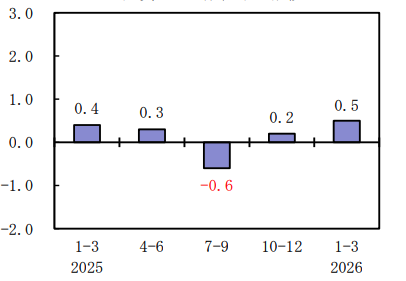
Source: Japan Cabinet Office
Sifting through the report reveals:
- Net exports contributed 0.3 percentage points (ppt) to growth as the export growth of 1.7% was partly offset by 0.5% import growth.
- Domestic demand edged up 0.2%, contributing to 0.2 ppt to growth.
- Among domestic demand items, household spending rose 0.2%, and when imputed rent was excluded, the spending growth was 0.3%. Private residential and non-residential investment climbed 0.5% and 0.3%, respectively, but slowed from the 5% and 0.3% growth for Q4.
- Public investment surged 1.4%, contributing 0.1 ppt to growth.
- Gross fixed capital formation (GFCF), which comprises private residential and non-residential investment and public investment, increased by 0.5%, slower than the 1.6% growth in the previous quarter.
- Public inventories remained neutral to growth and private inventories deducted 0.1 ppt from growth.
On a year-over-year (YoY) basis, the Japanese economy expanded 2.1%, more than the 1.7% consensus estimate and faster than the fourth quarter’s revised 0.8% growth.
The inflation reading of the report showed pricing pressure exceeding expectations The GDP deflator, which is calculated as a ratio of nominal GDP to real GDP, remained unchanged at 3.4% YoY but came in above the 3.2% rate expected by economists.
Outlook Muted as Input, Import Costs Bite
The Q1 GDP data do not reflect the full impact of the U.S.-Iran war that started on Feb. 28, and the conflict has raged on since without a resolution in sight.
Commenting on the report, ING South Korea and Japan Senior Economist Min Joo Kang said, “It demonstrates the economy’s resilience and indicates its ability to endure higher interest rates.”
The economist expects the growth to slow in the current quarter and the next due to energy shocks. She sees consumer spending continuing to grow, although at a slower pace, as government subsidies and wage growth support spending. Heightened uncertainty amid the geopolitical tensions and higher input costs will drag down investments, she added.
On the other hand, Kang expects inventory and net exports to drag down overall growth. Even if the war ends by the end of the second quarter, stockpiling oil and gas would inflate import costs, potentially denting Q3 growth, the economist noted
June Rate Hike on the Table
ING viewed that the Bank of Japan (BoJ) can modify the pace of Japanese Government Bond (JGB) purchases if needed. The firm expects the central bank to deliver rate hikes as the real interest rates remain in negative territory and the economy remains resilient.
The firm premised its rate-hike call to the need to anchor inflation expectations and prevent yen depreciation from further escalating inflationary pressures. The central bank will also look to narrow the yield gap with the U.S. Federal Reserve to support the yen and contain imported inflation.
ING expects a June rate hike and another in the fourth quarter, with the timing of the latter depending on the developments in the Middle East and the BoJ’s ability to convince the government of the need for rate hikes.
The BoJ ended its longstanding zero interest rate regime in March 2024 and several hikes since have left the uncollateralized overnight call rate at 0.75% currently. In comparison, the Fed funds rate stands at 3.50%-3.75%.
BoJ Uncollateralized Overnight Rate
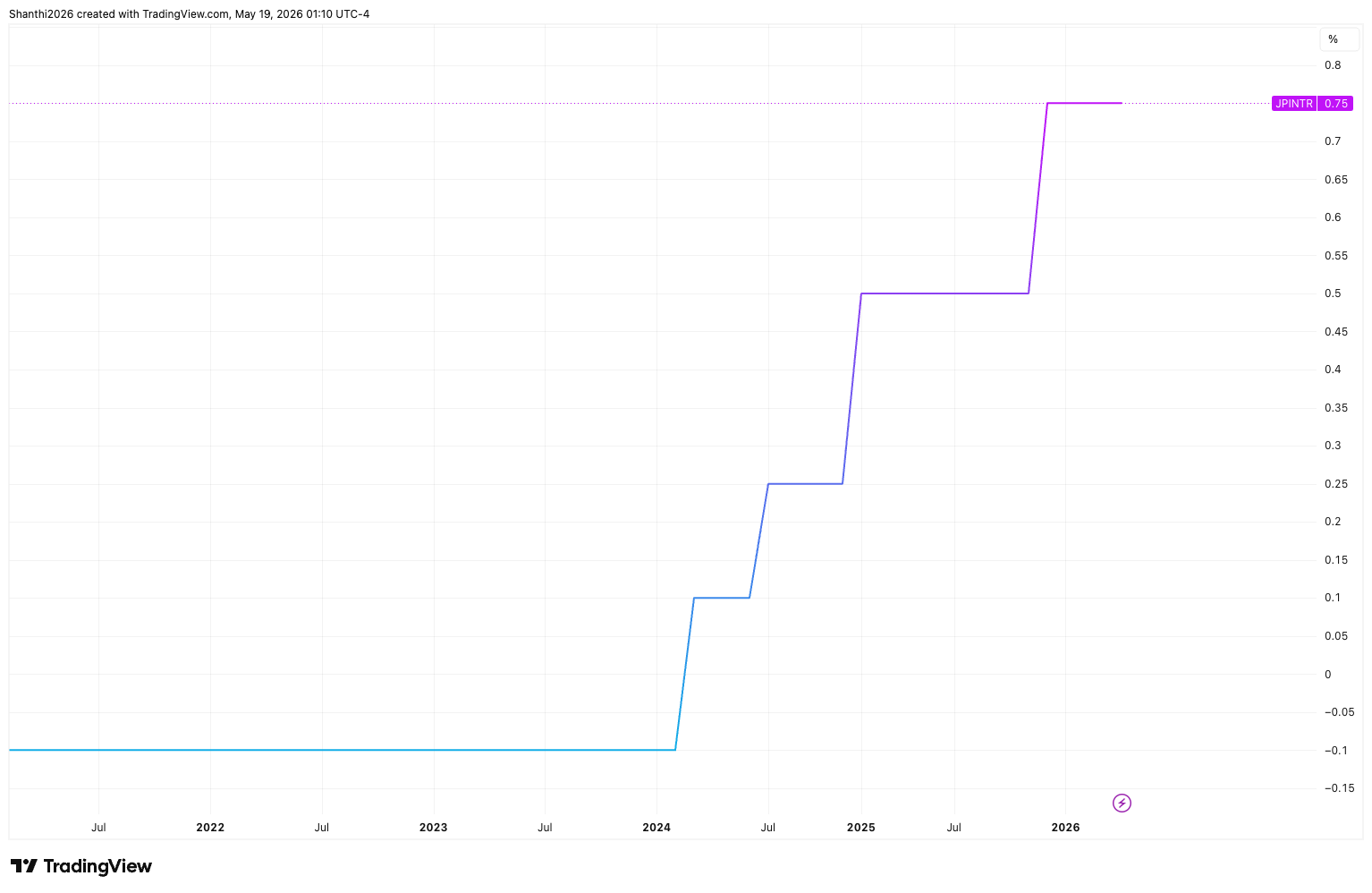
Source: TradingView
Markets React: Yen Firms, Asian Stocks Slide
In the forex market, the 6J contract firmed modestly on the GDP beat, although well off the levels seen in mid-2025. Meanwhile, the USD/JPY edged u[ to nearly 159 yen in the cash market as the broader dollar strength capped yen’s gain.
Yen Futures (One-year Chart)
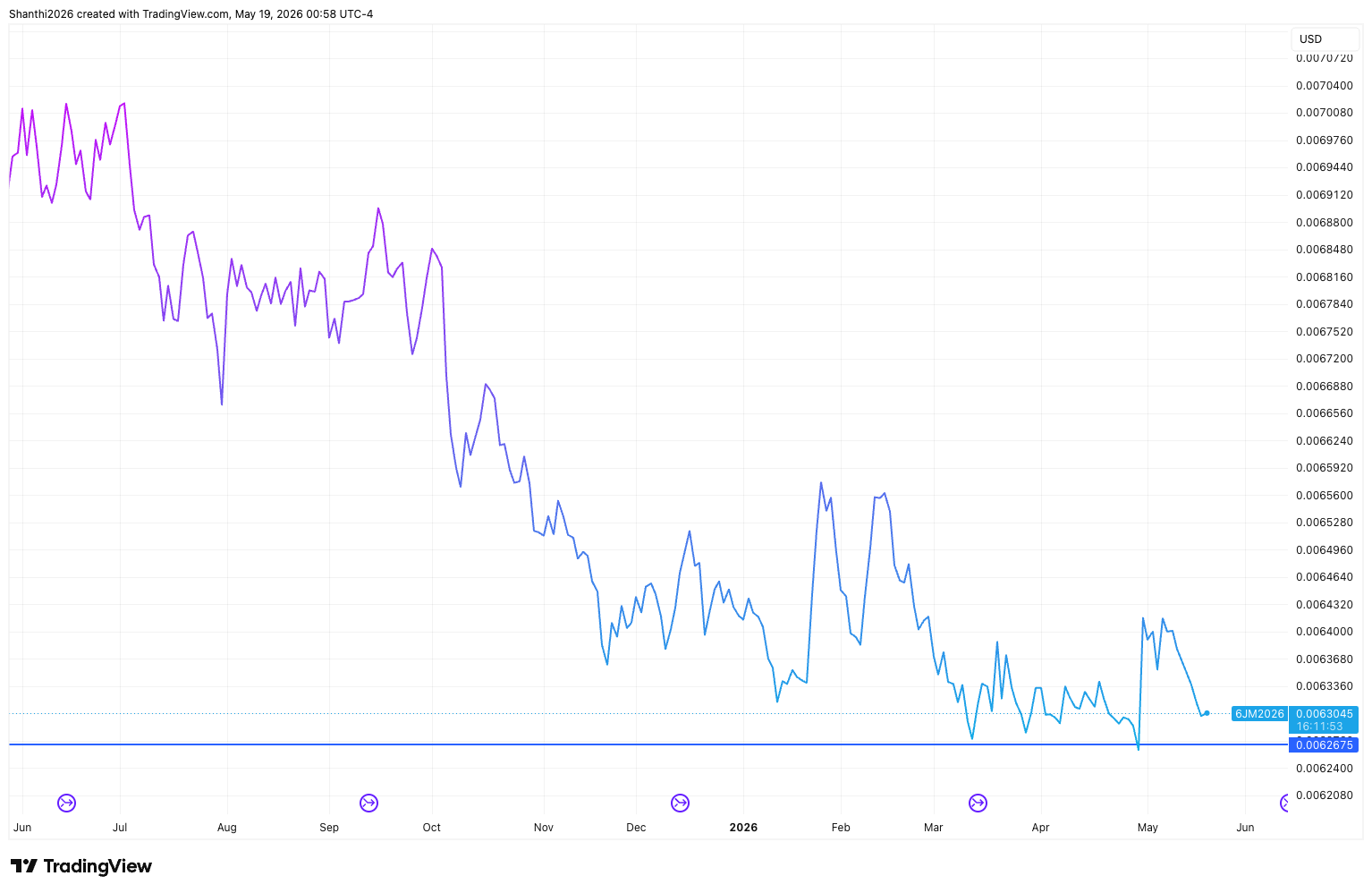
Source: TradingView
The Japanese equity market retreated, with the Nikkei 225 losing close to 1%. The mood across Asia was broadly cautious, with the tech-heavy Kosdaq in Korea and Taiwan's Taiex both under pressure, as the Kospi staged a modest recovery from early lows. Sentiment remained fragile following weakness in U.S. equities overnight, with elevated oil prices and geopolitical uncertainty continuing to weigh on the region.


