Crude futures remained volatile as the commodity continued to be highly exposed to escalating geopolitical tensions in the Middle East involving the U.S. and Iran. Since the escalation of the conflict in late February, the contract has gained more than 56%.
The strong rally raises questions about how much of the move is being driven by actual supply risks versus speculative geopolitical premium. While traders continue to price in the possibility of disruptions to regional energy infrastructure and shipping routes, some analysts argue that fears of a worst-case supply shock may be outpacing the current fundamental impact on global crude flows.
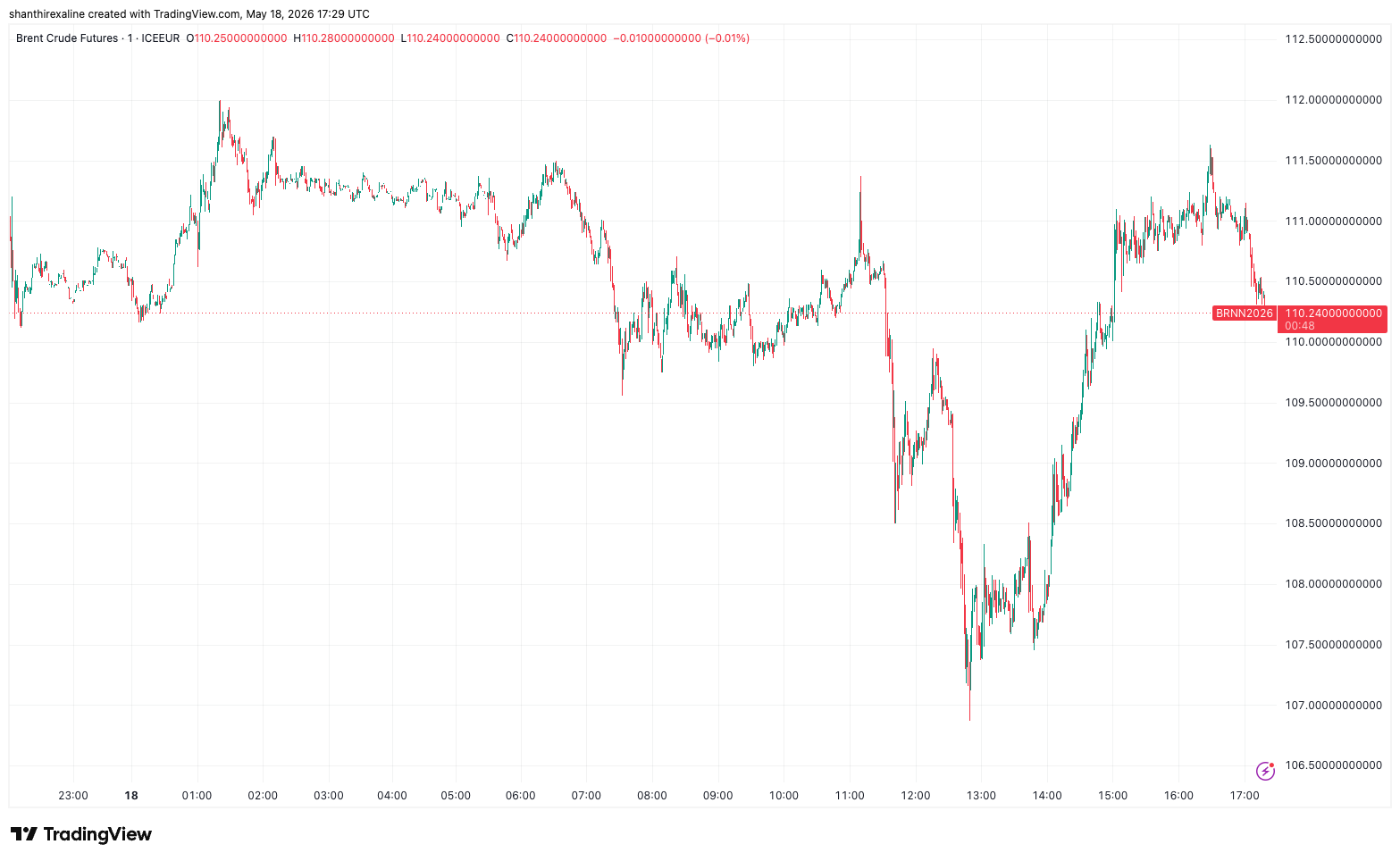
Monday’s price action offered a textbook example of a headline-driven move in oil markets.
Brent Crude Chart (One-day chart)
Source: TradingView
Diplomacy Rumors Pull Crude from Peak
Brent crude futures for July delivery climbed above $111 during the early European session after reports emerged that a nuclear power plant in the United Arab Emirates (UAE) had come under attack. To make matters worse, U.S. President Donald Trump warned on Truth Social that “For Iran, the Clock is Ticking, and they better get moving, FAST, or there won’t be anything left of them. TIME IS OF THE ESSENCE!”
https://truthsocial.com/@realDonaldTrump/posts/116590914302000241
Oil prices subsequently rose to their highest level since early May. However, the contract later surrendered those gains and turned lower after reports suggested that diplomatic efforts to resolve the standoff were ongoing. Prices have since remained highly volatile, swinging sharply between escalation fears and signs of potential de-escalation.
Iranian Foreign Ministry spokesperson Esmaeil Baqaei said during a press conference that the U.S. had sent “a set of revised points and considerations” through Pakistan last week, according to IRNA, Iran’s official state news agency. The communication followed the Trump administration’s rejection of a 14-point proposal submitted by Iran.
Baqaei’s remarks that “the process is continuing through Pakistan” eased some market concerns over a potential escalation, prompting crude futures to retreat from the day’s highs.
Separately, the semi-official Tasnim News Agency reported, citing a source close to the Iranian negotiating team, that the U.S. had shown willingness to discuss temporary sanctions relief. The report further supported hopes that backchannel diplomacy between Washington and Tehran remained active despite the recent escalation.
Do Fundamentals Support $100+ Prices?
Brent entered 2026 as a bearish commodity, having finished lower in each of the previous three years. Before the start of the year, JP Morgan projected world oil demand growth of 0.9 million barrels per day (mb/d) for 2026. Although the firm estimated that supply would markedly outstrip demand, it still viewed the market to be in equilibrium, courtesy of voluntary and involuntary production cuts. As a result, the firm projected Brent crude to average $58 in 2026, and remain largely flat at $57 in 2027.
In its mid-year review, JPMorgan said, prices significantly exceed most pre-conflict fundamental forecasts. Anything beyond $58 could therefore be interpreted as a combination of war-related risk premium and speculative positioning. By that measure, roughly 55% of the current price level may still be fundamentally justified, while the remainder reflects geopolitical uncertainty and headline-driven volatility.
The monthly oil market reports released by the Organization of Petroleum Exporting Countries (OPEC) and International Energy Agency (IEA) painted a mixed demand outlook. While the former maintained its 2025 demand growth outlook at 1.2 mb/d, propped up by non-OECD economies, the latter estimates a modest contraction in oil demand.
Markets also remain highly sensitive to developments surrounding the Strait of Hormuz, a critical chokepoint through which roughly one-fifth of global oil supply passes.
Most analysts now project a manageable impact from the closure of the Strait of Hormuz. Morgan Stanley’s baseline forecasts assume the Iran conflict will be resolved by mid-June. However, the bank’s worst-case scenario, which factors in re-escalation of the conflict, could push oil prices above $150 a barrel, potentially tipping the global economy into recession.
Read Next: Yuan Futures Defy Weak Data as Forex Market Bets on Stimulus Support


