Growth decelerated in Q2 as consumer spending strengthened, while PCE inflation cooled, matching estimates. Jobless claims held near multi-week lows, reinforcing a gradual labor-market slowdown rather than an abrupt downturn.
The latest U.S. economic data painted a picture of an economy that continues to expand but at a slower pace, and the Federal Reserve’s preferred inflation gauge slowed slightly in line with expectations, while the labor market continued to show resilience, according to a trio of reports released Thursday.
GDP: Growth Slows, Domestic Demand Holds Up
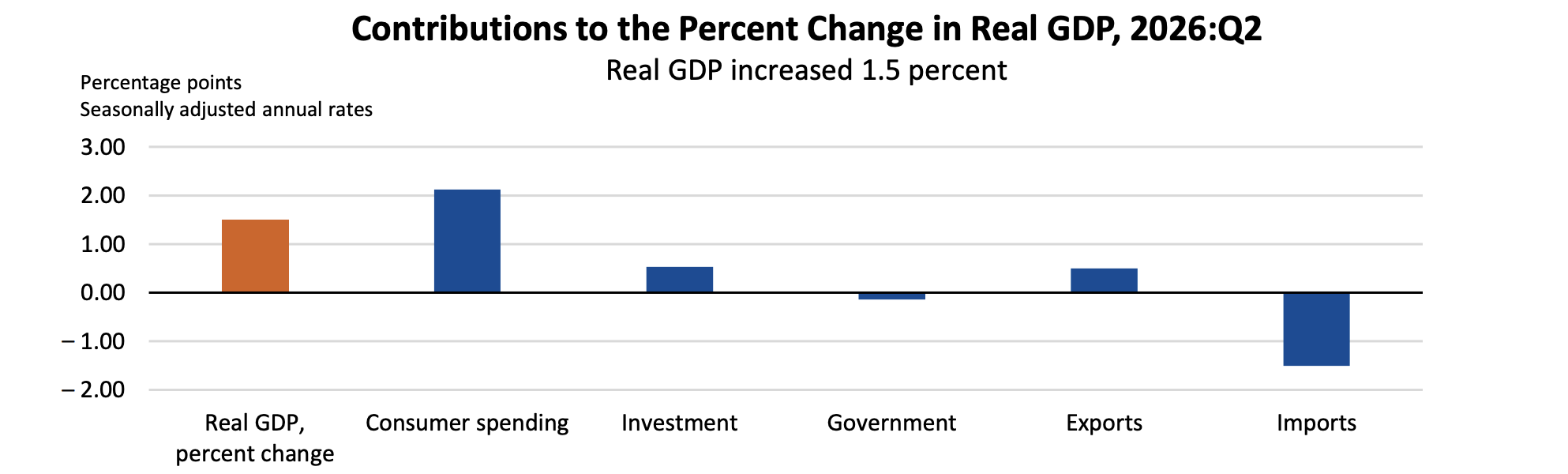
U.S. real GDP grew at an annualized 1.5% quarter-over-quarter pace in the second quarter, according to a Bureau of Economic Analysis (BEA) report. This marked a slowdown from first quarter’s 2.1% growth, and came in below market expectations.
The sequential slowdown in growth reflected:
- a downturn in government spending
- deceleration in investment, mainly non-residential investment
- deceleration in exports (to 4.5% from 10.9%), compounded by a strong import growth (+11.5%)
An acceleration in consumer spending growth to 3.2% from 0.5% partly mitigated the weakness. that were partly offset by an acceleration in consumer spending. Imports increased more in the second quarter than in the first quarter.
Source: BEA
Residential investment remained weak, reflecting the drag from high mortgage rates.
Beneath the headline, private demand looked healthier. Real final sales to private domestic purchasers, which combines consumer spending and private fixed investment, rose 3.9%, more than double Q1's 1.7% pace. That's often read as a cleaner gauge of underlying momentum than headline GDP.
Prices, however, ran hot. The price index for gross domestic purchases jumped 5.7%, up from 3.6% in Q1, while the PCE price index rose 5.1% versus 4.6% previously. Core PCE (ex food and energy) came in at 3.4%, versus 4.4% in Q1.
Personal Income & Spending: Consumers Keep Spending
June's report offered a softer read than the GDP price data implied. Personal income rose $54.9 billion (0.2%) in June, disposable income increased $48.3 billion (0.2%), and consumer spending (PCE) rose $65.2 billion (0.3%), split between $58.2 billion in services and $7.0 billion in goods. The personal saving rate held at 2.7% of disposable income.
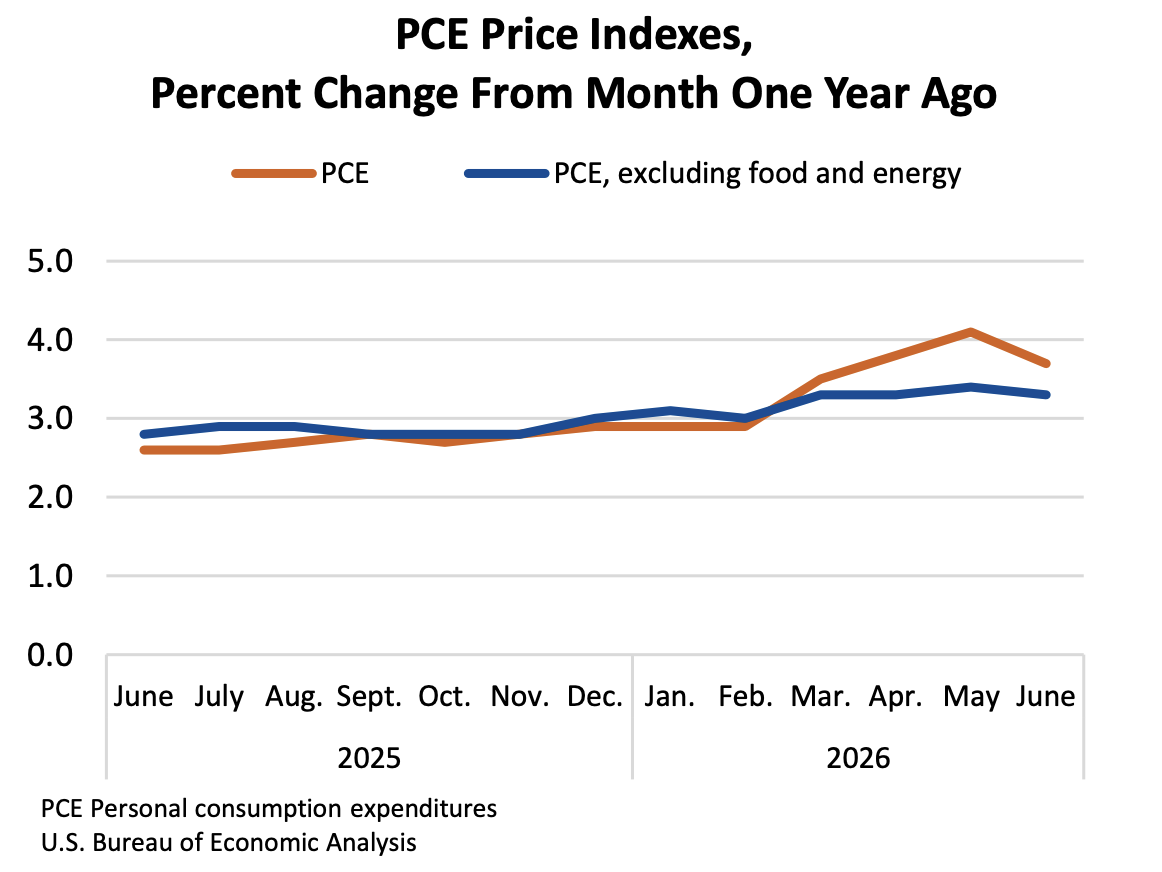
On inflation specifically: the monthly PCE price index actually fell 0.1% in June (in line with the consensus and slowing from May’s 0.5% growth). Meanwhile, core PCE (ex food and energy) rose just 0.1% for the month (vs 0.2% consensus & May 0.3% growth). Year-over-year, headline PCE inflation ran at 3.7% and core PCE at 3.3%, both in line with the consensus, both slowing from May’s 4.1% and 3.4% rate, respectively.
PCE Inflation Slows
Source: BEA
Nevertheless, inflation remains well above the 2% central bank goal. In his press briefing, Fed Chair Kevin Warsh said the central bank is fixated on the 2% target.
There is no soft inflation target, there is no soft implicit target —not on this Committee’s watch. There is only a target, and it is 2 percent. Not one of my FOMC colleagues is under any illusion.
The income gains were driven by higher compensation (led by private wages), investment income, and government social benefits (Medicare and Social Security), partly offset by a drop in farm proprietors' income tied to relief-program payment timing.
Labor Market Stays Resilient
The Department of Labor's weekly unemployment claims report indicated that initial jobless claims remained relatively low at 197,000 for the week ended July 25, suggesting layoffs remain limited. Economists had expected claims at 201,000 from the revised 188,000 reported for the previous week.
But continuing claims stayed elevated, pointing to workers taking longer to find new jobs after becoming unemployed.
Overall, the labor market continues to cool gradually rather than deteriorate sharply, reinforcing the Fed's view that employment conditions remain relatively healthy.
Piecing it together
The data set paints a "goldilocks-adjacent but not quite" picture for the Fed: growth is cooling from Q1's pace, monthly inflation trends (June PCE) look tame, but the broader Q2 GDP price gauges ran well above Q1's — a divergence likely to keep the committee cautious ahead of September. Meanwhile, jobless claims rose less than expected, suggesting the labor market isn't cracking, giving the Fed room to stay patient rather than rush toward the September hike three dissenters pushed for this week.