The Iran conflict that sent gasoline prices soaring buoyed March retail sales, which grew at the fastest pace in more than three years, according to a report released by the Census Bureau on Tuesday.
In early market reaction, the S&P 500 E-Mini futures (ES) contract held to its early gains and the 10-year Treasury-note yield climbed.
Crunching the Numbers: Retail sales climbed 1.7% month-over-month in March, faster than February’s upwardly revised 0.7% growth. Economists had expected a 1.4% increase for the month vis-a-vis the 0.6% growth estimated earlier.
On a year-over-year (YoY) basis, retail sales climbed 4% in March compared to a 3.71% increase in February.
Among the other key measures:
- Core retail sales (excluding autos): 1.9% Vs. upwardly revised 0.7% in February (1.4% consensus)
- Retail sales, excluding gas and autos: 0.6% Vs. upwardly revised 0.6% in February
- Retail control (excluding autos, gasoline, building materials and food services): 0.7% Vs upwardly revised 0.6% in February (0.2% consensus)
Gasoline station sales jumped 15.5% MoM following a 1.3% increase in February. YoY, the increase was 18.1%. Auto sales decelerated, while furniture & home furnishings, electronics & appliances, building materials and food & beverage store sales all witnessed accelerated growth.
Morgan Stanley strategists said the effects of the Middle East conflict will likely to be more visible in later months, once there is a better understanding of how long the disruption is likely to last and whether consumers will need to substitute away from other goods spending.
Read-Across for Rates: Retail sales are a key component of the personal consumption expenditure (PCE), which makes up two-thirds of GDP. Final GDP estimates released earlier this month showed the U.S. economy expanding at an annual rate of 0.5% in the fourth quarter, markedly slower than third-quarter’s 4.4% growth.
While the Federal Reserve decided monetary policy, keeping in mind the dual mandate of maximum employment and stable prices, strong growth, along with inflation may keep the doors open for rate hikes.
The Fed’s rate-setting committee, the Federal Open Market Committee, is scheduled to meet on April 28-29 to decide on the monetary policy. Futures markets currently see a 99.5% chance of a pause at 3.50%-3.75%, per the CME Group FedWatch Tool.
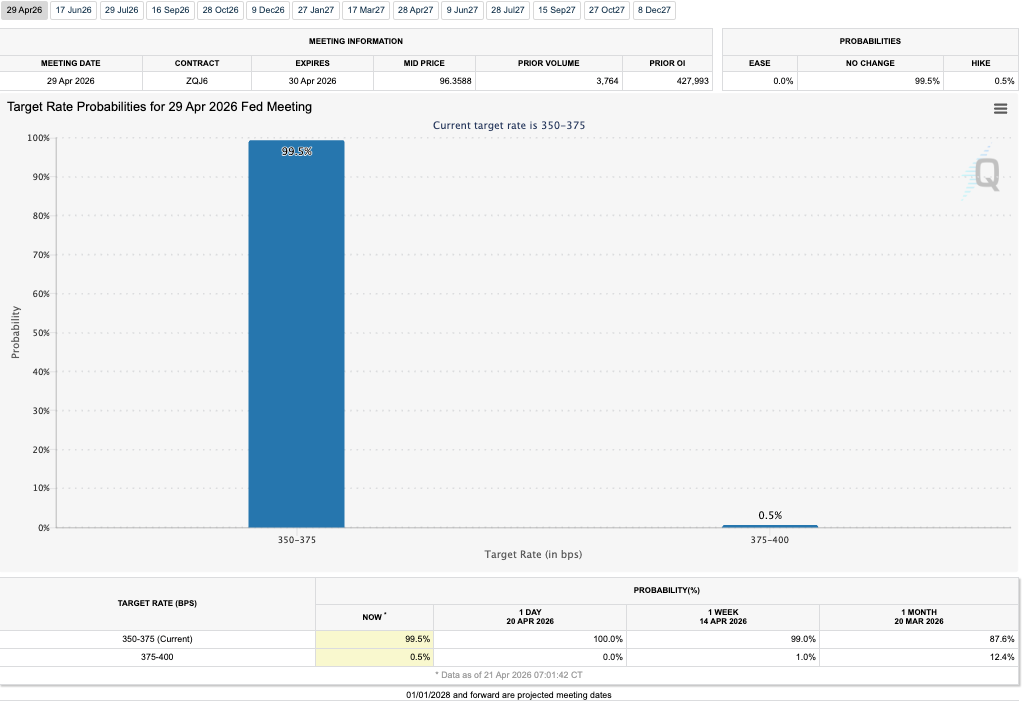
Source: CME
Inflation readings have seen a spurt in March due to higher gasoline prices following the supply shock that stemmed from the Middle East conflict that has shuttered cargo shipments through the Strait of Hormuz, a major chokepoint in the Persian Gulf. The central bank, however, has so far shrugged off the inflation as transitory.