The European Union’s (EU) trade surplus with the U.S. declined by 67% in March as exports to the country declined sharply, a Eurostat report showed Tuesday. Notwithstanding the sharp plunge, the U.S. continued to be the EU's top export destination among the countries outside the bloc.
Europe's Trade Edge With US Fades Fast
The EU exported 45 billion euro worth of goods to the U.S. in March, down 37.1% year over year (YoY), while its imports from the U.S. rose 1.1% to 31.5 billion euros. This resulted in a trade surplus of 13.5 billion euros, down sharply from 40.5 billion euros a year ago.
Commenting on the data, Institute of International and European Affairs Chief Economist Dan O’Brien said, “Tariffs have hit EU exports to America, but today's figures for March 2026 show the value of goods sold to the US at similar levels to the average in 2024 - €45 billion per month.”
The March export decline follows a period of front-loading, where businesses rushed shipments to the U.S. ahead of anticipated tariffs, artificially inflating export numbers through much of last year. Economist Christophe Barraud had flagged ahead of the data release that once the front-loaded surge subsided, exports would gradually weaken, a trend now clearly reflected in the March figures.
Following the “Liberation Day” tariffs announced by U.S. President Donald Trump in April 2025, and the subsequent U.S. Supreme Court ruling striking down the administration’s use of the International Emergency Economic Powers Act (IEEPA) as the legal basis for those measures, the U.S. now applies a flat 10% tariff on imports from the European Union. Steel and aluminum imports remain subject to a higher 50% tariff under Section 232 national security provisions. Trump has granted the European Union until July 4, to finalize and ratify a bilateral trade agreement with the U.S.
EU-China Trade Gap Widens Further
Imports from China climbed nearly 3% to 50.3 billion euros, while exports to the world’s second-largest economy fell 2.3% to 17.7 billion euros, leaving the 27-country alliance at a deficit of 32.6 billion euros.
Energy Trade in Deficit
The report also showed that energy imports from the rest of the world increased 8.2% to 40.2 billion euros, while EU’s energy exports, though rising 15.8%, totaled 11.6 billion euros, resulting in the widening of the deficit to 28.6 billion euros.
Among manufactured goods, the surplus on the trade in machinery & vehicles as well as chemicals fell sharply.
Euro Area Surplus Shrinks
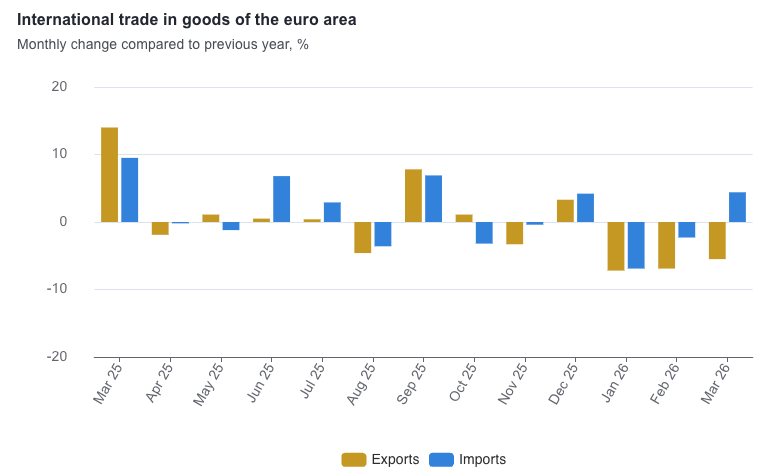
The euro area, comprising 21 countries sharing the euro as the common currency, collected a much smaller trade surplus of 7.8 billion euros in March, down 77% from the 34.1 billion-euro surplus in the year-ago period, and a 11.1 billion-euro surplus in the previous month. Economists had expected a smaller surplus of 5.4 billion.
EU Export-Import Data
Source: Eurostat
The smaller surplus reflected a 5.5% export decline to the rest of the world, accentuated by a 4.4% rise in imports. The EU’s trade surplus was a more modest 5.9 billion euros, down from the 34 billion-euro surplus a year ago, with the divergence from the euro area figure reflecting trade flows from non-euro EU members such as Poland, Sweden, and Denmark.
The sharp contraction in both the EU and euro area surpluses signals that the unwinding of pre-tariff front-loading, combined with softening global demand and an oil shock driven by Middle East tensions, is beginning to leave a tangible mark on Europe's external trade position.
Read Next: Japan Economy Defies Iran War's Energy Shock as Exports, Consumer Spending Come to the Rescue


