
A trio of reports released by the Census Bureau on Wednesday showed that the U.S. economy remained fairly resilient in March despite a pick up in inflationary pressure amid the U.S.-Iran war, confounding the Federal Reserve’s monetary policy outlook. Durable goods orders reversed a three-month declining streak in March, while housing starts unexpectedly increased, although building permits posted a surprising drop.
Durable Goods Orders Rebound
New orders for durable goods, items designed to last three years, or more climbed 0.8% month over month (MoM) in March, reversing some February’s 1.2% drop. Core durable goods orders, which exclude volatile transportation orders, rose 0.9%, slower than the upwardly revised 1.2% increase in the previous month.
Economists had expected both metrics to rise 0.4%.
Durable Goods Orders
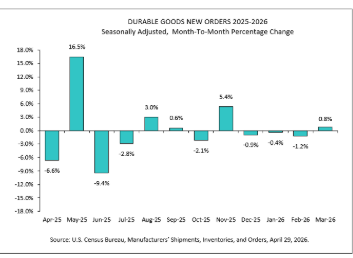
Source: Census Bureau
Non-defense capital goods orders, excluding aircraft and parts, considered a proxy for capital spending, rose 3.3%, faster than the previous month’s upwardly revised 2.3% growth and the 0.5% consensus estimate.
Computers and electronics products orders increased by 3.7%, lending support to the headline number.
Mixed Housing Market Readings
A separate report showed housing starts coming in at a better-than-expected 1.502 million in March, on a seasonally adjusted annual pace. This compares to February’s 1.398-million-unit rate. Economists, on the other hand, expected a slight dip to 1.380 million units.
On the other hand, building permits, an indicator of future housing activity, unexpectedly fell to a seasonally adjusted annual rate of 1.372 million units from 1.386 million units in February.
Trade Deficit Widens
Advance estimates released by the bureau showed the March trade deficit widening to $87.9 billion from $83.5 billion in February. Exports climbed by $5.2 billion month over month, while imports rose a steeper $9.6 billion.
The Fed’s rate-setting committee, the Federal Open Market Committee (FOMC), is set to announce its interest rate decision Wednesday afternoon. The central bank is widely expected to maintain the status quo despite the looming Iran war-induced inflation threat.