
U.S. consumer confidence weakened modestly in July as households grew less upbeat about current business and labour market conditions, while their outlook for the months ahead remained stuck at recession-like levels, underscoring lingering caution despite easing inflation pressures.
The Conference Board's Consumer Confidence Index fell 1.4 points to 90.8 in July from an upwardly revised 92.2 in June, missing economists' expectations for a reading of 92.4. The survey was conducted between July 1 and July 22, a period that coincided with renewed tensions in the Iran conflict, adding another layer of geopolitical uncertainty to an already fragile economic backdrop.
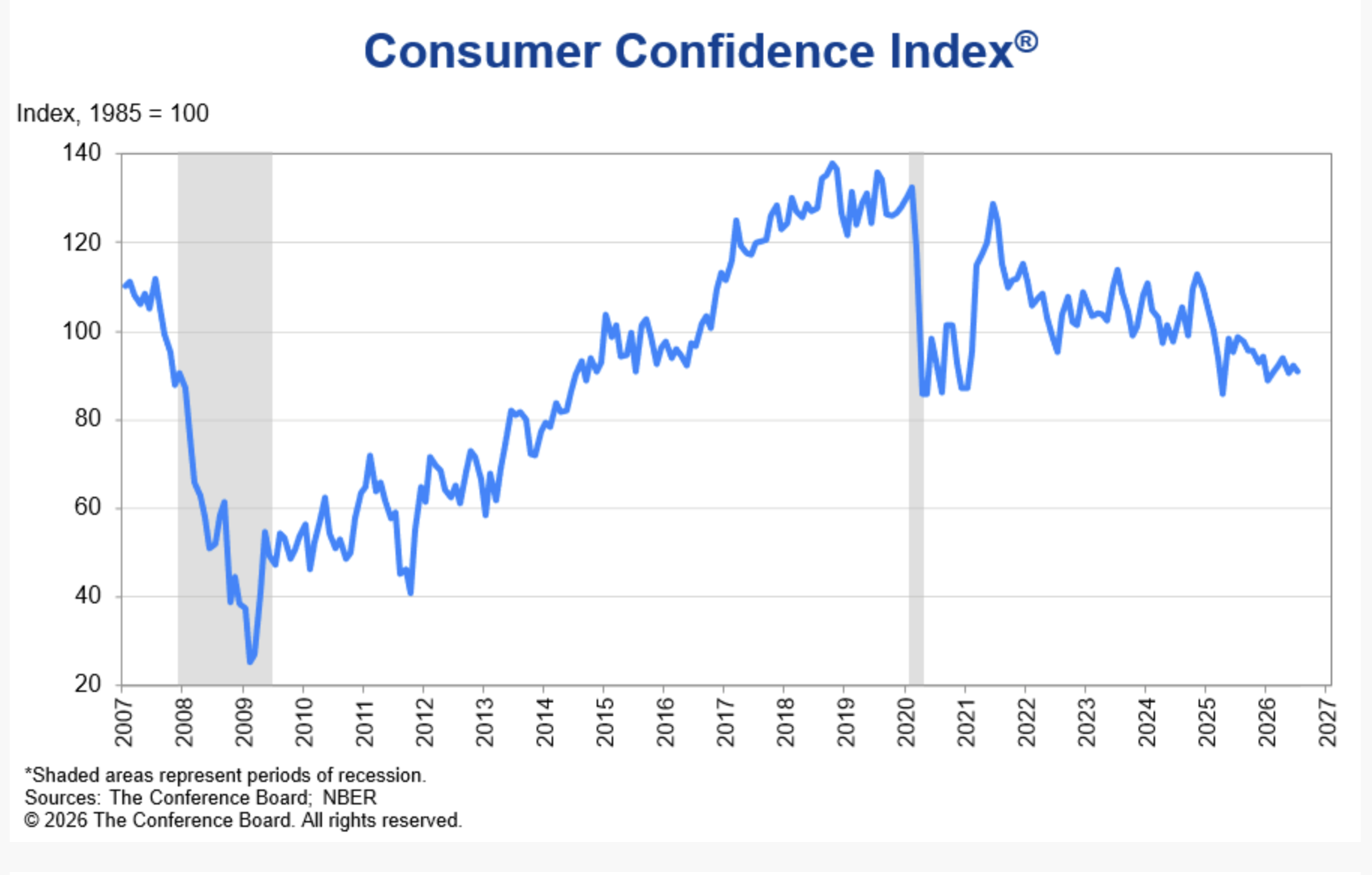
Source: Conference Board
The details of the report suggest that consumers are becoming increasingly uneasy about the present state of the economy rather than growing more pessimistic about the future.
The Present Situation Index, which measures consumers' assessment of current business and labour market conditions, dropped 3.6 points to 114.9, marking its third consecutive monthly decline. Meanwhile, the Expectations Index, which tracks consumers' outlook for income, business activity and employment over the next six months, was unchanged at 74.7.
That level remains well below the 80-point threshold that has historically been associated with an elevated probability of a recession over the following year, indicating that households continue to see little improvement on the horizon.
Current Conditions Continue to Erode
Consumers' assessment of business conditions softened further in July.
The share of respondents describing current business conditions as "good" versus "bad" slipped 2.6 percentage points to +1.1%, barely remaining in positive territory.
Views of the labour market also deteriorated modestly. The gap between consumers saying jobs are "plentiful" and those saying they are "hard to get" narrowed 0.7 percentage points to +3.1%. The deterioration was driven primarily by fewer consumers reporting that jobs are plentiful, although the share describing jobs as difficult to find also edged slightly lower.
Taken together, the data suggest that households are beginning to notice a gradual cooling in labour market conditions after several years of exceptional strength.
Future Outlook Remains Cautious
Consumers remained broadly pessimistic about the next six months.
Two of the three components of the Expectations Index weakened.
Net expectations for business conditions declined 1.5 percentage points to -3.3%, while expectations for household income eased 0.5 percentage points to +7.3%, although they remained comfortably positive.
The only improvement came from labour market expectations, where sentiment improved 1.3 percentage points. Even so, consumers still expect employment conditions to weaken over the coming months, with the measure remaining firmly in negative territory.
In other words, households anticipate little improvement in business conditions and only a modest stabilisation in the job market, reinforcing the view that consumers remain cautious despite resilient economic activity.
Conference Board Chief Economist Dana Peterson said consumers' assessment of current business conditions and, to a lesser extent, perceptions of the labour market softened in July.
"Looking ahead, consumers anticipate little improvement in business conditions over the next six months, but expectations for the labour market were slightly less negative. Expectations for household incomes moderated but remained optimistic overall."
Inflation Concerns Ease, But Food Prices Stay Front of Mind
The survey's written responses paint a nuanced picture of what is driving consumer sentiment.
The Conference Board said comments about the economy remained predominantly pessimistic.
Mentions of prices, oil and gasoline declined compared with previous months but remained elevated, suggesting inflation is no longer accelerating but is still weighing on household finances.
At the same time, references to food and grocery prices increased, indicating consumers continue to feel the pinch from everyday essentials even as broader inflation has cooled.
Mentions of war, geopolitics and conflict eased over the course of the survey period, despite the renewed flare-up in the Iran conflict, while comments relating to jobs and unemployment picked up slightly, consistent with the report's softer assessment of labour market conditions.
Inflation Expectations Improve
One encouraging sign was that consumers' inflation expectations moderated.
Both the average and median expectations for inflation over the next 12 months declined in July, suggesting households believe price pressures will continue to ease.
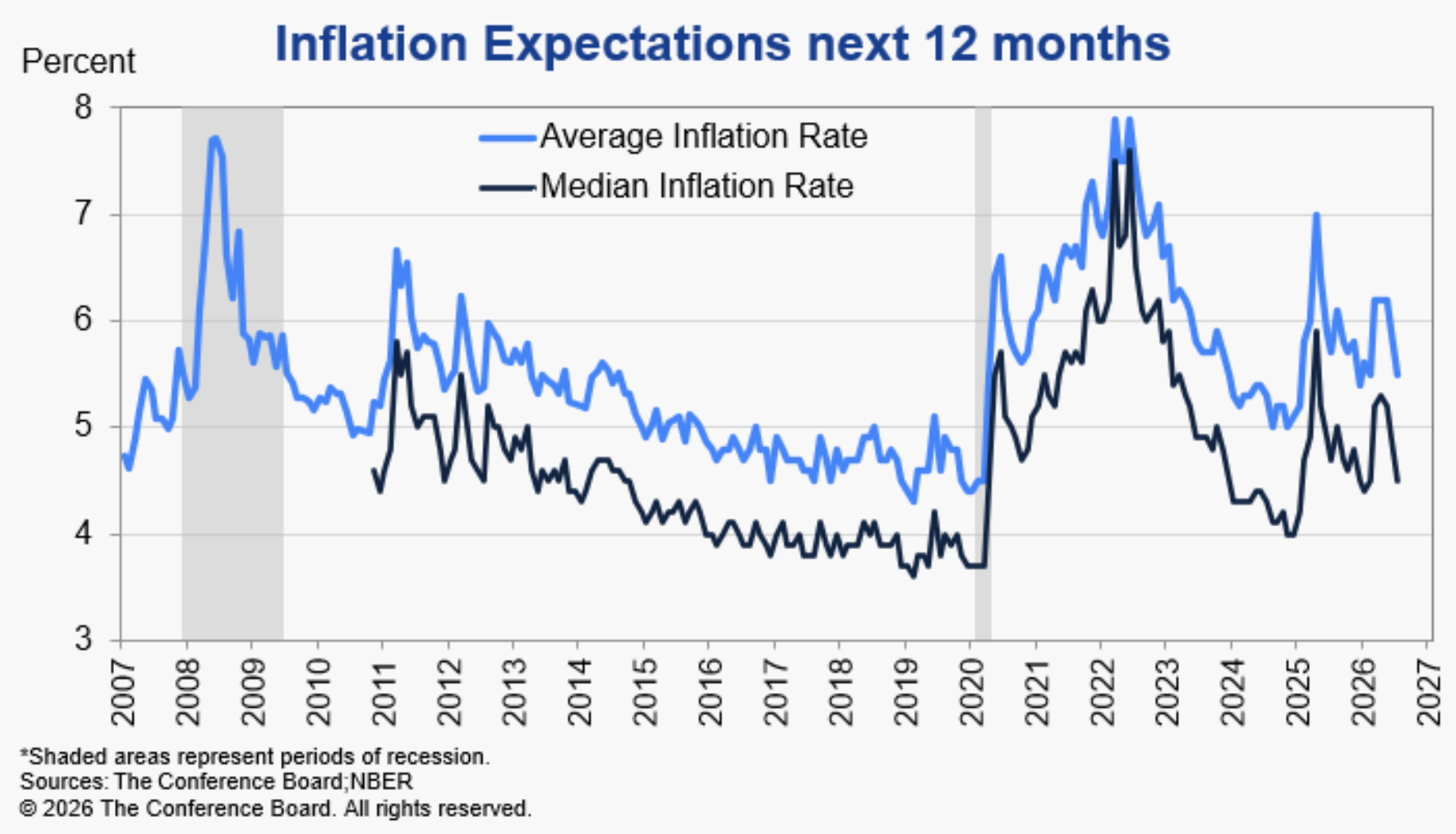
Source: Conference Board
Even so, most respondents still expect interest rates to be higher a year from now, reflecting lingering uncertainty over the Federal Reserve's policy path.
Despite recent volatility in financial markets, consumers also remained surprisingly optimistic about equities, with most expecting stock prices to be higher over the next 12 months.
Market Implications
July's report reinforces the view that the U.S. consumer remains resilient but increasingly cautious.
While the decline in confidence was relatively modest, the continued slide in the Present Situation Index suggests households are becoming less convinced that economic conditions are improving. More importantly, the Expectations Index remained below the recession-warning threshold for a sixth consecutive month, indicating that consumers still see meaningful downside risks to growth.
For the Federal Reserve, the survey offers mixed signals. Softer inflation expectations are consistent with progress on price stability, but the deterioration in current labour market perceptions suggests policymakers may be watching more closely for signs that hiring is losing momentum. Unless accompanied by a sharper deterioration in hard economic data such as payrolls or consumer spending, however, the report alone is unlikely to materially alter the Fed's policy outlook.