
Federal Reserve Bank of Chicago President Austan Goolsbee said policymakers can no longer assume that inflationary supply shocks will quickly fade, arguing that persistent disruptions may require a monetary-policy response.
Speaking at an Official Monetary and Financial Institutions Forum event in London on Monday, Goolsbee said the traditional approach of “looking through” supply shocks works when disruptions are temporary. But repeated or prolonged shocks create a different problem because allowing inflation to remain elevated for years would conflict with the Fed’s 2% inflation objective.
Goolsbee pointed to wars, oil shocks, tariffs, weather events and supply-chain disruptions as examples of forces that have become more frequent and persistent. He said recent U.S. experience suggests policymakers should presume that major shocks could last longer than initially expected rather than automatically treating them as temporary.
Oil, Tariffs and Demand Add to Inflation Risks
Goolsbee said the persistence of inflation has become particularly concerning because forecasts for when price pressures would peak have repeatedly been pushed back. He noted that expectations for inflation to begin falling moved from late 2025 to successive quarters in 2026 and now into 2027.
The comments come after the Fed raised its policy rate by 25 basis points last week to 3.75%-4.00%, citing elevated inflation and saying the move would support a more timely return to the 2% goal.
Goolsbee also distinguished supply-driven inflation from demand overheating. If demand is too strong, higher rates can directly cool spending. With a supply shock, however, monetary policy cannot increase supply and instead has to reduce demand, potentially weakening output and employment.
Fed Faces a Stagflationary Trade-Off
Goolsbee said that trade-off means the response to persistent supply shocks may not need to be as aggressive as the response to demand-driven overheating, but policymakers cannot simply ignore sustained inflation.
He highlighted service-sector inflation and the possibility that artificial intelligence (AI)-related data-center construction could spill into broader demand as areas to watch. If those pressures signal excess demand rather than supply constraints, he said the policy response would be clearer.
The CME FedWatch tool, constructed based on expectations of traders expectations, puts the odds of an October rate hike at 53%.
Fed Funds Rate Target Rate Probabilities
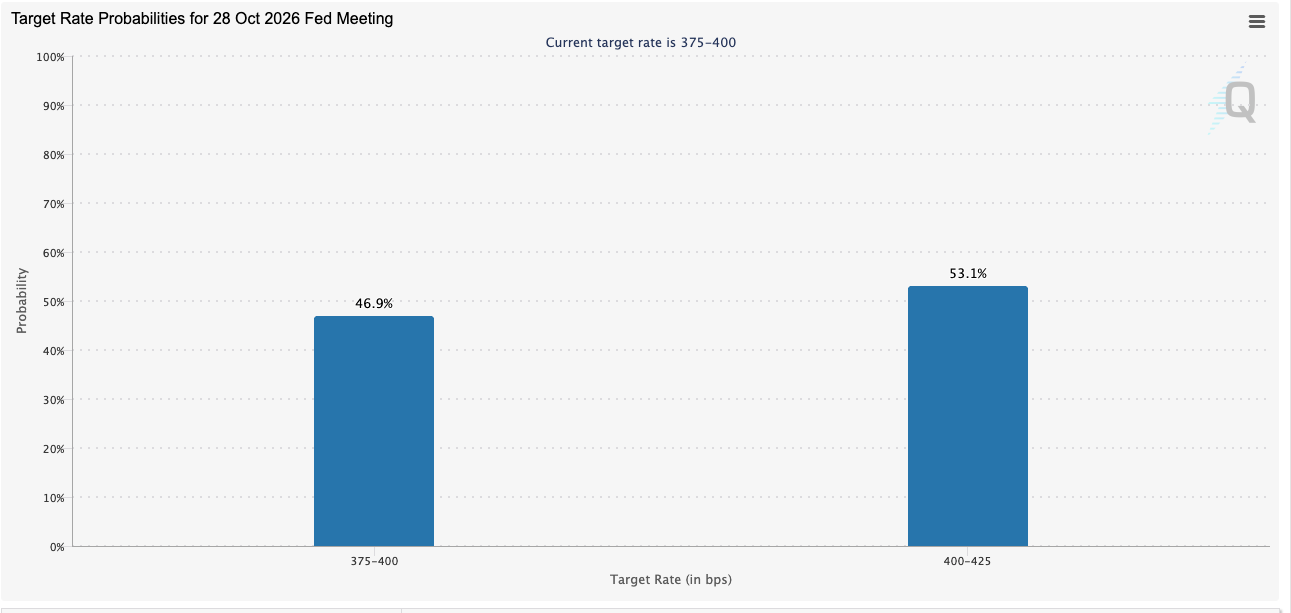
Source: CME Group
For markets, Goolsbee's remarks reinforce the importance of determining whether current inflation is temporary or becoming embedded. Persistent oil and tariff pressures could make the path back to 2% more difficult, while signs of demand overheating could strengthen the case for keeping monetary policy restrictive.
The S&P 500 Index (SPX), a measure of broader market performance, is indicated to open higher on Monday following a down week. The setup for E-mini S&P 500 (ES) contract, derived from SPX, remains structurally bullish, according to MarketFramework's Top Traded Contracts tool. About 72% of traders are long and the 7-day lean classified as Strong Long. Winners are also skewed long at 59%, suggesting long positioning has had a relative edge.
The long bias supports the upside narrative, but the sharp recent losses mean ES longs are becoming less comfortable. A sustained price move higher would validate the positioning; continued weakness could expose crowded longs to further losses.