The week traders had circled for months delivered what they feared, and then some. The Federal Reserve raised interest rates for the first time in three years on Wednesday, a quarter-point move that was all but fully priced in.
The central-bank drama didn't stop there: the Bank of Japan pushed its policy rate to a 31-year high on Friday and signalled more to come, while the Bank of England also met midweek and held rates steady. But the standout was the U.S. dollar, which broke back above the 100.00 level on the Dollar Index for the first time in roughly two months, as the hike was confirmed.
Stocks steadied into the weekend even as bond yields sat near two-decade highs, and oil cooled back under $100.
One Hike Down and a Harder Message Underneath
The move itself was priced; the message was the story.
Federal Reserve Chair Kevin Warsh framed this as the start of a fight against sticky inflation, not a one-off, and the Fed signalled that inflation won't be back at its 2% target until 2029. Remember that Warsh has scrapped the Fed's usual "forward guidance", the practice of telling markets in advance where rates are heading along with the quarterly forecast grid. There is no dot-plot map to lean on, so traders have to read the incoming data and the speeches instead.
That leaves a new question hanging over every asset: not whether the Fed hikes, but how many more times this cycle.
The Cross-Asset Scoreboard
Dollar. Clearing 100.00 is the house line playing out in real time, reclaim 100 and the hike trade is back on. Notably, USD/JPY still pushed higher even after the BoJ hiked, because richer US yields outweighed Japan's own move. The dollar won the week anyway.
Indices. A split tape. The S&P 500 and the tech-heavy Nasdaq held up better than the Dow. Nasdaq futures (NQ) round-tripped the hawkish shock and reclaimed the 29,800 area, with the 30,000 round number the next magnet overhead, while the Dow (YM) lagged.
It's the familiar dispersion trade: lean on the stronger structure, hedge the weaker one, rather than betting the index outright.
Rates. The 10-year Treasury yield hovered near 5%, close to two-decade highs [VERIFY] — the long end is doing part of the Fed's tightening for it.
Gold Unproven Until $4,400 Acceptance
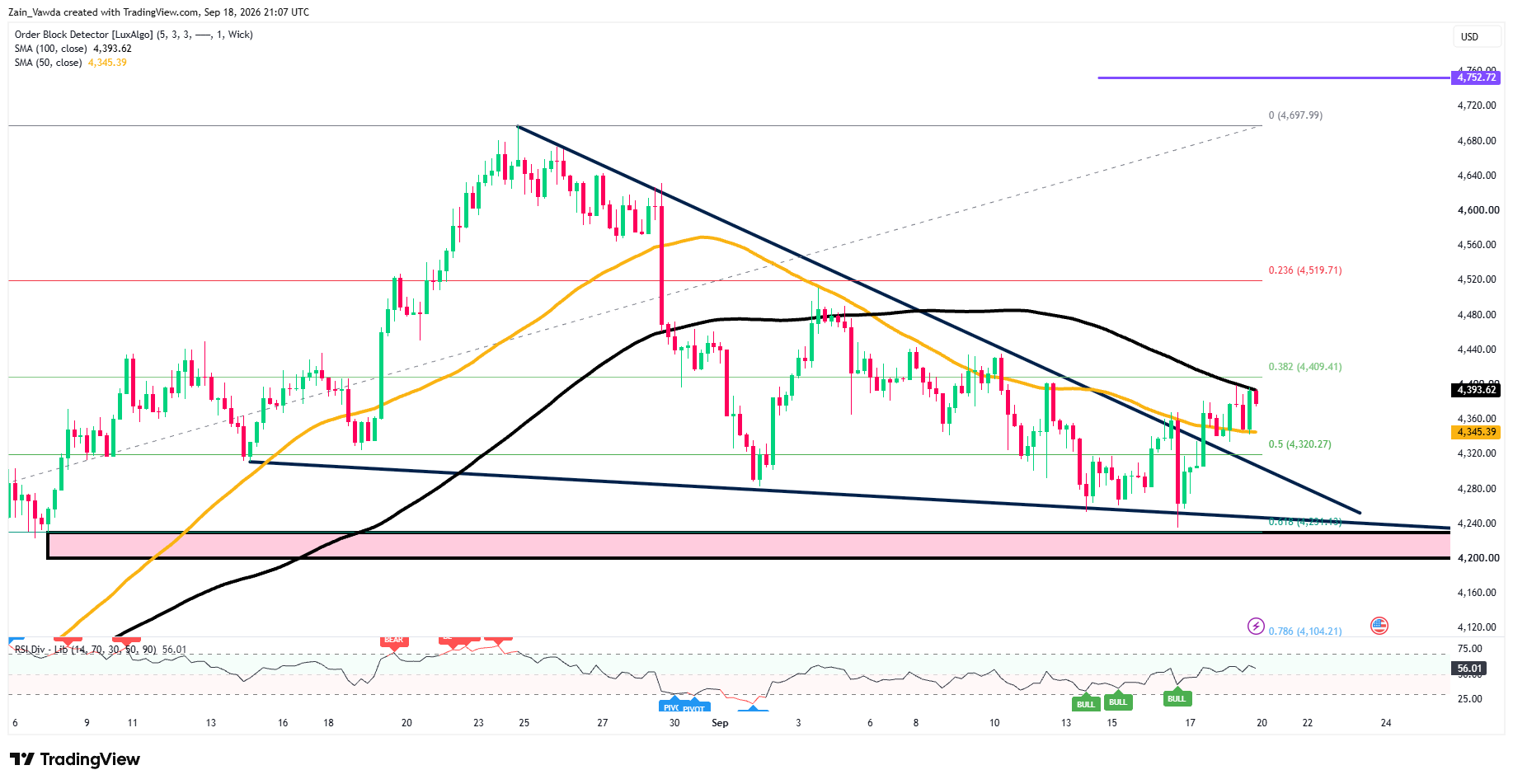
Gold is staging a recovery inside a larger correction. The bounce off the $4,200–4,240 order block (demand zone) arrived with bullish RSI divergence, and price has since reclaimed the 50-period SMA ($4,345) and the 50% retracement ($4,320).
Gold Four-Hour Chart, September 18, 2026
Source: TradingView
The decision zone now sits directly overhead, where three levels converge: the 100-SMA ($4,393), the 38.2% retracement ($4,409) and the descending trendline off the $4,697 high.
Possible Scenarios for Gold
A clean H4 close above roughly $4,410 would argue the correction is ending and open $4,519 (23.6%), then the $4,697 swing high.
Rejection here keeps the downtrend intact, with support at $4,345, then $4,320, the 61.8% retracement near $4,290, and the $4,200–4,240 block.
Bias: cautiously constructive above $4,320, but unproven until $4,410 breaks.
The Week Ahead: A Quiet Calendar Hands the Mic to the Fed
After three central-bank decisions, next week is unusually light on top-tier US data. That vacuum makes two things matter more.
First, Fed speakers now out of their pre-meeting quiet period, get their first chance to explain the hike and hint at how far this cycle runs; watch for Chair Kevin Warsh and colleagues.
Second, Wednesday's flash PMIs from S&P Global, the first read on September business activity (a reading above 50 signals the economy is still growing, below 50 signals it's shrinking).
Elsewhere, the People's Bank of China sets its loan rates Monday (expected unchanged) and the Swiss National Bank decides Thursday.
U.S. durable goods orders and the final University of Michigan sentiment survey close the week Friday, alongside Germany's IFO business survey.
The next real inflation test, the Fed's preferred PCE gauge doesn't land until the following Wednesday, September 30, so this week is mostly about positioning into it.
The standing wildcard remains oil and any fresh Middle East supply news, plus any Trump–Xi or tariff headlines.
Key Events & Dates
| Day | Key Event | Why It Matters |
|---|---|---|
| Monday 21 | PBoC loan prime rate; Chicago Fed activity index; Fedspeak resumes | First official comments since the hike |
| Tuesday 22 | Richmond Fed manufacturing; Fedspeak; 2-year note auction | Factory pulse + rate-path hints |
| Wednesday 23 | S&P Global flash PMIs (US, EU, UK, Germany) | The week's marquee data. A first look at September growth |
| Thursday 24 | SNB decision; US jobless claims; new home sales | Global rate leg + labour-market check |
| Friday 25 | US durable goods; Michigan sentiment (final); Germany IFO | Consumer and factory read into quarter-end |