
The Canadian dollar lost ground against the U.S. dollar on Monday as the Middle East conflict intensified and the domestic March consumer price inflation (CPI) report came in tamer than expected.
At last check, the Canadian dollars futures (6C) contract traded down 0.12% at 0.7320.
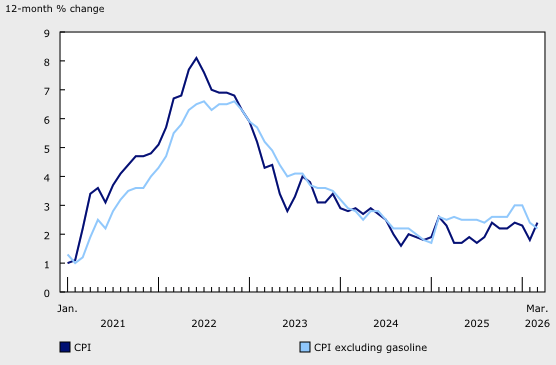
Crunching the Numbers: March CPI data for Canada showed a 2.4% year-over-year (YoY) increase, according to a report published by Statistics Canada on Monday. This was faster than February’s 1.8% rate but slower than the 2.5% consensus. On a monthly basis, consumer prices increased 0.9% compared to 0.5% in January and the consensus of 1.1%.
The closely-tracked median annual CPI rate remained unchanged at 2.3%, a tad lower than the 2.4% consensus. The trimmed CPI rate ticked down to 2.2% from 2.3%.
Excluding food and energy, consumer prices were up a more modest 0.1% MoM and 1.9% YoY.
The agency noted that energy prices (+3.9% YoY), specifically gasoline (+5.9%), contributed to the bulk of the increase in the CPI. On a monthly basis, gasoline recorded a record increase of 21.2% due to the supply shock stemming from the Middle East conflict. The relatively tamer YoY increase in gasoline prices is due to a tougher comparison with March 2025, which included the since-removed consumer carbon levy.
Annual increase in CPI and CPI, excluding gasoline
Source: Statistics Canada
If not for lower natural gas, the increase in energy product prices would have been bigger, Statistics Canada said. Natural gas prices fell 18.1% YoY as the country is largely dependent on North American supply and therefore more insulated from global price changes.
Food Prices Accelerate: Prices of food purchased from stores climbed 4.4% YoY in March following a 4.1% increase in February. Fresh vegetable prices accelerated 7.8%, marking the largest increase since August 2023.
Read-across for Rates: The Bank of Canada has a target range of 1%-3% for inflation, and the headline CPI has stayed within the range for more than two years now.
At the March monetary policy meeting, the Bank of Canada left its benchmark interest rate unchanged at 2.25%. The central bank, however, warned about “increased volatility in global energy prices and financial markets, and heightened risks to the global economy.”