This story has been updated to include the Bank of Japan’s revised growth and inflation outlook.
The Bank of Japan (BoJ) on Tuesday decided to keep its benchmark interest rate (the uncollateralized overnight call rate) unchanged at around 0.75%, aligning with the consensus estimates. The outcome was widely watched, given the U.S.-Iran war that has sent energy prices soaring due to the supply shock triggered by the closure of the Strait of Hormuz, a major chokepoint in the Persian Gulf.
The central bank also reduced its near-term growth forecasts, while also nudging up its inflation forecast, citing the Middle East geopolitical risk.
The Nikkei 225 Average, the key Japanese stock market gauge, which closed at a fresh high past the 60,000 mark on Monday, retreated by over 1% following the rate decision. The USD/JPY pair weakened modestly from above 159.5 level toward the 159 mark.
BoJ Pauses Again: Following the conclusion of a two-day meeting, the bank decided to maintain the status quo stance by a 6-3 split vote, with the three dissenting members calling for a rate hike to around 1%. They argued that the “situation in the Middle East remained unclear, given economic developments, risks to prices were skewed to the upside under accommodative financial conditions."
The central bank has held fire in each of the past two meetings, with the March pause adopted by an 8-1 vote.
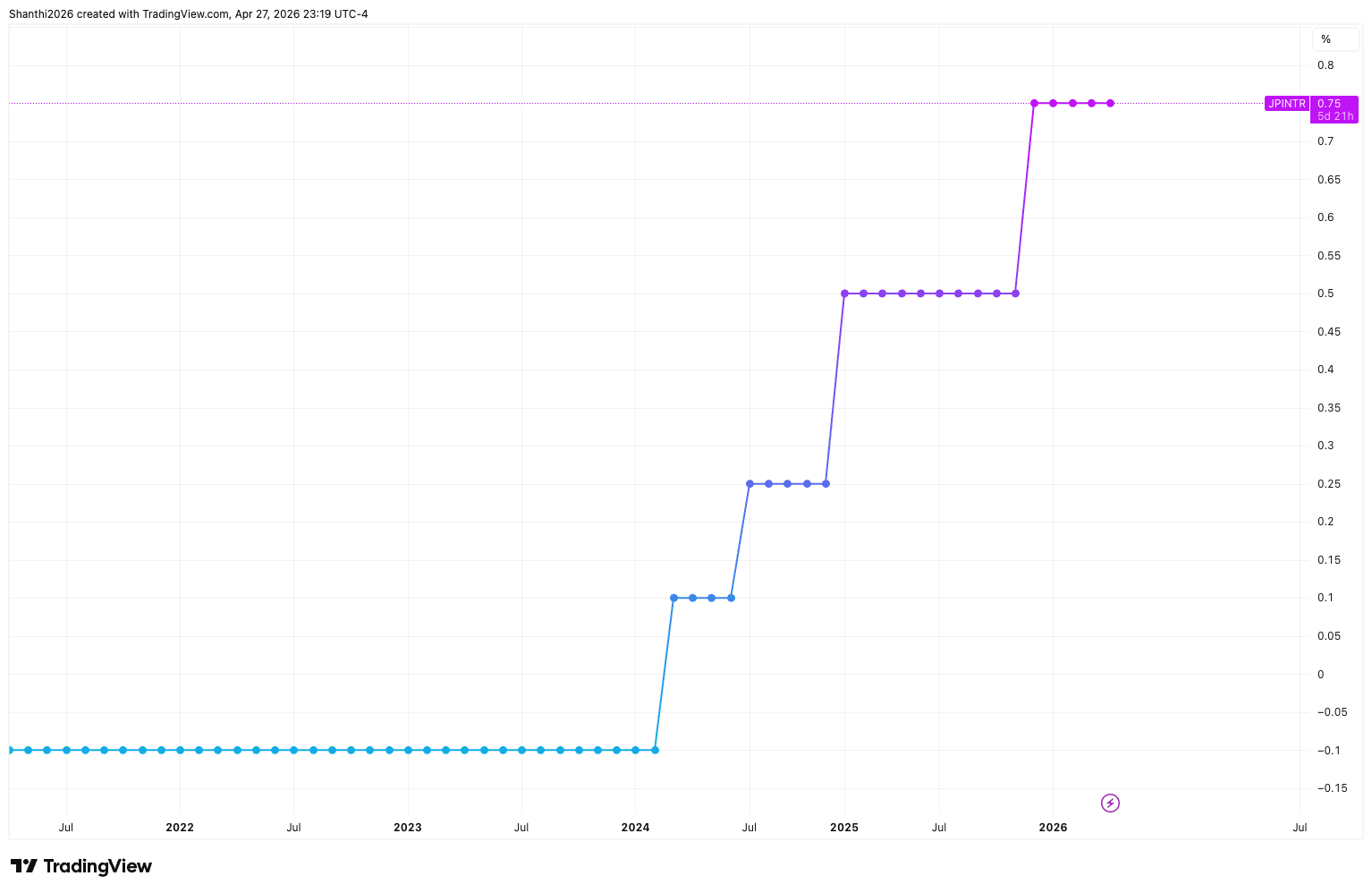
BoJ Uncollateralized Overnight Call Rate
Source: TradingView
BoJ Rate Trajectory: After pursuing an ultra-loose monetary policy for decades, the BoJ pivoted only in March 2024, lifting its key rate into positive territory, and also abolishing yield curve control. The central bank has since paused and hiked intermittently, and the last hike was in December 2025, a 25-basis-point increment that took the policy rate to 0.75%. In each of the two meetings held so far this year, the central bank has opted to hold rates steady, with the U.S.-Iran war conflict cited as a key factor influencing the policy decision in March.
Growth Downgraded, Inflation Hiked: In its “Outlook for Economic Activity and Prices” report released after the rate decision, BoJ lowered its growth assessment, expecting the economy to continue to grow moderately in the fiscal year 2026 (April 2026 to March 2027), although at a decelerated pace. It now expects 0.5% GDP for 2026, down from the previously estimated 1%.
The central bank attributed its tempered opinion to rising crude oil prices following the Middle East crisis. This, in turn, is likely to weigh down on corporate profits and households' real income through factors such as a deterioration in the terms of trade, the central bank said.
The BoJ expects growth to pick up moderately from fiscal year 2027 as the adverse impact of higher energy prices wane.
The domestic economy expanded 0.3% quarter over quarter (QoQ) in the fourth quarter, which translated to an annualized pace of 1.3%. The first preliminary estimate for first-quarter growth is scheduled for release on May 19.
As expected, the central bank increased the year-over-year (YoY) core consumer price inflation rate (excluding fresh food) to a range of 2.5%-3% for fiscal year 2026. It expects inflation to soften to 2%-2.5% in the following fiscal year before returning to its 2% target by iscal year 2028.
Risks Facing the Economy: Apart from the potential fallout of higher energy prices, the BoJ flagged other ancillary risks, such as slowdown in overseas economies and weakened demand related to artificial intelligence (AI). Japanese tech companies play a critical role in supplying components and equipment to the industry.
The central bank also pointed to the foreign exchange risk and its impact on domestic economic activity and prices.
Inflation Still a Threat: Inflation data released last Friday showed that consumer prices rose 1.5% year over year (YoY) in March, up from 1.3% in February and above the consensus estimate of 1.4%. Core inflation, which excludes fresh food, accelerated for the first time in five months, rising to 1.8% from 1.6%.
With 2026’s “shunto” negotiations providing for more than 5% wage growth and small and medium businesses (SME) also announcing fairly strong increases, ING South Korea and Japan Senior Economist Min Joo Kang expects businesses to pass on higher input cost hikes onto consumers.
All eyes turn toward BoJ Governor Kazuo Ueda as he explains the deliberations at the meeting in a press conference due shortly. The next monetary policy meeting is scheduled for June 15-16.