The yen staged its biggest one-day rally since late 2022 after Japanese officials hinted that “decisive action” against currency weakness was imminent, fueling speculation that Tokyo had stepped into markets after USD/JPY breached 160. Yet history suggests intervention can slow, but rarely reverse, the yen’s structural decline unless backed by a narrower U.S.-Japan rate differential.
Tokyo Acts; Yen Weakness Fades
The reversal in the yen was not entirely unexpected. Historically, whenever the currency weakens beyond the psychologically important 160-yen-per-dollar threshold, Japanese authorities have either verbally intervened or stepped directly into the market. Here’s how the chain of events unfolded this time around:
- The BoJ, led by Governor Kazuo Ueda, kept its uncollateralized overnight call rate unchanged at 0.75%, despite market speculation that accelerating inflation, partly linked to higher energy prices following the recent U.S.-Iran conflict, could force another rate hike.
- Although the BoJ left rates unchanged at 0.75%, a more hawkish policy statement and dissenting calls for tighter policy reinforced expectations of further normalization.
- The BoJ’s updated growth and inflation projections showed higher inflation forecasts, and slower economic growth in 2026.
- Although Ueda did not give a timeline for future rate hikes, markets increasingly began pricing in a June hike, with some strategists also anticipating another upward adjustment in the fourth quarter.
The yen traded broadly sideways on Tuesday, although it did weaken immediately after the decision. The downtrend continued on Wednesday, with the yen breaching the 160 mark intraday, and it fell further on Thursday, hitting as low as 160.7. Between the European and early New York sessions, the USD/JPY pair reversed course, with the yen rising as high as 155.57, courtesy Finance Minister Satsuki Katayama’s comments that “I have been mentioning the chance of taking decisive action. I believe the timing for taking such decisive action is nearing.”
Subsequently, the Japanese unit strengthened to its highest level since late February, and also recorded a single-day gain of about 2.5%, the biggest since December 2022.
While officials stopped short of confirming direct intervention, Bloomberg estimates based on BoJ current-account data suggest Tokyo may have spent roughly $34.5 billion supporting the currency. The scale of intervention may have been around 5.4 trillion yen, compared to an average of 3.8 trillion yen spent on three occasions in 2024, the report said. The yen continued to firm on Friday.
Yen on Secular Decline
Despite the recent flutter, the yen remains near multi-decade lows against the dollar. Since appreciating to around 75 a dollar in October 2011, the currency has been in a broad secular decline, reflecting persistent structural disadvantages.
The primary driver remains the wide monetary policy divergence between Japan and the United States.
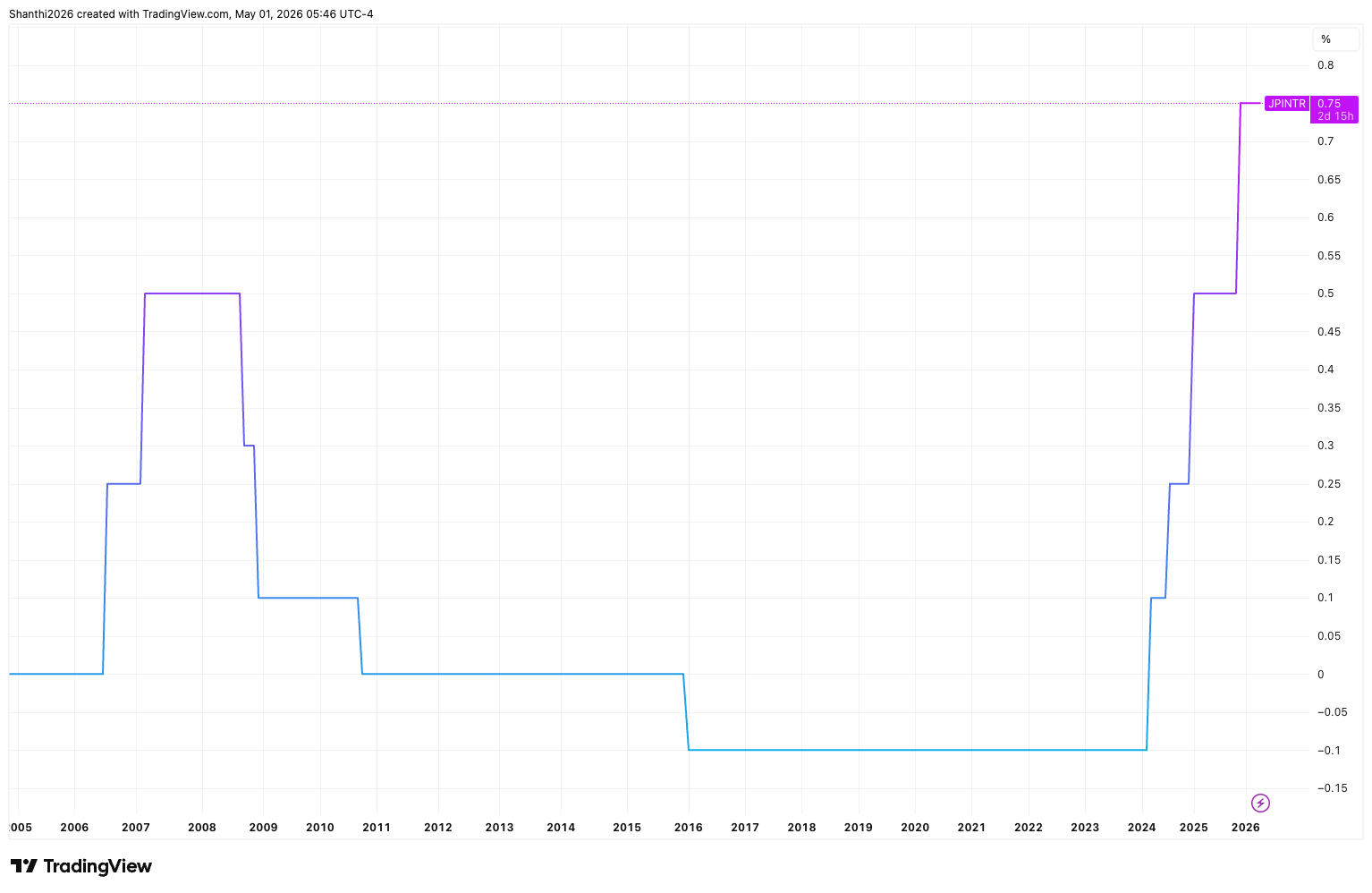
After maintaining negative interest rates for a little over eight years, beginning in 2016, the BoJ pivoted only in March 2024, lifting the benchmark interest rate into positive territory, and also abolishing yield curve control.
The central bank has since paused and hiked intermittently, and the last hike was in December 2025, a 25-basis-point increment that took the policy rate to 0.75%. In each of the three meetings held so far this year, the central bank has opted to hold rates steady. In contrast, the peak U.S. Fed funds rate during the current monetary policy cycle was 5.5%, and the interest rate differential is roughly between three and four percentage points. This spread continues to incentivize capital outflows from Japan and supports dollar strength via carry trades.
Beyond rate differentials, the U.S. dollar’s appeal as a safe haven currency during uncertain times has proved negative for the yen. Prime Minister Sanae Takaichi has pursued an expansionary fiscal stance since taking office last year, reinforcing concerns about Japan’s debt trajectory and limiting optimism toward the yen.
BoJ Interest Rate
Source: TradingView
Past interventions reveal a fairly consistent pattern in Japan’s currency playbook. First, unilateral intervention by Tokyo can trigger sharp but typically short-lived yen rallies, as seen in September 2022, when authorities stepped in after the currency’s rapid slide but failed to engineer a lasting reversal.
Second, repeated interventions tend to be more effective at flushing out speculative short-yen positioning, as demonstrated in 2024 when multiple rounds of yen-buying, combined with heavily crowded bearish bets, helped generate a more sustained retracement.
Finally, history suggests that durable yen appreciation rarely comes from intervention alone; it usually requires a supportive macro backdrop such as expectations of Federal Reserve System rate cuts, tighter policy from the Bank of Japan, or in rarer cases, coordinated action with G7 authorities.
In other words, intervention can disrupt momentum and reset market positioning, but it has historically struggled to reverse the yen’s structural downtrend without a parallel shift in monetary or global risk conditions.
Have Past Interventions Worked?
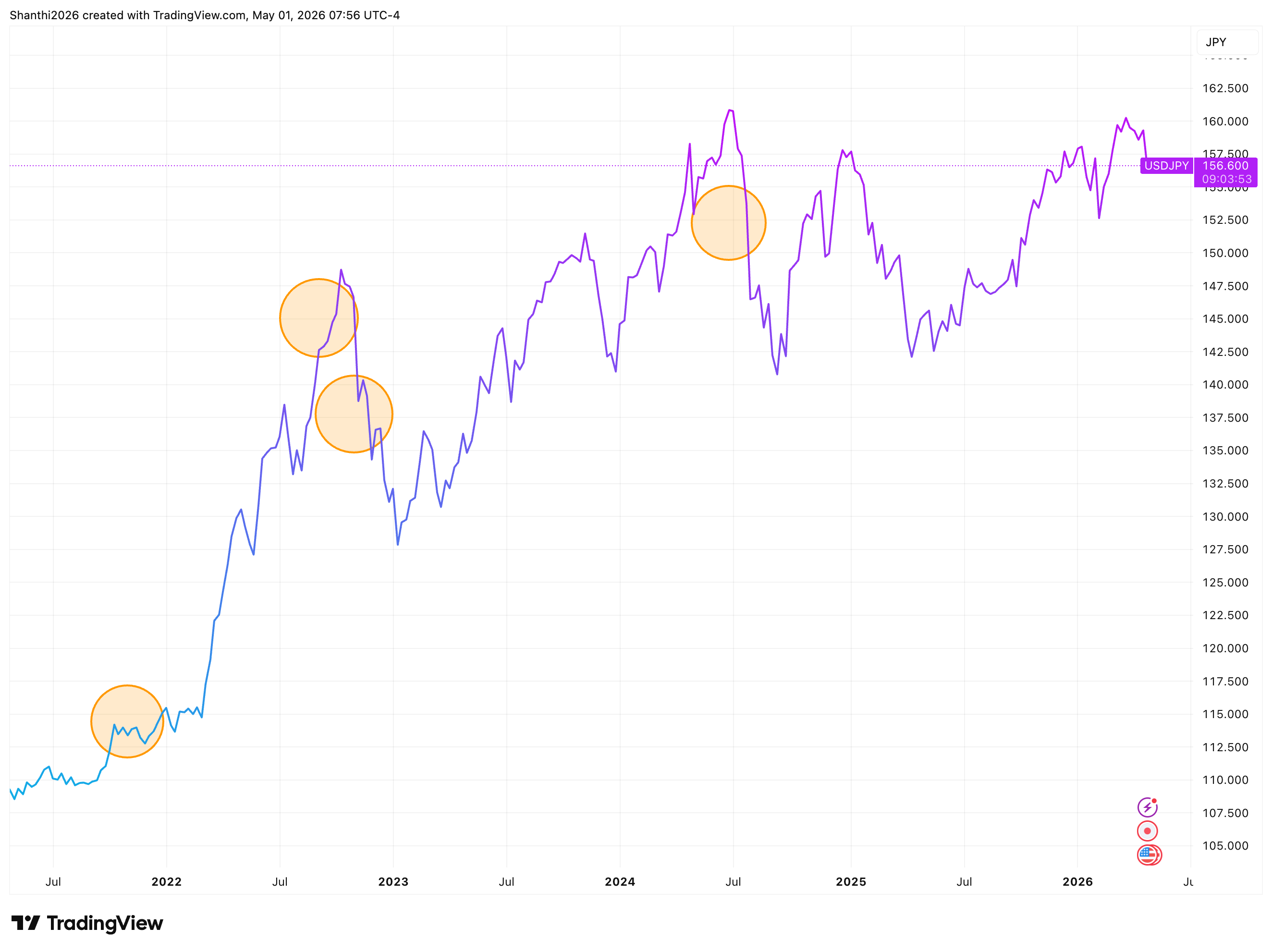
- July 2024: The previous intervention before Friday’s speculated move was done in 2024, when the BoJ sold $35 billion worth of USD/JPY in a single day. The intervention, totaling $100 billion, proved effective as investors were heavily short yen and on top of that the Fed was expected to begin cutting later that year. The move was precipitated by the yen’s plunge to a 38-year low.
- Sept./Oct 2022: Japan’s September-2022 intervention caused an immediate sharp spike in the yen, although the impact was only transitory. The November intervention produced a far more lasting impact (10 days). According to Nomura, the intervention was atypical as the initial intervention on Sept. 2022 was not followed by additional yen purchases, until Oct. 21 despite substantial yen depreciation in the interim.
- Nov. 2011/June 1998: The coordinated G7 intervention these two years lent only temporary support.
Japan’s Forex Intervention and USD/JPY
Source: TradingView
It is clearly evident from the chart, a sustained yen revival did not follow each intervention.
This Time Will Be No Different Unless….
ING strategists think any BoJ forex intervention in the current environment can at best only put a lid on the USD/JPY strength in the 162/165 area, rather than turn the trend. “Taking into account high energy prices and Japan running substantially negative real interest rates, plus the dollar being in demand, Tokyo cannot expect a sustained drop in USD/JPY,” ING’s Regional Head of Research for U.K. and Central and Eastern Europe Chris Turner said.
However, the involvement of the U.S. Treasury and a joint U.S.-Japanese intervention to sell USD/JPY would be far more significant than Japan acting unilaterally.
“Were we to see joint intervention with the US Treasury, we suspect this would raise some broader issues over dollar policy and be worth a move to the 155 area, with USD/JPY staying offered for longer,” Turner said.
BLC Ecosystems CEO Shing Cheung notes in a social-media post that the market currently perceives the 160-162 range as the definitive intervention warning line, potentially laying a floor for the yen. Currency intervention does not cure structural imbalances, he said, adding that a structural reversal to a stronger yen remains highly improbable now due to the real interest rate chasm between Japan and the U.S. and the terms of trade crisis Japan due to it being a net energy importer.
The Goldilocks Level for Yen
Given Japan is an export-driven economy, too much of yen strength will dent the company’s export profits and also reduce the competitiveness of its products in international markets. According to a research paper published in 2024, a 4% appreciation of the yen would shave about 0.2 percentage points of Japan’s GDP.
Before the start of the year, JPMorgan China Japan Forex Strategist Junya Tanase said it might become difficult to prevent the yen depreciation through policy measures such as rate hikes or intervention, as the easing cycle of most G-10 central banks draws to a close.
Since then, the U.S.-Iran war and consequent supply shock that has pushed up energy prices have made most central banks hawkish-leaning.
So, what would be the just-right level for the yen, one which is neither deflationary or inflationary? In practical terms, Japan’s preferred yen level is likely not a hard line but a functional range. Analysts generally view 135–145 yen per dollar as a Goldilocks zone: weak enough to support Japan’s export-heavy economy and sustain moderate inflation, yet stable enough to avoid politically sensitive increases in import costs for food and energy.
Beyond 150, official discomfort tends to rise, while moves into the 160s have repeatedly triggered intervention warnings and, at times, direct market action. As such, Tokyo appears less focused on restoring the yen to historical strength than on preventing a disorderly slide deeper into inflationary territory.
Japan has entered its Golden Week holidays that will run through May 6, and traders do not rule out follow-on interventions by the central bank during the holiday week.
For now, intervention may have bought Tokyo time but not necessarily a stronger currency. Unless the BoJ accelerates normalization or the Federal Reserve turns materially more dovish, any yen rally may prove tactical rather than structural, leaving the market once again testing where Japan’s true pain threshold lies.
Read Next: US Q1 GDP Growth Reaccelerates, Jobless Claims Hit Multi-Decade Low But Iran War Keeps Prices Hot


