West Texas Intermediate (WTI) crude futures pushed above $94 a barrel in Tuesday’s overnight session before retreating to around $93.75, extending a powerful recovery that has taken prices from below $70 in early July to three-month highs. WTI has gained roughly 8% since the start of September.
The latest leg higher follows a renewed escalation in Middle East supply risks. Oil surged Tuesday after Houthi attacks on Saudi energy infrastructure added another threat to regional production and refined-product supplies, while tensions between the U.S. and Iran remained elevated.
Iran’s statement regarding an imminent shipping-management deal with Oman for the Strait of Hormuz also stirred fears concerning the control of the chokepoint.
Why Oil Jumped Again Tuesday
The immediate catalyst was another deterioration in the Middle East supply picture. Attacks on Saudi energy facilities raised concerns about physical supply, while the continued disruption to tanker traffic through the Strait of Hormuz kept the market focused on the risk that the conflict could constrain exports for longer.
Hormuz remains particularly important because the waterway normally carries roughly one-fifth of global oil and LNG shipments. Tanker flows have remained well below normal, meaning every fresh military escalation carries a larger potential supply premium for crude.
The rally is therefore no longer being driven by a single headline. The market is increasingly pricing the possibility that disruptions persist, with Goldman Sachs reportedly raising its Brent and WTI forecasts on expectations that supply constraints could extend into 2027.
That helps explain why WTI has been able to absorb brief pullbacks and repeatedly push toward new highs.
Speculators Are Adding to the Bullish Case
The latest CFTC Commitments of Traders report also shows speculative positioning moving in the same direction as price.
Managed money (hedge fund + CTA), the closest proxy for fast money in the COT report turned decisively bullish on WTI crude in the week ending Sept. 1. The period captures the initial Larak Island strikes and the early leg of the current rally. Managed money added 8,418 long contracts even as they trimmed 1,843 short contracts, a net swing of over 10,000 contracts toward the bullish side. This category is now net long roughly 94,281 contracts, with the scale of buying and the simultaneous unwind of shorts pointing to active, high-conviction positioning, rather than a passive drift.
That being said, one should keep in mind that the CFTC data is inherently backward-looking, covering positions as of Tuesday and released on Friday.
The Technical Breakout Is Now the Key Test
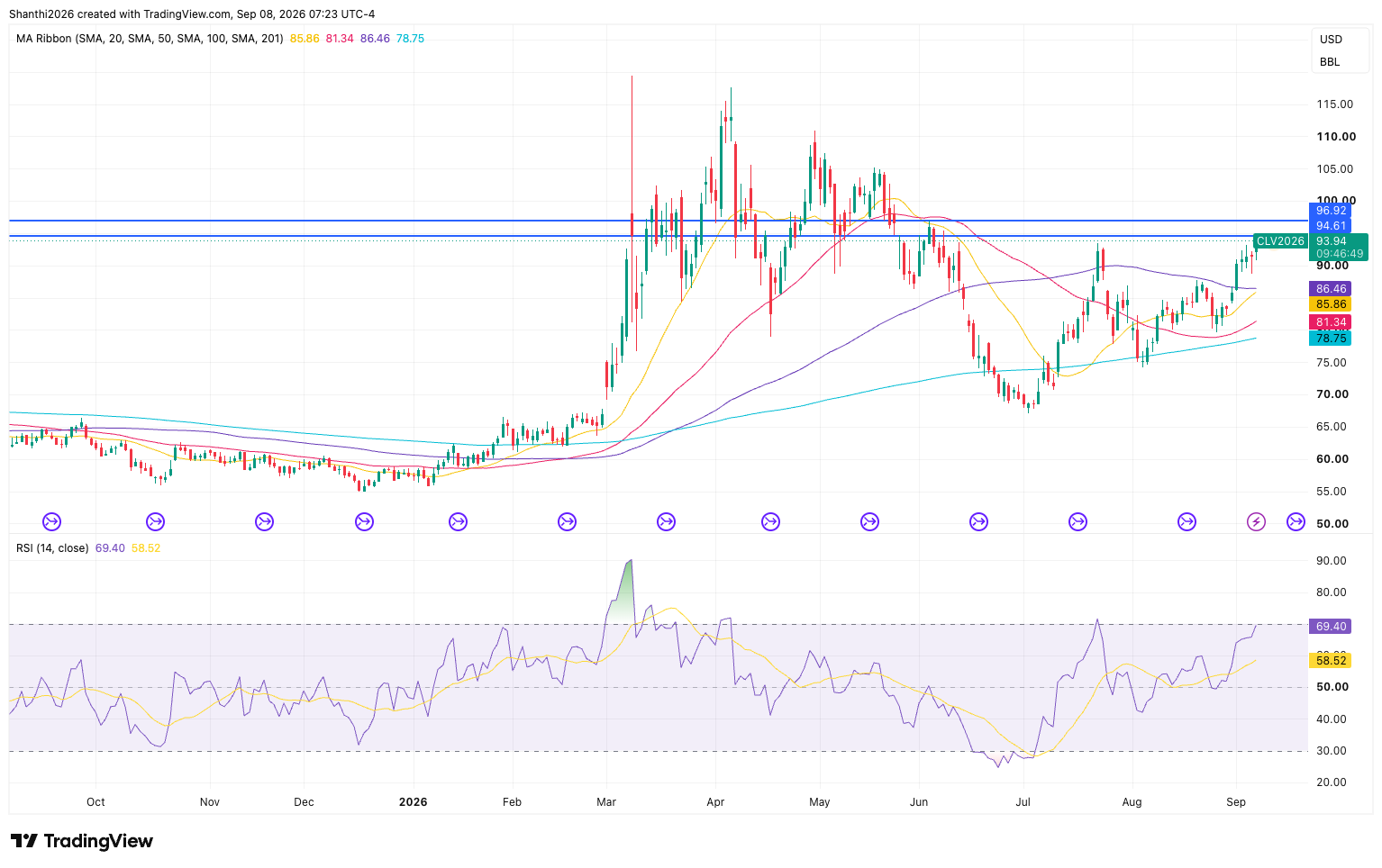
From a technical perspective, the move through $93-$94 matters because WTI is pushing against a well-defined resistance zone at $94.5-$97 that capped price twice this year (once during early June and then during late July. Since the July low near $63, the contract has traced a steady, higher-lows, recovery, climbing back through all four simple moving averages in the ribbon. The relative strength index (RSI) now sits at just under 70, the threshold that demarcates overbought levels.
Source: TradingView
The immediate question is whether Tuesday's move above $94 becomes a breakout or a failed push higher.
A sustained hold above $94 would strengthen the bullish structure and potentially expose the $95-$97 area next. Some technical analysis already identifies $95-$97 as an important higher-timeframe resistance zone.
On the downside, a retreat back below $93 would weaken the immediate breakout signal, while a deeper move back below $90 would suggest that geopolitical risk is failing to translate into sustained upside momentum.
MarketFramework's Top Traded Contracts tool shows Strong short positioning, with today's book at 38% long and 63% short. This is a sharp reversal from the Strong Long positioning seen last week. That suggests at least with retail traders, the recent oil rally is increasingly being met with short positioning rather than fresh long chasing. Winners are spit as 60% short, meaning even profitable traders are leaning bearish. Successful positioning is anticipating either a pullback or resistance around current levels.
On the other hand, a large majority of losing traders are short (74%) while WTI has rallied toward $94. If crude continues higher, these positions could face further losses and potentially fuel short covering, adding momentum to the upside.
Can WTI Make a Run at $100?
The path toward $100 is becoming increasingly plausible, but the market still needs to prove that it can sustain prices above the mid-$90s.
The bullish case rests on three factors: continued disruption around Hormuz, additional attacks on regional energy infrastructure and continued speculative demand for crude. The latest COT report shows that traders were already increasing bullish exposure before the latest escalation.
But the higher crude climbs, the more important demand and macro risks become. A prolonged oil shock could lift inflation expectations, keep interest rates higher and eventually weigh on global fuel consumption and economic growth. That creates a potential feedback loop in which the same geopolitical premium supporting crude ultimately undermines demand.
For now, however, $94 is the level buyers need to defend. Holding above it would keep the breakout intact and put $95-$97 in focus, with $100 becoming the next major psychological target. A failure to hold the breakout would instead raise the risk that the latest geopolitical premium is being unwound.