
SpaceX closed below $120 on Monday, down more than 3% and extending its losing streak to a seventh consecutive session — a fresh post-IPO low, and comfortably beneath the $135 offer price it debuted at on June 12.
The round trip has been violent. SPCX priced at $135, opened its first session near $150 and closed at $160.95. Within four days it printed above $225, briefly carrying a market capitalisation approaching $3 trillion — enough to pass Microsoft and Amazon.
It is now worth roughly $1.6 trillion. Close to a trillion dollars of notional value has evaporated in five weeks, and short sellers have booked something in the order of $8.7 billion.
Why it fell
Three things stacked. Starship Flight 13 was aborted at zero when engines failed to start, removing the operational catalyst the bulls were underwriting. The company confirmed its first-ever bond issuance, and the market began pricing further equity issuance behind it — dilution risk on a name valued on 2030s cash flows. And the SpaceXAI narrative, which carried much of the IPO premium, has run into the same scepticism now attaching to every AI capex story.
Elon Musk responded in the familiar register, posting on July 17 that the survival probability of firms holding significant short positions in SpaceX over time is very low. Traders should read that as sentiment, not information.
The Street has not capitulated either: 32 analysts still average a Buy with a twelve-month target near $244.
Why the Nasdaq-100 has barely noticed
This is the part that matters for futures traders. SpaceX entered the Nasdaq-100 on July 7 under the exchange’s new fast-track rule, added on its fifteenth trading day. But the index weights by free-float market capitalisation, and SpaceX’s float is tiny relative to its size. JPMorgan modelled entry with capitalisation set at three times a raw float of $75 billion, producing an index weight of roughly 1.3%.
For context, Amazon carries around 4% at a comparable market capitalisation.
Jefferies put it plainly at the time — given the low float, the index weight would not be as impactful as anticipated. That is exactly how it has played out. A near-halving of the largest IPO in history has cost NQ a fraction of what the headline market-cap loss implies.
Impact of SpaceX Price Moves on the Nasdaq
| SPCX Move | Index Impact at 1.3% Weight | Nasdaq Points |
|---|---|---|
| -10% | -13bp | Approximate 38 Point Move |
| -20% | -26bp | Approximate 76 Point Move |
| -30% | -39bp | Approximate 114 Point Move |
| -47% (peak to now) | -61bp | Approximate 178 Point Move |
Roughly 180 index points across a five-week collapse of a trillion-dollar company. That is noise against a contract that moved 385 points in a single overnight session on a ceasefire headline. If you have been attributing NQ weakness to SpaceX, you have been trading the wrong variable.
What changes — and when
The float is not static. Insider lock-up restrictions lift in tranches between 70 and 135 days after the June 12 IPO — an August-to-late-October window — with Musk’s own shares and those of certain large holders restricted for a full 366 days. As those tranches release, free float rises, and the index weight rises mechanically with it.
That is the asymmetry worth writing down. SpaceX’s drag on the Nasdaq-100 increases precisely as new supply reaches the market. The index gets more exposed to the stock at the same moment the stock gets more sellers. Add Q2 earnings on Aug. 4 into that window and the compounding is obvious.
Scenarios into the first lock-up tranche
| Scenario | Trigger | Implications for the Nasdaq |
|---|---|---|
| Bull | Starship flies successfully; August 4 earnings validate Starlink economics | SPCX squeezes on a thin float; low weight caps the index benefit — upside is a single-stock trade, not an index one |
| Base | Stock bases in the $110–135 range through the summer | Drag stays inside 50–75 bp; NQ continues to trade macro and megacap earnings, not SPCX |
| Bear | Lock-up supply from late August meets weak earnings and further issuance | Weight rises into falling price — the one path where SpaceX becomes a genuine index variable rather than a headline |
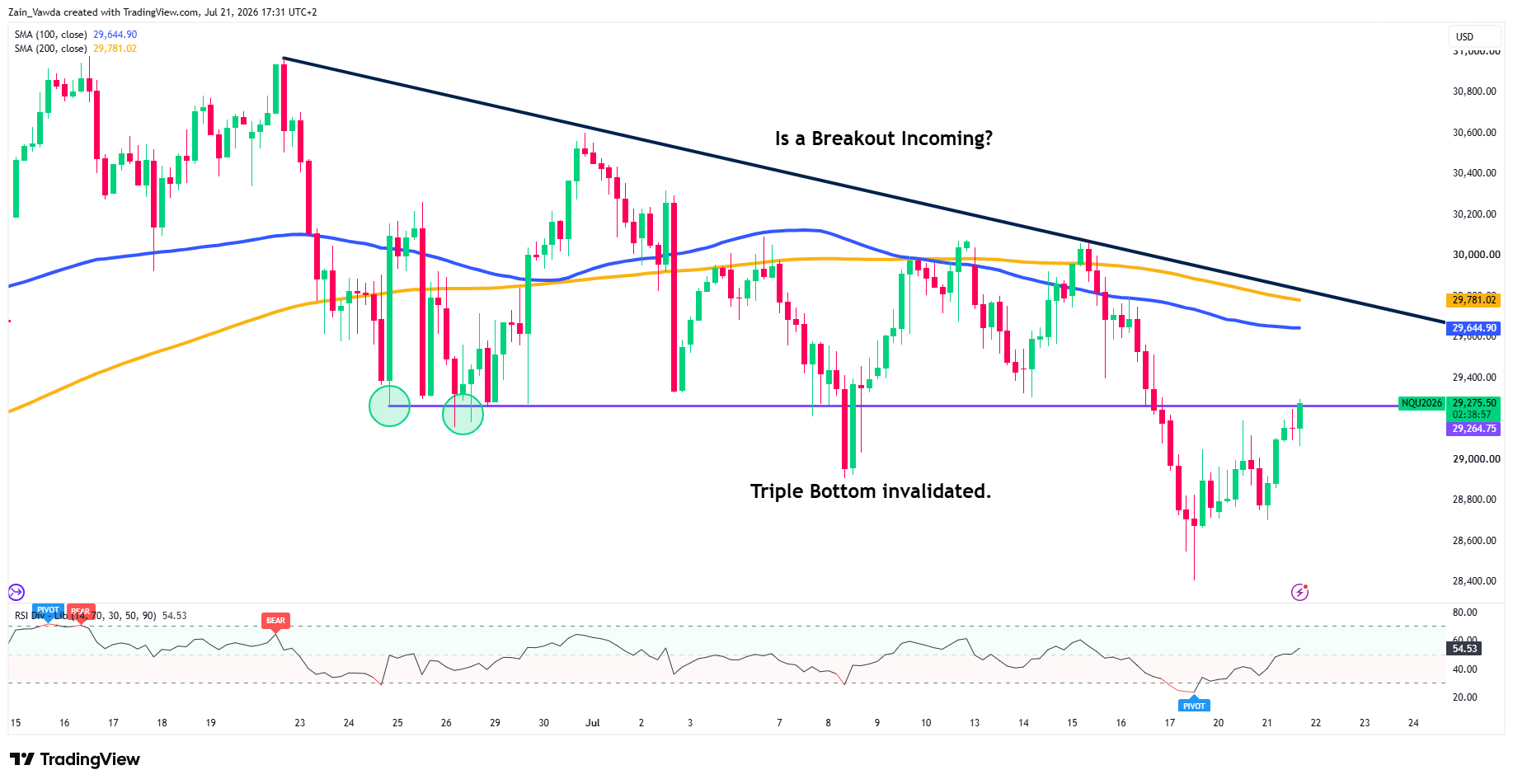
Nasdaq Four-Hour Chart, July 21, 2026
Source: TradingView
Price is back at 29,264.75 — the shelf that held three times through late June before failing on July 17. That break flushed the index to 28,430, and the level now flips to resistance. This retest from below is the decisive test of the bounce.
Overhead, the 100-SMA (29,644.90) and 200-SMA (29,781.02) sit tightly clustered just beneath the descending trendline from the 31,000 high. That triple confluence caps any move toward 29,800.
RSI at 54.53 has recovered off the July 17 pivot low but reflects mean reversion, not trend change.
Treat this as a counter-trend bounce until a 4H close clears 29,781. Rejection at 29,265 reopens 28,800, then 28,430.