
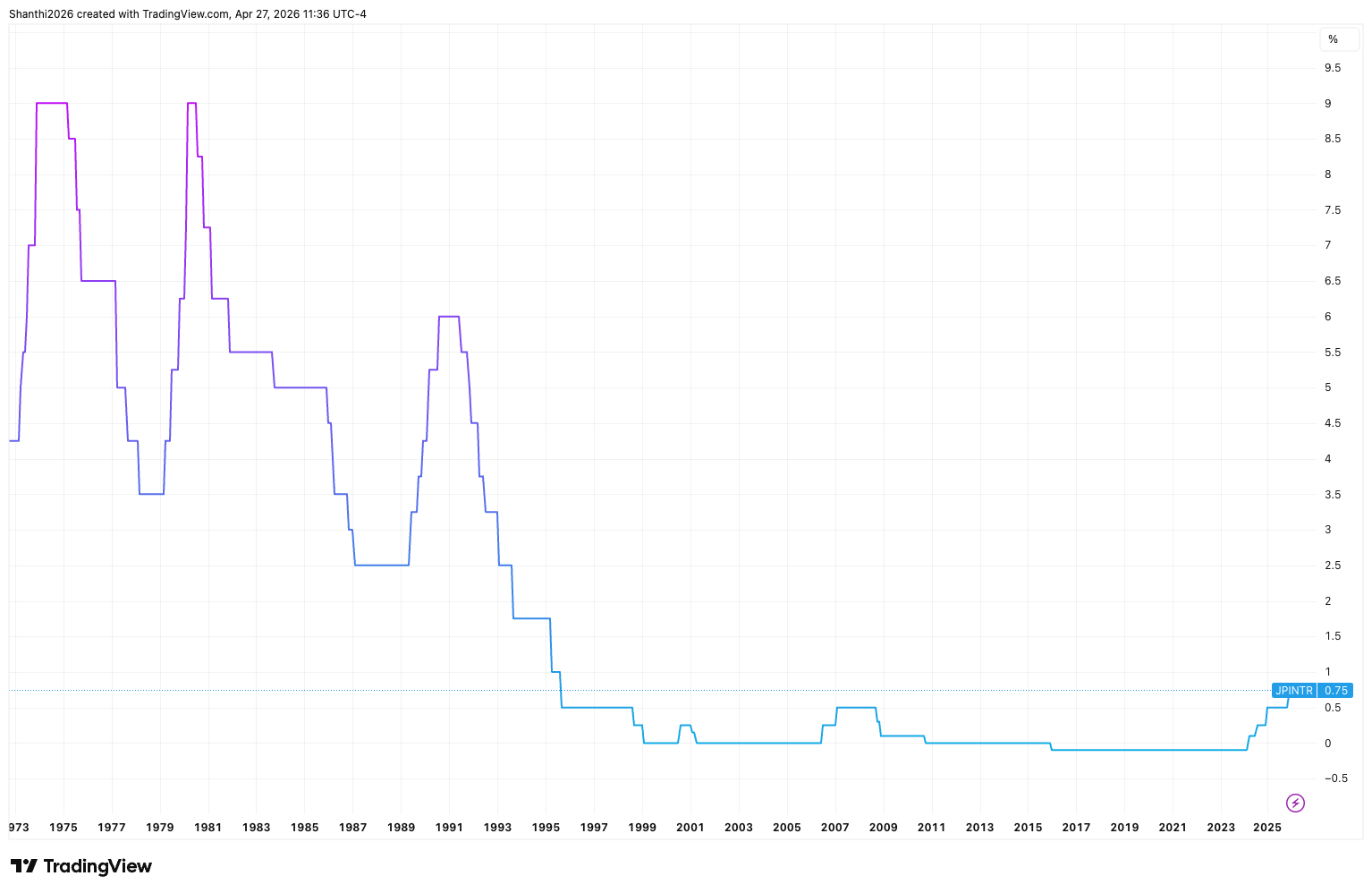
The Bank of Japan (BoJ) is set to lead this week’s G7 central bank rate decisions, with its monetary policy outcome due on Tuesday at around 12 noon local time. After pursuing an ultra-loose monetary policy for decades, the BoJ pivoted only in March 2024, lifting the benchmark interest rate (the uncollateralized overnight call rate) into positive territory, and also abolishing yield curve control.
BoJ Rate Backdrop
The central bank has since paused and hiked intermittently, and the last hike was in December 2025, a 25-basis-point increment that took the policy rate to 0.75%. In each of the two meetings held so far this year, the central bank has opted to hold rates steady, with the U.S.-Iran war conflict cited as a key factor influencing the policy decision in March.
Bank of Japan Benchmark Interest Rates
Source: BoJ
The March pause was adopted by an 8-1 vote but the BoJ said it will continue to raise the policy interest rate and adjust monetary policy accommodation if the economic activity and prices evolve in line with its January projections. The hawkish tilt was premised on real interest rates remaining significantly negative.
In its mid-March assessment of economic conditions, the central bank said the domestic economy has recovered moderately, although some pockets of weakness remain. It characterized financial conditions as accommodative. While noting that annual inflation has been brought to around 2% (BoJ’s inflation target rate), partly due to government measures to curb rising food prices, the BoJ stated that the inflation rate will likely face upward pressure from rising energy prices.
Citing sources familiar with BoJ’s thinking, a Reuters report stated last week that the central bank is leaning toward a pause to assess the fallout from the Iran conflict.
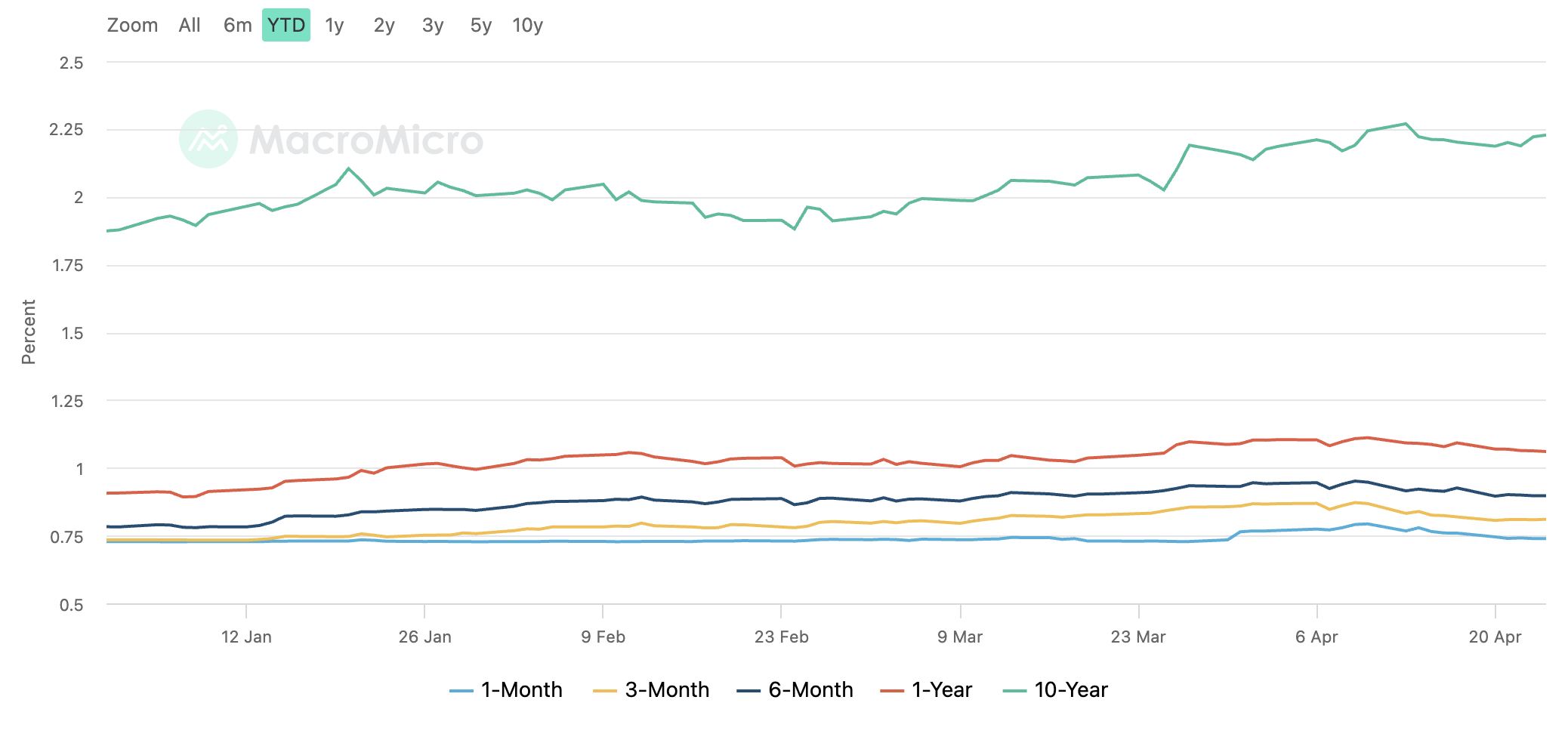
The rates for Japan Overnight Indexed Swaps (OIS), which exchange a fixed rate against the compounded Tokyo Overnight Average Rate (TONA) over a specified period, have eased in recent weeks, particularly at the front end of the curve. This indicates a moderation in near-term BoJ tightening expectations.
Japan Overnight Indexed Swap Rates
Source: MacroMicro
Inflation to Accelerate?
As feared, inflation data released Friday showed that consumer prices rose 1.5% year over year (YoY) in March, up from 1.3% in February and above the consensus estimate of 1.4%. Core inflation, which excludes fresh food, accelerated for the first time in five months, rising to 1.8% from 1.6%.
With 2026’s “shunto” negotiations providing for more than 5% wage growth and small and medium businesses (SME) also announcing fairly strong increases, ING South Korea and Japan Senior Economist Min Joo Kang expects businesses to pass on higher input cost hikes onto consumers.
What Economists Expect
ING still sees a rate hike in play: “We still see an April hike possible if the BoJ gives priority to preventing inflation expectations from accelerating.” “In our view, recent data suggest that energy shocks are having a more prolonged and much larger impact on inflation than on growth,” it added.
Danish investment bank Saxo opined of all the G7 central banks, the BoJ has the biggest potential to surprise markets of all the major central banks in action this week. “Markets will look for a guide on the chance of a June hike but the BoJ could surprise with one at this meeting,” the firm said.
The firm expects this to be reflected in the BoJ’s upcoming quarterly outlook report.
The next rate-setting meeting has been scheduled for June 15-16.
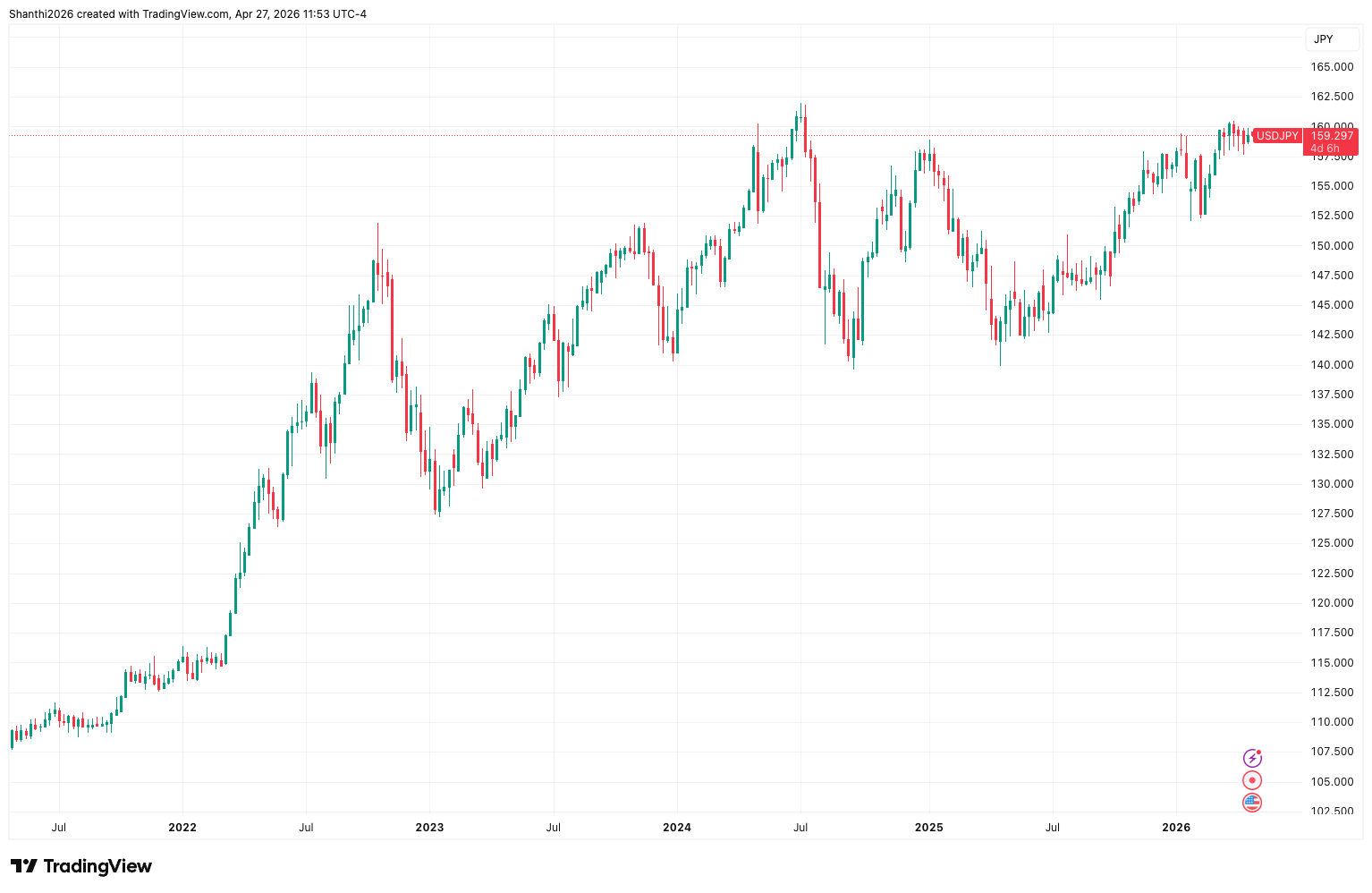
What all these mean for Markets: The USD/JPY pair approached the 160 level in the early Asian session but has since retreated. According to Alpha Binwani Capital’s Ashwin Binwani, repeated failures near the 159.30-159.40 range indicate active profit-taking and supply. He also noted that historically, BoJ has intervened or signaled concerns when the yen weakens toward the 160 level. He, therefore, sees market positioning as driven not just by price action, but by expectations of potential policy response.
The strategist described the move as a pricing battle, rather than a structural trend shift. He, however, cautioned that a clean break above 160 could trigger rapid short covering and a momentum-driven spike.
USD/JPY (5-Year Chart)
Source: TradingView
The Japanese equity market has been on a roll, with the Nikkei 225 Average ending Monday’s session at a new high above the 60,000 psychological resistance. The rally reflects a combination of structural and cyclical factors. A weaker yen has boosted the export-driven economy, while Japanese companies have improved profitability amid government-led corporate governance reforms encouraging higher return on equity, share buybacks, and dividend payouts.
Also, the global artificial intelligence (AI) boom has proved healthy for Japanese tech companies, which play a critical role in supplying components and equipment to the industry. Importantly, monetary policy, despite the gradual normalization, is still supportive of growth.
It remains to be seen whether the BoJ opts for a cautious wait-and-see approach or moves preemptively to contain rising inflation expectations.
Read Next: US Stock Futures Mixed as Hormuz Flare-Up Lifts Crude, Traders Eye Big Tech Earnings, Fed Decision