Taiwanese foundry TSMC delivered one of the strongest quarters in its history on Thursday but Wall Street sold it anyway. The world's largest contract chipmaker, whose factories produce the vast majority of advanced AI processors on the planet, reported a 77% jump in second-quarter profit, comfortably clearing analyst estimates, and announced plans to pour an additional $100 billion into U.S. manufacturing on top of existing commitments.
By any conventional measure, this was a blowout quarter paired with a bullish long-term signal. Yet TSMC's U.S.-listed shares fell nearly 4% in premarket trading, and the weakness helped drag E-mini Nasdaq (NQ) futures down about 1% even as the rest of the market tried to hold onto a two-day rally. The mismatch between the fundamentals and the market's response is the real story here. And the timing makes it more than a passing curiosity.
TSMC has kicked off a crucial three-week period in which markets will repeatedly reassess whether relentless AI spending can continue to justify elevated valuations across Big Tech.
The Numbers That Should Have Worked
On paper, there was very little for the market to complain about.
- Q2 Net income: NT$706.56 billion Vs. NT$632.64 billion consensus; 77% YoY growth and 23.4% QoQ growth
- Q2 Net sales: NT$1.27 trillion Vs NT$1.264 trillion consensus; 36% YoY growth and 12% QoQ growth
- Q2 Gross margin: 67.7% Vs. Q1’s 66.2% and year-ago’s 58.6%
- Driven largely by AI demand, the high-performance computing (HPC) segment represented 66% of TSMC's second-quarter revenue.
- Q3 Revenue guidance: $44.6B-$45.8B
Layered on top of a stellar quarter was the announcement of $100 billion in incremental U.S. investment, extending TSMC's existing American manufacturing buildout and signaling confidence in sustained long-term demand. These results highlight the AI-driven strength that has underpinned semiconductor valuations for much of the year, powering a large share of the broader market's gains. If anything, this was the kind of quarter that companies hope will silence doubters. Instead, it barely slowed the selling.
Why the Market Didn't Reward It
Three forces appear to have converged to override what should have been a straightforwardly positive print.
First, this was sector-wide de-risking rather than a verdict on TSMC specifically. The sell-off had real momentum before TSMC even reported: South Korea's SK Hynix plunged more than 11% in Seoul overnight, dragging the Kospi index down more than 6% in its worst session in some time. That weakness rippled through Europe, hitting STMicroelectronics, ASML-adjacent supplier ASMI, and Germany's Infineon Technologies, before U.S. futures even opened. TSMC's stock was swimming against a current that had little to do with its own performance.
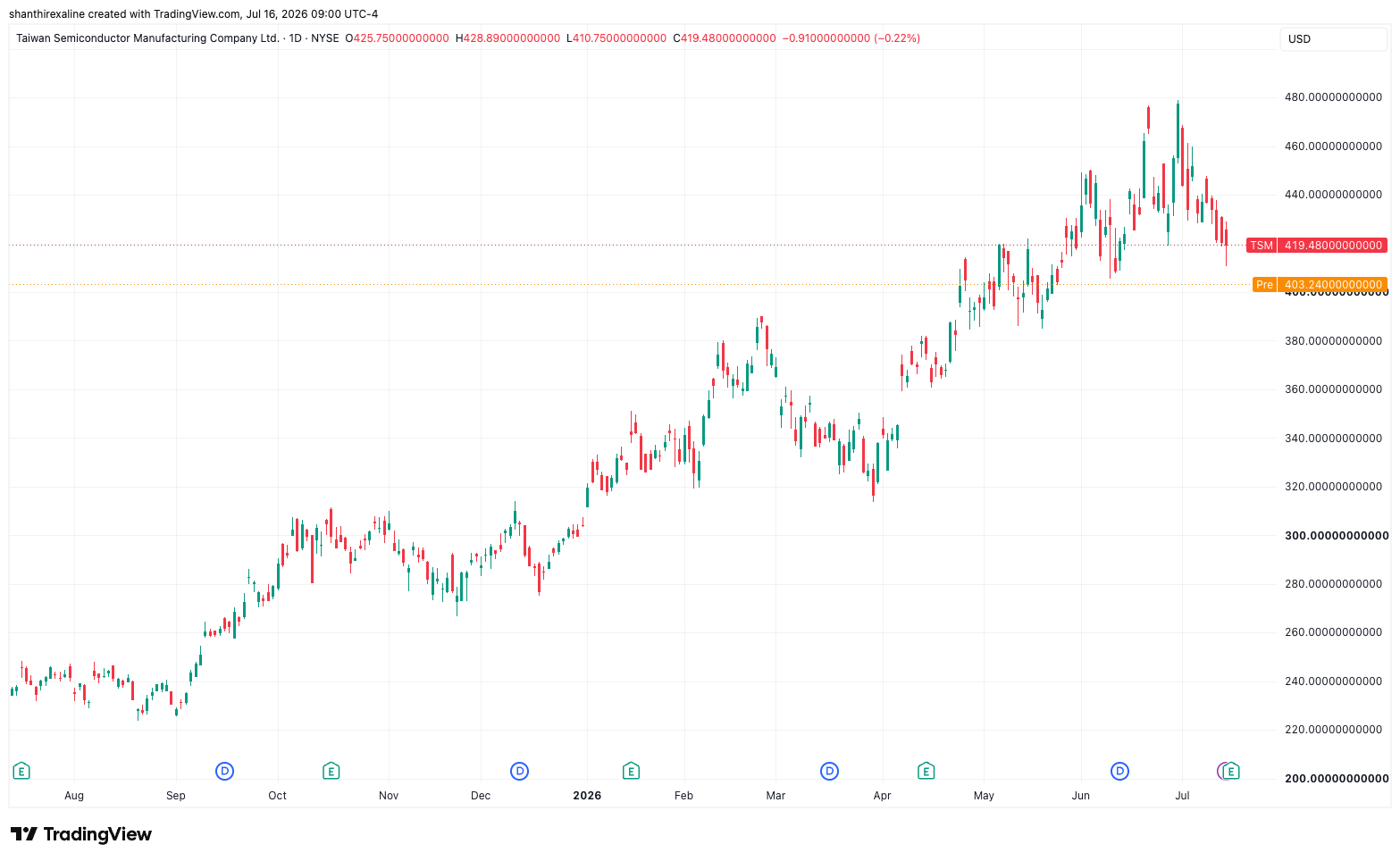
Second, there's a "priced for perfection" dynamic at work. After a multi-year AI-driven rally, expectations for chip companies have climbed so high that even genuinely strong results can trigger profit-taking instead of fresh buying. When a beat is already baked into a stock's price, "great" isn't a surprise — it's confirmation, and confirmation doesn't always move markets the way a genuine upside surprise does.
TSMC Stock's AI-Powered Rally
Source: TradingView
Third, and perhaps most overlooked, is a margin question buried inside the headline investment number. A $100 billion U.S. buildout sounds unambiguously bullish, but U.S.-based semiconductor fabs have historically carried higher labor and operating costs than TSMC's flagship Taiwan facilities, and newer lines tend to run less efficiently in their early years. Some investors may be reading the announcement less as "more capacity, more growth" and more as "more capex, thinner future margins" — a subtler, less headline-friendly interpretation that a simple recap of the beat wouldn't capture.
Why This Is Bigger Than TSMC — The Megacap Calendar Ahead
TSMC's earnings print isn't an isolated data point. It is the opening act in a stacked earnings calendar where the market's patience for AI spending gets tested by the very companies whose capex commitments have been justifying TSMC's growth in the first place.
Alphabet reports first among the megacaps on July 22, a date that has historically served as a bellwether for cloud and AI infrastructure commentary across the sector. Then, on July 29, both Microsoft and Meta report after the market close — on the same day the Fed announces its rate decision and Chair Kevin Warsh holds his press conference, meaning investors will be digesting monetary policy and two hyperscaler capex updates within hours of one another.
Apple and Amazon follow on July 30, and Nvidia, arguably the single most-watched name in the entire AI trade, closes out the season in late August.
The scale of what's being tested is significant. Amazon, Google, Meta, and Microsoft are collectively guiding toward roughly $725 billion in AI infrastructure spending for 2026, up about 77% from $410 billion in 2025 — coincidentally the same percentage TSMC just posted for profit growth.
Alphabet alone spent $35.7 billion in the first quarter and has guided to a full-year range of $180 billion to $190 billion. Every one of these companies will now be asked, in front of the same investor base that just punished TSMC's beat, to justify why spending at this scale still makes sense.
The Read-Through for the Broader Market
This matters beyond the semiconductor sector because so much of the broader market's gains this year trace back to the AI capex story. The S&P 500 has climbed more than 10% in 2026 and remains near its June record close — a rally in which AI-linked chip demand and infrastructure spending have played an outsized role.
MarketFramework’s Trade Validator tool suggests the retail crowd among futures traders are moderately long on the E-mini S&P 500 futures (ES). Both profitable and unprofitable trades had a majority contribution from long bets.
If the market won't reward TSMC for a beat, a raised bar, and a major reinvestment pledge, that raises the threshold for how Alphabet, Microsoft, Meta, Apple, and Amazon will be judged when they report their own capex numbers. A single disappointing reaction could be dismissed as noise. But a repeat of Thursday's "good numbers, bad reaction" pattern across two or three of the five megacap reports would be a far louder signal that the market's tolerance for spending ahead of proven AI revenue is genuinely thinning, not just having an off day.
What to Watch Next
In the near term, the clearest tell will be whether chip-sector weakness stabilizes or deepens before Alphabet reports on July 22. Alphabet's cloud and AI commentary will effectively serve as the first real test of megacap sentiment in TSMC's wake. From there, attention shifts to whether the Fed's July 29 decision amplifies or offsets the market reaction to Microsoft and Meta's earnings landing the same day.
Any downward revisions across the five reports would suggest that companies themselves are becoming more selective about AI investments, reinforcing concerns that the pace of AI spending may be slowing.


