The U.S. Treasury has gone significantly further than the minimum size investors were expecting for its first enlarged long-end bond buyback, announcing a $6 billion operation for Thursday.
That figure is important because it lands well above the $4 billion minimum Treasury established last month when it said it would at least double the size of its long-duration liquidity-support operations. Treasury previously bought back as much as $2 billion per operation in the longer-dated sectors.
It also lands directly inside the range that Wall Street had been debating. RBC had viewed $6 billion as a base case, while some strategists had put the potential size as high as $8 billion to $10 billion.
But the more important benchmark comes from Morgan Stanley: its rates strategists argued that $10 billion per operation represented the upper bound under Treasury's existing cash-management framework and without additional bill financing.
At $6 billion, Treasury has therefore moved much closer to the aggressive end of the range than the minimum implied by its August announcement.
Why $6 Billion Matters
Treasury's buyback is targeting the 10-year to 20-year segment, with eligible securities ranging from February 2037 through August 2046.
The objective is liquidity support: Treasury is buying older, less-liquid securities and helping improve trading conditions in parts of the long end of the curve. Reuters reported that Thursday's operation will be three times the size of the previous long-dated operation.
That makes the announcement significant for the Treasury market, but it does not make the operation equivalent to Federal Reserve quantitative easing.
Morgan Stanley stressed that Treasury buybacks have to be funded. The options include additional Treasury-bill issuance, coupon issuance or drawing on the Treasury General Account. That funding constraint is one reason the bank argued that unlimited or uncapped buybacks were unrealistic.
$6 Billion Is Big but Is It Big Enough to Cap Yields?
The immediate market reaction suggests investors are not treating the buyback as a guaranteed solution to rising yields.
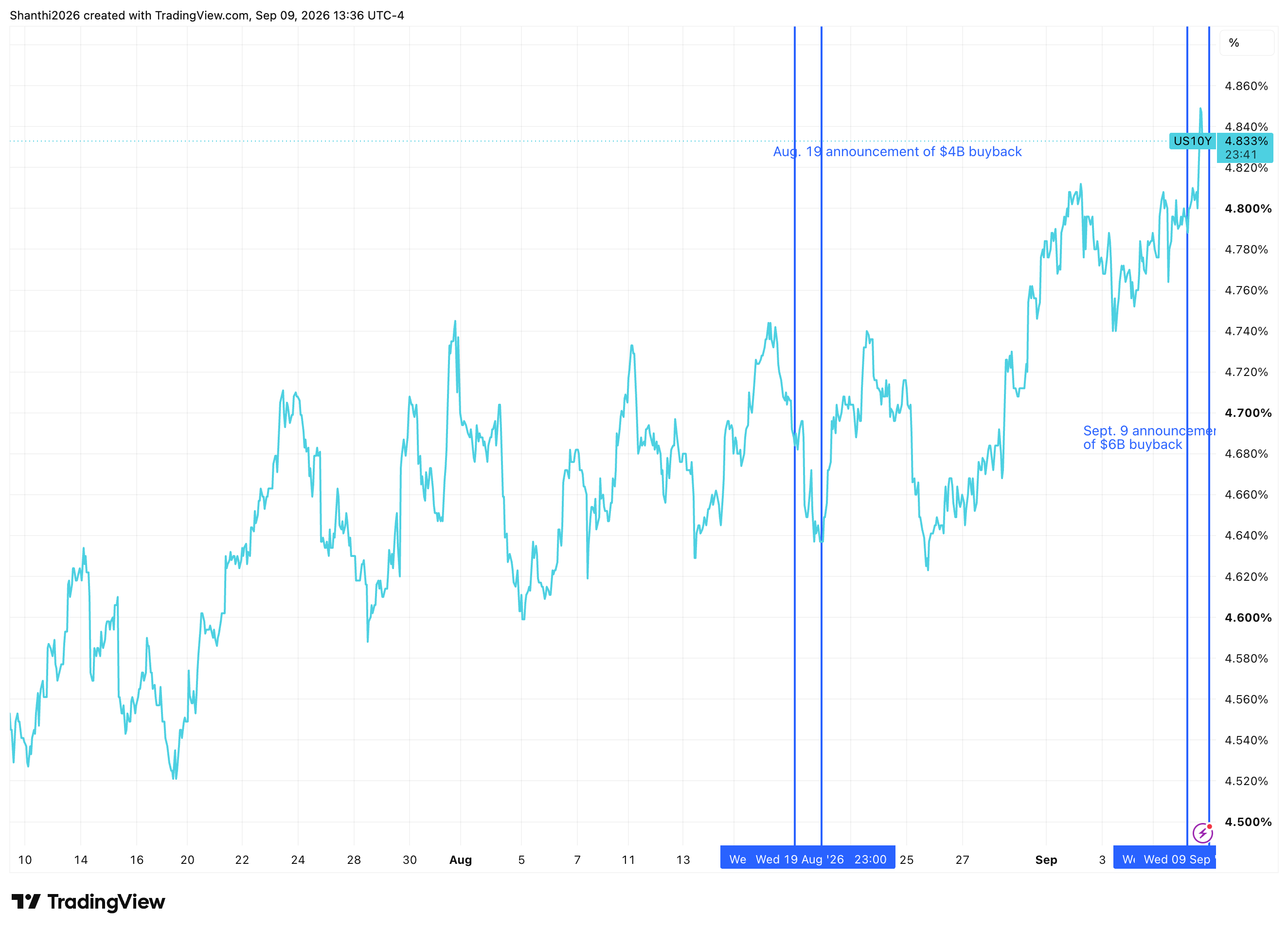
The 10-year Treasury yield climbed toward 4.85% after the announcement, reaching its highest level since November 2023, while the 30-year yield moved above 5.3%.
Treasury Yield Reaction to Augmented Buyback
Source: TradingView
If the purpose of the larger operation is to improve liquidity and reduce pressure in the long end, the fact that yields moved higher after the announcement suggests that the market is still focused on the forces driving Treasury valuations rather than simply the size of the buyback.
Those forces include fiscal concerns, Treasury supply, the term premium and, increasingly, inflation risks from higher energy prices.
Oil Makes the Buyback Question More Complicated
The timing could hardly be more challenging.
Brent crude has moved above $100 a barrel, while WTI has climbed above $95 as the Middle East conflict intensifies. That is pushing a fresh inflation risk into the Treasury market just as the August consumer price inflation (CPI) report approaches.
The result is a difficult combination for bonds: Treasury is attempting to provide additional liquidity support to the long end at the same time that investors are demanding compensation for the possibility of higher inflation.
That distinction matters because the Treasury cannot buy away an oil shock.
If higher yields are primarily a function of liquidity and market functioning, a larger buyback could have a meaningful technical impact. But if yields are rising because investors expect oil to keep inflation elevated and the Federal Reserve to remain more restrictive, the effect of a $6 billion operation is likely to be much more limited.
Morgan Stanley’s More Important Signal: Watch Swap Spreads
For traders trying to determine whether the buyback is actually changing the bond market's underlying dynamics, Morgan Stanley argues that Treasury swap spreads may be more informative than outright yields.
The reason is that outright Treasury yields are influenced by multiple factors, including energy prices and expectations for the Fed. Swap spreads can provide a cleaner indication of how expectations around Treasury supply are changing.
Morgan Stanley noted that 30-year Treasury SOFR swap spreads had widened by about 5 basis points since Treasury announced larger buybacks on Aug. 19, even while 30-year Treasury yields were broadly unchanged.
That makes Thursday's operation a useful test: does the larger purchase materially improve long-end market technicals, or does the broader macro backdrop overwhelm the intervention?
What It Means for Stocks and NQ
For Nasdaq-100 E-mini futures (NQ), the bond-market reaction matters more than the buyback headline itself.
Technology stocks are particularly sensitive to long-term interest rates because higher yields increase the discount rate applied to future earnings. If Treasury's larger buyback helps stabilize the long end, it could remove one source of pressure on NQ.
But the more difficult scenario is one in which the buyback fails to stop yields from rising because the underlying catalyst is inflation.
That is where the oil market becomes critical.
With Brent above $100 and CPI due Friday, investors are effectively asking two questions at once: Can Treasury stabilize the long end, and can the Fed look through the energy shock?
A $6 billion buyback can address liquidity. It cannot address inflation.
The CPI Test
That leaves Friday's CPI as the next major test for the Treasury intervention.
A contained inflation reading could allow investors to separate the Treasury buyback from the broader macro backdrop, potentially helping yields stabilize and giving NQ some breathing room.
But if CPI shows renewed price pressure while oil remains above $100, the market may conclude that the problem is not a shortage of Treasury liquidity. It is the prospect of a more persistent inflation shock and a less accommodative Fed.
In that scenario, $6 billion may look large relative to Treasury's previous operations but small relative to the forces pushing yields higher.
That distinction could determine whether the Treasury buyback becomes a catalyst for a relief rally or simply another test of how much higher yields the equity market can absorb.