The U.S. dollar is having its worst week in months, and the reason isn’t the one traders are used to. It isn’t weak data or a dovish central bank. It’s the Treasury, not the Federal Reserve stepping into the bond market to hold interest rates down.
That move eased the pressure on stocks and lit a fire under Bitcoin. But it also handed the currency market a fresh idea: if Washington is going to keep a lid on yields by force, the dollar becomes the release valve.
This is the trade to understand going into next week’s Jackson Hole meeting.
What Actually Happened This Week
The 30-year U.S. government bond yield climbed to its highest level in about 19 years, a level not seen since before the 2008 financial crisis. On August 19, Treasury Secretary Scott Bessent responded by at least doubling the size of the government’s bond buybacks in the 10- to 30-year part of the market, lifting the cap from $2 billion to at least $4 billion per operation, running from September 9 to November 4.
In plain terms: the government started buying back its own long-dated debt to push those borrowing costs down.
It didn’t hold. Yields dropped on the announcement, then climbed straight back, the 30-year returned to around 5.25% by Thursday, wiping out the move. The problem is size: these buybacks are tiny next to a roughly $32 trillion Treasury market, and they landed the same day U.S. national debt crossed about $40 trillion.
Strategists were blunt. ING said the intervention “smacks of discomfort” and warned Washington may feel forced to do it again and again. Others noted the deeper driver of the sell-off isn’t the Fed at all, it’s a widening budget deficit and heavy borrowing, a problem a buyback can’t fix.
Why This is a Dollar Story, Not Just a Bond Story
Here’s the link that matters for currency traders. When a government leans on the bond market to keep yields artificially low what economists call financial repression, the pressure doesn’t vanish. It moves somewhere else, and that somewhere is usually the exchange rate.
Citi has flagged exactly this: falling yields plus a Treasury willing to intervene are now new reasons to be bearish on the dollar, on top of a cooling economy and fading odds of further rate rises.
There’s a clear precedent. Japan spent years capping its bond yields, and the side effect was a much weaker yen. The U.S. now looks like it’s taking a step down that road. And there’s an awkward twist at the center of it: the Fed’s new Chair, Kevin Warsh, has said he wants the open market, not the government to set interest rates.
The Treasury doing the opposite looks a lot like the finance ministry overriding the central bank.
For the market, that may blur the line on who really controls U.S. rates, and a dollar backed by a compromised rate signal is a weaker dollar.
The Jackson Hole Hinge
This all comes to a head next week. Warsh gives his first keynote as Fed Chair at the Jackson Hole symposium on Friday, August 28, three weeks before the September 16 rate decision.
Most of the attention will be on what he signals for stocks and tech. The more interesting question for the dollar is narrower: does Warsh defend the Fed’s independence and push back on the idea of yields being managed for him, or does he sound resigned to it?
The first would give the dollar a reason to bounce. The second would confirm the bearish trade.
U.S. Dollar Technical Outlook
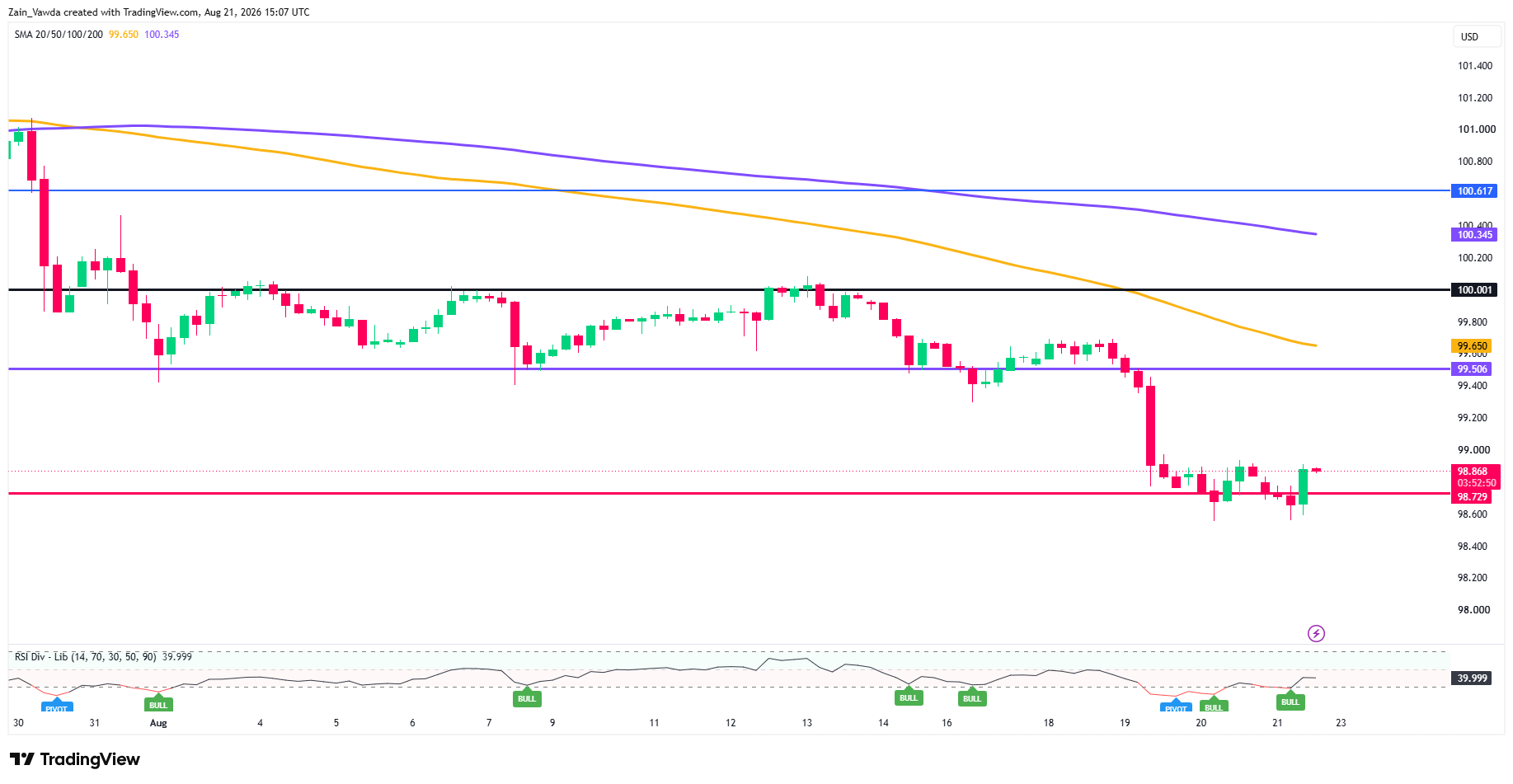
The US Dollar Index (DXY) remains under intense bearish pressure near 98.86 after a sharp breakdown below key overhead structure.
Price action is currently consolidating just above immediate horizontal support at 98.73, where recent downside momentum has temporarily stalled. The RSI is hovering near 40.00 with emerging bullish divergence, hinting that selling pressure could be exhausting in the short term.
U.S. Dollar Index (DXY) Four-Hour Chart, August 21, 2026
Source: TradingView
For a relief bounce to gain traction, bulls must defend 98.73 and reclaim intermediate resistance at 99.51, followed by dynamic resistance at the 50 SMA (99.65).
Conversely, a decisive close below 98.73 will signal a continuation of the broader downtrend toward lower support levels.
Scenarios into Jackson Hole
| Scenario | What Triggers It | U.S. Dollar Path |
|---|---|---|
| Bullish Dollar | Warsh defends Fed independence and pushes back on easing at Jackson Hole, or today's flash PMIs come in hot | DXY reclaims 99.46, then targets 99.85–100.11; a close back above 100 revives the hike trade. EUR/USD slips back under 1.16 |
| Base | Warsh stays structural and non-committal; no fresh catalyst; PMIs roughly in line | DXY chops between 98.40 and 99.85 — soft but not breaking. Euro and pound hold recent gains |
| Bearish Dollar | Warsh sounds resigned to the yield-suppression backdrop or leans dovish, or PMIs disappoint | DXY loses 98.41 → 97.84 → the 96 handle. EUR/USD pushes toward 1.18–1.19, GBP/USD toward 1.38 |
Trader Positioning
Given the sell-off already experienced bu the DXY the question for traders will be whether or not to chase the move.
This is where the profitable and unprofitable crowds tend to split. The unprofitable cohort chases the dollar lower into an already oversold reading, or tries to catch a bounce with no level to lean on and gets shaken out on the first sharp reversal.
The profitable cohort trades the lines instead: it waits for a daily close back above 99.46 before betting the slide is over, and it treats rallies into the 99.85–100.11 ceiling as places to sell only if they fail there.
It is always helpful to keep an eye on trade positioning data using the Positioning Edge Tool on MarketFramework. This provides traders with an edge before making any trading decision.


